1754–1826. A French chemist who worked for many years in Spain: he discovered the law of constant composition of chemical compounds.
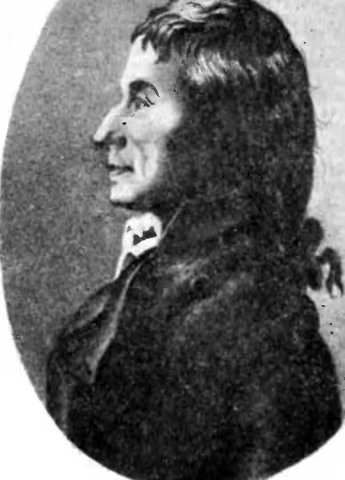
Joseph Louis Proust (26 September 1754 – 5 July 1826) was a French chemist and a member of the Paris Academy of Sciences (from 1816). He was born in Angers. Until 1777 he studied at the University of Paris. From 1777 to 1780 he taught at the seminary in Vergara (Spain), from 1780 to 1791 he lectured in Paris, and from 1791 to 1808 he was a professor at the Artillery School in Segovia (Spain) and at the University of Madrid. In 1808 he returned to France, where he carried on his research.
His research was chiefly the chemical analysis of inorganic compounds. He was the first to introduce the idea of metal hydroxides and proposed (1800) the term “hydrate”. He established (1799) the existence of copper(I) oxide. He studied camphor, starch and sugar. He investigated (1797–1809) the composition of various metal oxides, chlorides and sulphides, and this work was the basis of his discovery (1799–1806) of the law of constant composition of chemical compounds. The law became the empirical basis of chemical atomism and later of the classical atomic and molecular theory. From 1800 to 1808 he carried on a debate with C. L. Berthollet, who denied that chemical compounds have a constant composition. The debate ended in victory for Proust and in the acceptance of the law that bears his name as one of the three stoichiometric, or “fundamental”, laws of chemistry. He isolated (1802) glucose from grape juice.
From Kaloyan Manolov's “Great Chemists”
As a child Joseph Proust, a small, dark-eyed boy, was dreadfully restless and astonishingly curious1. Besides noisy games with his friends, he loved to slip into his father's pharmacy and look at the jars and packets of all sorts of substances there. Monsieur Louis Proust's pharmacy was one of the largest in Angers. Several apprentices, working tirelessly, helped him to keep the business running well. Little Joseph was everyone's favourite in the pharmacy, and not only because his big dark eyes shone with kindness: everyone liked it when he asked questions and talked like a grown-up as he did so. At six Joseph already knew many of the chemicals and could tell them apart by the colour of the jars and their places on the shelves. He never got it wrong when he was asked to fetch a substance.
“Joseph, bring me the jar of calomel,” someone would say, and the boy would do it at once; he loved helping the grown-ups.
When Joseph started school, he still kept dropping into the pharmacy. That was why his father decided that at eleven his son was old enough to learn the secrets of the apothecary's art. Joseph read thick folios, manuals of pharmacy; he studied the properties of substances and mastered the methods of laboratory work. All this, of course, absorbed him. But he took even greater pleasure when he had the chance to be alone in the laboratory. Then he would mix various chemicals, pour a little from different jars and bottles into the mixture and stir the contents of the glass. The thick mass would turn now green, now blue, or it would froth up and start giving off gases. The boy choked and coughed, but stubbornly went on with his experiments. On one such evening his father came into the laboratory.
“Why is the laboratory so full of smoke? What are you up to?”
Joseph lowered his eyes in embarrassment and did not answer. His father gave him a reproachful look.
“Let me see, what is this mess? What have you put in it?”
Joseph pointed to the open bottles.
“A bit of everything.”
“You are only spoiling the chemicals. And you don't even know that you could poison yourself. Remember this well: never mix substances without knowing what will come of it and without reading about it in the manual. You deserve a good thrashing. A big boy, and you do such silly things.”
“Father, I saw some very interesting reactions. When I added sulphuric acid to salt, it began to froth and some choking gas came out in clouds. It even made my throat sore.”
“If you are so interested in chemistry, we shall send you away to study.”
“Really, Father? It is what I dream of most.”
“I don't want you doing silly things in future too. And what if something explodes and you are blinded?”
Joseph lived for the thought of leaving for Paris. He read diligently, wanting to learn as much as he could: it would be shameful to disgrace himself in the capital. The summer was hot, and the boys of his age spent whole days in the river, but Joseph did not give in to temptation. He sat in the shade of the trees and read doggedly. And when his birthday came, his father told him that in two days' time they would set off.
To fourteen-year-old Joseph the journey to Paris seemed almost a voyage round the world.
His father placed Joseph in a boarding house whose landlady, a talkative, stout Parisienne, he had once met in Nantes.
Classes at the Jardin du Roi began in October. Joseph could hardly wait to take up chemistry. He attended the lectures of Guillaume François Rouelle1а, a well-known apothecary, professor of chemistry and member of the Paris Academy of Sciences.
Joseph showed particular skill and craft in the laboratory classes. This could not escape the watchful eye of Professor Rouelle, who began to give young Proust more difficult tasks. Proust always handled the work he was given excellently, and so won the professor's goodwill.
A year and a half had passed since Joseph Proust came to Paris. He worked very hard and often stayed in the laboratory until late. One cold February evening the professor came into the laboratory. Proust was finishing an experiment.
“I hope you have read my paper on salts2,” said Professor Rouelle.
“Yes, I have read it several times; I wanted to understand it thoroughly. Tell me, Professor, how do you obtain salts with an excess and with a deficiency of acid?”
“To do that you must take wood ash and add sulphuric acid to it until the liquid stops frothing, and then add as much acid again to make sure there is an excess. If the solution is then heated and afterwards cooled, crystals with a sour taste are obtained. But if you pour sulphuric acid into a glass and begin adding ash to it until the ash is in excess, and then boil it again and filter it once it has cooled, you will obtain crystals with an alkaline, astringent taste.”
“I see. The second salt will be one with a deficiency of acid.”
“It is remarkable that the amount of metal contained in these two kinds of salt changes by a jump. In the acid salt there is about one and a half times less of it3.”
“How little we know about the substances around us!”
“You are my best pupil, Proust, and I can see that you are strongly drawn to science. Would you like to begin some real research?”
“I cannot tell you how glad I am to hear your offer, Professor.”
“Then sit down and listen. You know from my lectures that life is still the greatest mystery to us. What goes on in our bodies, in the bodies of animals, how does the food we eat every day change? Of course, we shall not be able to answer all these questions, but let us try to uncover at least a tiny part of this great mystery. Take urine, for example. It contains the most varied substances. We must try to identify them, obtain them pure and study them. You can start on it tomorrow.”
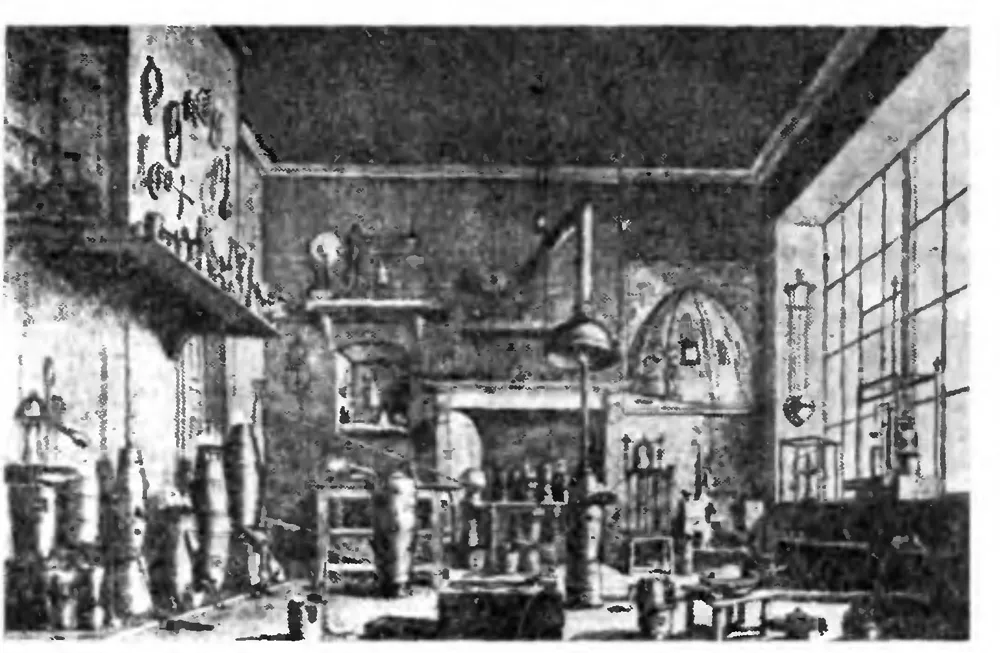
The task was far from easy. At that time methods of analysis had not yet been worked out, and many chemical elements had not yet been discovered. This often led to mistakes and to results that could not be explained. Proust evaporated urine to concentrate it and left it to cool. When he came into the laboratory the next day to continue the work, he noticed a considerable amount of white crystals at the bottom of the vessel; he separated them and purified them by repeated recrystallization. Proust soon satisfied himself that this was not one substance but a mixture of several. He managed to separate them and obtain them pure, but the problem was still unsolved. Proust's teacher, Professor Rouelle, did not live to see it solved: he died in 1770.
Proust continued the work under the professor's brother, Hilaire Martin Rouelle. Several more years of hard work and continual study went by. He had already established that urine contains several salts: sodium chloride and ammonium salts. Proust discovered a new acid, which also had the look of small white transparent crystals, and called it uric acid.ed.2
Having joined the staff of the laboratory, the young scientist soon won a reputation as a most able researcher and a brilliant speaker. People listened to his explanations with great interest. Before long Proust was being talked about in Europe. He received an invitation from Spain: he was offered the chair of chemistry at the Royal Seminary of Segovia.ed.1
The twenty-three-year-old Proust accepted the invitation and set off for Spain.
Segovia turned out to be a small town on the western slopes of the Sierra de Guadarrama. Life in the place ran a quiet, monotonous course, but for Proust real life was only to be found in the laboratory.
Proust had to master Spanish, since he was to give lectures. He set about it eagerly and in a short time spoke the language brilliantly. People who had not known him before even took their new lecturer for a Spaniard. In 1780 Proust accepted an offer to become professor at the Royal Lyceum of Segovia, where future artillery officers were trained. The lyceum had large laboratories, and that was what attracted the young scientist. Now and then Proust went off into the mountains. More than once he climbed the peak of Almanzor in the Sierra de Gredos. The young scientist was interested in minerals, and he collected all sorts of plants as well; in the high mountain valleys, beside the eternal snows that capped the summits, he found the broad bluish-green fronds of Iceland moss. In the laboratory he made an infusion of the lichen in water and extracted a bitter juice from it. Then he boiled the plant for a long time and gave the decoction to soldiers suffering from scurvy. After a while the swelling of the sick men's gums went down and the gums stopped bleeding. Proust was convinced that scurvy was caused by the poor, low-calorie food the soldiers were fed. He set about studying various foodstuffs and drawing up recipes to improve the soldiers' diet. Proust made special tablets from meat and bones, and these were handed out to the soldiers as extra food on long and gruelling marches.
Perhaps the most interesting of his researches was his work on gunpowder mixtures. In those years the artillery needed powerful explosives, and the lyceum's laboratory set to work in earnest on making them. In some mortars pine charcoal was ground to the finest powder, in others sulphur was pounded, in others saltpetre. Proust drew up various recipes, changing the amounts of charcoal, sulphur and saltpetre. From these mixtures explosive charges for shells were then made; everything was loaded onto mules, the guns were harnessed, and the whole column moved off to the firing range in the mountains, where, in deserted rocky country, the tests of the explosive properties of the powder mixtures began. The roar of the explosions shook the neighbourhood. After each shot the soldiers measured the range of the shells, and Proust wrote the results in a notebook, filling it with columns of figures and calculations. The most varied powder mixtures were tested, and experiments were carried out to determine how fast they burned. Proust made a device for catching the gases after an explosion and an apparatus for analysing the gases left in the barrel of the gun. But repeated analyses of the gases and repeated measurements showed that the effort spent on it had not led to the results hoped for. Proust was not much upset; he only regretted the time lost. The hopes of the head of the lyceum, General Ruentos, however, were disappointed. He came to the firing range in person to see for himself that the attempts had failed.
“This is all I could do,” said Proust. “The old recipes for gunpowder are evidently more reliable. As long ago as 1250 the book of the alchemist Marcus Graecus recorded the following: ‘Take one pound of live sulphur, two pounds of linden or willow charcoal and six pounds of saltpetre... and mix carefully.’4”
“I am very sorry, Professor. I would like to hope that in the near future we shall nevertheless find a more powerful explosive. You understand what that means for our artillery?”
“Certainly, General. But the problem is by no means insoluble: we simply have to take a different road.”
“What do you propose?”
“To look for other explosives. Gunpowder has gone as far as it can.”
“I hope your research will succeed.”
“It is hard to promise anything in advance. As you know, the work in the laboratory goes on without a break, but the future will show what comes of it.”
Proust's laboratory held the most varied ores: iron, copper, zinc, lead and mercury ores. To analyse an ore, Proust heated it in a solution of sulphuric acid. A foul-smelling gas (hydrogen sulphide) came out of the vessel; at first it was called sulphurous gas, and later hydrogen sulphide. One day, while decomposing a zinc ore, Proust noticed that a sky-blue solution of blue vitriol in a vessel standing next to it had become covered with a brown film. He moved the vessels close together and began to stir the blue solution, which gradually turned blackish-brown: a precipitate had come down.
“What has happened, Monsieur Proust?” his assistant asked him.
“A curious phenomenon: the sulphurous gas has destroyed the blue vitriol. Look how the solution has lost its colour, and a black precipitate has formed at the bottom. Evidently this reaction can be used to find the composition of substances still unknown.”
Proust set about studying the action of the sulphurous gas on other solutions. He established that in solutions of salts of lead, cobalt and nickel hydrogen sulphide forms black precipitates, and in solutions of antimony salts an orange one. It was an outstanding discovery. The ability of hydrogen sulphide to give coloured precipitates became the basis of new methods of analysis on which the analytical chemistry then being born was built, and which even today uses hydrogen sulphide to separate and identify metals.
Proust was occupied mainly with practical questions. To increase the output of metals, the techniques of producing them had to be improved. This called for the building of a large research laboratory in Madrid. In 1791 Proust left Segovia to become head of the laboratory in Madrid. Some twenty scientists, well known in their day, who had studied chemistry at the universities of Paris, Salamanca and Pisa, worked in it. Proust went on with his research on ores. The Spanish soil was rich in lead and zinc: in the Sierra Morena there were huge deposits of mercury ore, the country round Minas de Riotinto in Andalusia abounded in copper ore, and pyrite had been found in the mountains of Asturias and Catalonia.
Early in his research Proust had noticed that two salts of sulphuric acid, with different properties, could be obtained from iron pyrites. Once, talking with his assistant, he shared his observations:
“If we decompose pyrite with sulphuric acid and leave it to crystallize, we get green vitriol*. If we roast pyrite and dissolve the resulting ash in sulphuric acid, red vitriol is formed**. Green vitriol gives a pale green precipitate of the iron base with alkaline solutions***, while red vitriol forms a reddish-brown precipitate****. If the pale green precipitate is kept in the air for a while, it gradually turns brown. This shows that two different states of oxidation are characteristic of iron salts. From this we may conclude that iron has two different oxides, a lower and a higher5.”
“And are the other properties of these two kinds of salt different too?” asked Ernesto.
“Yes. Only red vitriol gives Prussian blue*****, and only red vitriol forms a black compound with a solution of oak galls.”
“That's right,” Ernesto confirmed. “The analyses you asked me to carry out showed that one oxide contains about one and a half times as much oxygen as the other.”
“Quite so. There are two different degrees of oxidation of iron, and they give rise to two series of compounds.”
Although the methods of analysis at the time were inaccurate and the results Proust obtained were far from the true ones, they clearly showed that there are two kinds of iron compounds. Proust found confirmation of this in the different colours of the compounds. It followed from his research that copper, tin, antimony, cobalt, nickel and lead also form two clearly distinct oxides each. He tried to obtain both kinds of compound of these metals, but his experiments did not succeed.
On the other hand, for some elements he obtained only one single oxide. For example, he knew a white powder (zinc oxide) that was obtained when zinc was roasted. The most interesting thing, in his opinion, was that this white powder always had the same properties. Proust had zinc ore, sphalerite******, from various parts of Spain. When heated to a high temperature it burned and turned into a white powder, zinc oxide. Proust roasted sphalerite brought from Almadén, from Minas de Riotinto or from the valley of the Guadiana, but in every case the zinc oxide had exactly the same properties. Even zinc hydroxide made in the laboratory (by the reaction of a zinc salt with alkalis) turned, when heated to a high temperature, into the same white zinc oxide.
“I am convinced,” Proust used to say, “that this constancy is no accident. There is some regularity that all substances obey when they combine with one another.”
“But that needs proof,” objected Ernesto.
“We have it... What do you say about malachite? The properties of natural malachite and of malachite made in the laboratory are exactly the same. If you heat them, you get a black oxide. They have the same copper content too. Is malachite formed in nature from blue vitriol and alkali, from wood ash or a solution of soda?”
“Of course not.”
“And yet they have the same properties. So these compounds have a constant composition, although they were obtained in different ways.”
Proust had a good deal more evidence that his conclusions were sound. He remembered very well the observations he had made in the mercury mines of Almadén: there the mercury ore was heated to decompose it and release the mercury. Sometimes, though, a light reddish-yellow dust formed on the surface of the mercury, the same as is found in nature. Could it be that the oxygen of the air and the mercury vapour were combining again to form the oxide?
His research showed the same thing: the compound (the oxide) always had one and the same composition. At that time, lecturing at the Egyptian Institute in Cairo, Berthollet was maintaining that substances can combine with one another in arbitrary proportions. In Berthollet's view the constant composition of compounds was a matter of chance; it depended only on the experiments being carried out under the same conditions.
So began the famous dispute between two great scientists. Experiments, scientific papers, discussions... For many years the learned minds of Europe worked at this disputed question. In the end scientists in France, Germany, England, Italy, Russia and Holland acknowledged that Proust was right, and the law of constant composition of chemical compounds was established6.
Alongside this Proust worked on practical problems, in particular on making sugar from local raw materials. At the time many scientists were interested in the problem. Marggraf7 and Achard8 had tried to obtain sugar from beet. Lowitz9 had obtained crystalline sugar from honey, but the discovery found no practical use.
Proust decided to use the same methods as are used for making sugar from sugar cane. He prepared grape juice, purified it carefully and did indeed obtain sugar. As early as 1802 he kept in his laboratory several jars filled with yellowish crystalline sugar obtained from grape juice. His further research showed that grape juice contains several different sweet substances. He was not, of course, able to establish their composition, but scientists learned that there are several kinds of sugar in grapes.
In 1808 Proust returned to France. One day a stranger dressed all in black called at his house. He went into the study and handed over an envelope closed with the imperial seal.
“What can I do for you?” asked Proust.
The man pointed to the envelope. Proust opened it and took out a long letter. He was utterly bewildered: good Lord, a letter from Napoleon! The scientist became absorbed in reading it. France, the Emperor wrote, was having great difficulty in obtaining sugar, and so solving the problem was a task that could not wait. Would Monsieur Proust agree to take charge of organizing the production of sugar? The government had set aside a hundred thousand francs for it.
A hundred thousand! With that sum you could buy a whole town. It was strange; perhaps there was some trap behind it? No, better not to take on such a thing. After all, when his research on obtaining sugar from grapes was published, there had been an incredible uproar. People said all sorts of things: that he had not been the first, that others had done such research before him, that he had borrowed his ideas... Let those who had beaten their breasts proving their own merits in the matter now take up the production of sugar. He did not need money. What he needed was science and a laboratory, and he had them, and that was quite enough.
Proust raised his head, but the stranger had gone. Proust took up his pen and briefly set out his refusal to the Emperor.
Life in Paris was hard. Napoleon's unending wars caused enormous difficulties in the country. France was threatened with famine.
This made the scientist turn once more to the study of foodstuffs. What if he tried to obtain substitutes for some of the foods that were in short supply?
Proust began his research with wheat flour. He hoped to find a way of turning it into a product that could take the place of cheese. If you knead a dough and then wash it for a long time under a gentle stream of water, the starch is washed out and in the end an elastic, sticky substance is left. Proust let this substance ferment. The result was a spongy product with a sourish taste somewhat like that of spoiled cheese. For several years in succession Proust carried on this research and established that when this product ferments, carbon dioxide, ammonia and acetic acid are formed. For comparison he also examined cheese: Proust isolated an acid soluble in alcohol and an insoluble white powder, which he called “oxide of cheese”. He studied and described its properties in detail. This “oxide” sublimed on heating and decomposed at a high temperature. When set alight, the white powder burned with a bright flame. Proust decided that the substance resembled not only fats but also the “animal oxides”, as proteins used to be called. It was later shown that this substance, first isolated and studied by Proust, is one of the amino acids that make up proteins: leucine. Finding no likeness between the substances extracted from cheese and the elastic substance of wheat flour, he called the latter gluten.ed.3 This substance, protein in character, is found in wheat.
Proust's great contribution to science was highly valued by French scientists. In 1816 Joseph Louis Proust was elected a member of the Paris Academy of Sciences. It was the highest honour, and the modest scientist deserved it.
Tired out by unceasing work, Proust decided to retire to Angers to rest. Here, in the house where he was born, he hoped to spend the last years of his life. But his restless nature gave him no peace even at home. Proust took to calling more and more often at the pharmacy, which his brother now ran. After resting for a few months, he firmly decided to go on with his research.
“Pierre, I can't sit idle,” he said to his brother one day.
“I can see, Joseph, that you keep looking at our pharmacy.”
“You know, for me idleness is not rest but real torture. I only rest among the test tubes in the laboratory. I shall start work tomorrow.”
“But where?”
“Here, in the pharmacy.”
“A scientist like you, an academician, working in a pharmacy! Whoever heard of such a thing? We'll fit out a laboratory in the big room, and I'll find you assistants. I have some able young people in mind.”
“A good idea, but I don't want to wait. For the time being I'll work here. There is a supposition I must check.”
“What do you mean?”
“We know that wheat contains gluten. But I want to know whether this substance is also found in other cereals, in barley, for example.”
...The research, the scientist's last work, went on for several years. He died on 5 July 1826. Posterity will always remember his name: Joseph Louis Proust discovered one of the fundamental laws of chemistry, the law of constant composition of substances.
Notes
- 1. J. L. Proust was born in Angers (western France) on 26 September 1754 (and not in 1755, as is sometimes stated in the literature). See: Bugge G., ук. соч., с. 350.
- 1а. Professor Rouelle's chemistry lectures drew audiences in particular. One of his pupils, the apothecary and writer Louis Sébastien Merciered.4, wrote of them: “When Rouelle spoke, he inspired, he astonished. He made me love a craft of which I had not the slightest notion. Rouelle enlightened me, he converted me. He made me a devotee of this science, which is to revive every industry, one after another.” Rouelle was a brilliant experimenter; Lavoisier and Proust were among his followers (Дорфман Я. Г., ук. соч., с. 15).
- 2. In this work Rouelle proposed a classification of neutral salts based on the shape of their crystals, their content of water of crystallization, and the temperature at which the salts begin to crystallize when solutions are evaporated (Фигуровский Н. А., ук. соч., с. 284).
- 3. Rouelle contributed to theoretical chemistry not only an exact definition of a “salt” as the product of the reaction of an acid with a base, but also the distinction between “neutral”, “acid” and “basic” salts (Джуа М., ук. соч., с. 127—128).
- 4. The “Book of Fires for the Burning of Enemies” (1250) of Marcus Graecus was compiled from still older Byzantine writings of a chemical kind.
- 5. Between 1797 and 1809 Proust carried out a great many studies of the composition of various metal oxides. In 1797 he established that there are two oxides of iron, containing 27 and 48% oxygen. These data helped Proust to discover the law of constant composition. By 1806 he declared with confidence: “A compound is a privileged product to which nature has given a fixed composition...” But Proust gave no theoretical grounding to his law; as an experimental chemist he did not build hypotheses. See: Становление химии как науки, ук. соч., с. 239 и сл.; Волков В. А. и др., ук. соч., с. 411; Биографии великих химиков, ук. соч., с. 85—88.
- 6. On the history of Proust's discovery of the law of constant composition in detail see: Partington J. R., ук. соч., т. 3, с. 644—653.
- 7. Andreas Sigismund Marggraf (1709–1782), an outstanding German chemist, a pupil of Stahl and an honorary foreign member of the St Petersburg Academy of Sciences. He studied the composition of salts and minerals, improved the method of making phosphorus (1743), and was one of the first to use the microscope in chemical research; with it, in 1747, he found crystalline sugar in thin sections of beet roots and so laid the foundation of the beet sugar industry. A convinced follower of the phlogiston theory. On Marggraf see: M. Speter, in: Bugge G., ук. соч., т. I; E. O. von Lippmann, in: Great Chemists, ук. соч., с. 193—199; Становление химии как науки, ук. соч., с. 124 и сл.; Сабадвари Ф., Робинсон А., ук. соч., с. 50 и сл.
- 8. Franz Karl Achard (1753–1821), a German chemist and a pupil of Marggraf, worked out an industrial process for making sugar. On Achard see: Partington J. R., ук. соч., т. 3, с. 592—594.
- 9. Tobias Lowitz (Tovy Yegorovich Lovits, 1757–1804) obtained “honey sugar”, glucose, from honey and established how it differs from “cane sugar”. He also tried to obtain sugar from native Russian plants: cabbage, swede, various kinds of turnip and red beet. In 1788 Lowitz discovered the adsorption of dissolved colouring and odorous substances by charcoal, and he laid the foundations of microchemical analysis. On Lowitz see: Ловиц Т. Е. Избранные труды по химии и химической технологии. — М.: Изд-во АН СССР, 1955. — (Классики науки); Ахумов Е. И., Розен Б. Я. Природа, № 11, 77 (1955); Фигуровский Н. А. Журн. физ. химии, 31, 2766 (1957); Левинштейн И. И. Аптечное дело, 8, 72 (1959); Балезин С. А., Бесков С. Д. Выдающиеся русские ученые-химики. — 2-е изд., перераб. — М.: Просвещение, 1972, с. 34—40; Мусабеков Ю. С., Черняк А. Я., ук. соч., с. 75—79; Крицман В. А., ук. соч., ч. II, с. 122—126.
- * Iron vitriol, FeSO₄·7H₂O (green crystals). — Editor's note.
- ** Iron sulphate, Fe₂(SO₄)₃·9H₂O (yellowish-red crystals). — Editor's note.
- *** Iron(II) hydroxide, Fe(OH)₂. — Editor's note.
- **** Iron(III) hydroxide, Fe(OH)₃. — Editor's note.
- ***** Iron blue, Milori blue, Paris blue: the iron salt of ferrocyanic acid, always containing some K₄Fe(CN)₆, K₃Fe(CN)₆ and water. — Editor's note.
- ****** Zinc blende, ZnS, the chief mineral of zinc. — Editor's note.
From the site's editors
- ed.1 The handbook “Выдающиеся химики мира” tells Proust's Spanish years differently: in 1777–1780 he taught at the seminary in Vergara, and he was a professor at the Artillery School in Segovia and at the University of Madrid in 1791–1808.
- ed.2 Uric acid was discovered in 1776 by C. W. Scheele (so too the handbook “Выдающиеся химики мира”, in its entry on Scheele).
- ed.3 The gluten of wheat flour had been described as early as 1728 by the Italian physician Jacopo Bartolomeo Beccari.
- ed.4 Louis Sébastien Mercier (1740–1814) was a writer and playwright, not an apothecary.