1743–1794. A French chemist, one of the founders of modern chemistry: he overthrew the phlogiston theory, explained combustion as combination with oxygen, and proved that air and water are compound.
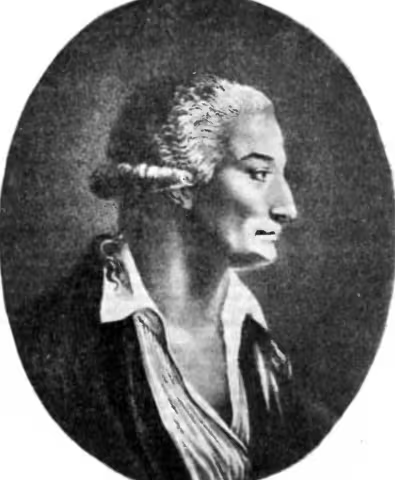
Antoine Laurent Lavoisier (26 August 1743 – 8 May 1794) was a French chemist and a member of the Paris Academy of Sciences (from 1772). He was born in Paris. He graduated from the faculty of law of the University of Paris (1764) and attended a course of lectures on chemistry at the Botanical Garden in Paris (1764–1766). From 1775 to 1791 he was director of the Gunpowder and Saltpetre Administration. At his own expense he built a fine chemical laboratory, which became the scientific centre of Paris. He was a supporter of constitutional monarchy. During the French Revolution he was executed by sentence of the revolutionary tribunal.
He was one of the founders of classical chemistry and brought strict quantitative methods of research into it. His experimental work — burning sulphur and phosphorus, heating tin in a hermetically sealed vessel — began the refutation (1774) of the phlogiston theory. Setting out to check the experiments of C. W. Scheele and J. Priestley, he obtained oxygen (1774), established its nature as a chemical element, and showed that it combines with phosphorus and sulphur when they burn and with metals when they are calcined. He proved (1775–1777) that atmospheric air is compound, containing oxygen and “mephitic air” (nitrogen). With this work Lavoisier, in the words of F. Engels, “was the first to place all chemistry, which in its phlogistic form had stood on its head, squarely on its feet”. Having correctly explained combustion and oxidation, he laid the foundations (1777) of the oxygen theory. Together with the French mathematician and chemist J. B. Meusnier he proved (1781) that water is compound, consisting of oxygen and “inflammable air” (hydrogen); the two of them also synthesised (1785) water from hydrogen and oxygen. With C. L. Berthollet, L. B. Guyton de Morveau and A. F. Fourcroy he worked out (1786–1787) the principles of a new chemical nomenclature. He proposed (1789) a “Table of Simple Substances”, in essence the first classification of the elements, and published (1789) his “Elementary Treatise on Chemistry”. He worked out a classification of organic compounds, defining them as compounds of oxygen with carbon radicals, and laid the foundations of organic analysis. He was the first to suggest that acetic acid forms when spirit of wine is oxidised by the oxygen of the air. Together with P. Laplace he designed (1782–1783) the ice calorimeter and measured the thermal constants of a number of substances; he measured the heat given by various fuels. He was the first to apply physico-chemical methods of research systematically to biology. He proved that respiration is akin to combustion and that the formation of carbon dioxide in respiration is the main source of heat in a living body. Together with Berthollet and other scientists he founded (1789) the journal “Annales de chimie”.
From Kaloyan Manolov's “Great Chemists”
As usual, in the astronomy lesson the master, Nicolas La Caille1, could barely keep up with his inquisitive pupils' questions. The Collège Mazarin2 taught the children of the most eminent people not only of Paris but of all France. Monsieur La Caille tapped the table with his wooden pointer and said:
“Quiet, please. That is enough questions. Now it is my turn: I shall ask and you will answer. I am glad you are so curious, but I want to be sure that you know something too. So tell me, which constellations are called the constellations of the zodiac, and what do you know about them?”
A forest of hands went up.
“Antoine, if you please.”
Seventeen-year-old Antoine went up to the master's desk. Everyone listened with bated breath: Antoine always knew how to set out even the hardest material briefly, clearly and simply. La Caille listened closely with a benevolent smile. He was entirely satisfied with the answer.
“Excellent, Lavoisier. Sit down. This afternoon we shall take up our meteorological observations again. This time we shall make them on the veranda of the library building. I shall expect you at three o'clock.”
The bell rang, and at once the classroom grew noisy. All sorts of questions were on the leavers' minds now. In two months they would have their diplomas. What then? How would their lives turn out? Each of them was making plans, each had his own hopes. But Antoine was the most anxious of all. For him, leaving the college meant above all parting from Monsieur La Caille. How much his beloved master had given him in that time! He kept with care the notebooks filled with endless columns of figures, the data of the observations they had made together. Lavoisier leafed through them with sadness and affection, regretting the coming separation.
At the beginning of June 1761 the Collège Mazarin held its leavers' evening. On that solemn day the hall was festively decorated. The pupils stood on the stage and listened attentively to the principal's speech. He congratulated the leavers on finishing the college and handed them their diplomas. Antoine, the best pupil in the college, was entrusted with the speech of thanks. La Caille, sitting in the front row, smiled at him kindly. As soon as the ceremony was over, the leavers rushed from their places to their masters, lifted them on their shoulders and broke into song together.
“Vivat professore...”
“Long live La Caille!”
Everyone applauded, and the mothers, deeply moved, dabbed their tearful eyes with lace handkerchiefs.
For Antoine a new life was beginning.
“Congratulations, Antoine,” said Monsieur Laurent Lavoisier3,ed.4, one of the best-known advocates in the city, to his son.
“Thank you, Father.”
“Let me kiss you, my child,” whispered Madame Lavoisier4 in a voice choked with emotion. Tears shone in her eyes.
The Lavoisier family slowly descended the college's marble staircase.
In the street a slim young man came up to them.
“Congratulations on your diploma, dear Antoine,” he said.
“Guettard, how pleasant that you should be the first to meet us. Do come to dinner with us on this happy occasion,” said Monsieur Lavoisier.
“Thank you, I accept your invitation with pleasure.”
A few minutes later, sitting in the carriage, they were discussing Antoine's future. Jean Étienne Guettard5 was a well-known mineralogist and an old friend of the Lavoisier family.
“It seems to me,” his father was saying, “that he could make a brilliant career at the bar. Antoine has a sharp mind and a clear head, priceless qualities in a lawyer. And of course it counts for a good deal that my practice is one of the best known in Paris.”
“It is hard to disagree with you, Monsieur Lavoisier,” said Guettard. “Your arguments are convincing. We accept your proposal. So, at dinner, the first toast is to the future advocate Antoine Lavoisier.”
“Come now, that is enough talk of business. Let us rather think how Antoine is to spend the holidays, where he is to rest,” said Madame Lavoisier.
“We have the whole summer before us, my dear,” replied the elder Lavoisier.
“I have a proposal,” said Guettard. “For several years now we have been working on a geological map of France. I should be very glad if Antoine spent this summer with me and helped me with it. There are several more mountain districts still to be studied.”
“Oh! That will surely be a splendid excursion!” exclaimed Antoine.
“Not only that. There will be a great deal to learn as well, my dear friend,” said Guettard.
Antoine did indeed learn a great deal that summer. What a variety of minerals the depths of the earth hold! How many substances kept their secrets, the secrets of elements not yet discovered!
Lavoisier picked out with extraordinary diligence every pebble that seemed to him in any way different from the rest. In the evenings they sat by the fire and examined and sorted the minerals they had gathered during the day.
“These glittering black crystals are iron ore too,” Guettard told him. “They have a very curious property: like a magnet, they can attract small pieces of iron.”
“How interesting,” said Lavoisier. “Let me try.”
“Here you are. This property has given the mineral its name too: ‘magnetite’6.”
Lavoisier held the glittering black mineral to bits of wire and tried to lift them, but at the slightest movement of his hand they came away and fell.
The more Antoine came to know the world of minerals, the more questions he had. Mineralogy was no less interesting than the law, to which he meant to devote his life. The summer flew by unnoticed, and Antoine entered the Sorbonne to continue his education. He went regularly to the lectures on Roman law and studied the criminal code, but he also found time for the lectures of the well-known professor of chemistry Guillaume François Rouelle7. At the chemistry lectures Lavoisier learned about acids and salts and about Stahl's theory, and understood how many problems were still waiting to be solved. He listened with interest when the professor spoke of a special substance, phlogiston, which escaped from bodies as they burned. From Rouelle, too, Lavoisier learned about the elements. Driven by a thirst for knowledge, he found the works of Robert Boyle in the library and read them all, one after another. At the same time Antoine was preparing diligently for his examinations.
In the spring of 1763 Lavoisier completed the faculty of law with success and took the degree of bachelor. But he was still drawn to geology and chemistry. He spent only a few hours in his father's office or in the courtrooms. How much pleasanter it was to shut himself up in his room and study the minerals he had collected. Guettard often called on him, and the two of them would spend long hours discussing all kinds of problems of geology and chemistry.
But there were also questions the whole city was talking about. At that time the question of lighting the French capital was at the centre of attention. At night the streets were plunged into darkness, and it was unsafe to walk about the city. The Academy of Sciences decided to announce a competition for a paper on the lighting of large cities. Lavoisier resolved to try his strength and take part. With his characteristic energy and diligence he set about studying the problem. The paper he submitted did not win the advertised prize, but it attracted the attention of scientists. Lavoisier had developed and set out the problem with the utmost clarity, showing a deep knowledge of theory and an intuition for applying it to practical ends. It was decided unanimously to publish the paper in the Academy's journal and to award its author a gold medal.
A ceremony was held for the presentation of the medal. Young Lavoisier's heart was festive too.
“I should like to believe,” said the President of the Academy in his speech, “that 1766 will be a year of great success for young Antoine Lavoisier. I hope that in the not too distant future he will be elected to our ranks. Let us wish you fruitful work, my young friend!”
Stormy applause drowned the speaker's last words. Lavoisier warmly thanked the distinguished assembly and set off home in high spirits. He ran lightly up the stairs and went into his room. The evening passed in reflection, and the next day Lavoisier made a firm decision: to give up a career at the bar and devote himself to research. He had studied the problems of chemistry so deeply and with such interest that work in this field, he realised, had become the meaning of his whole life.
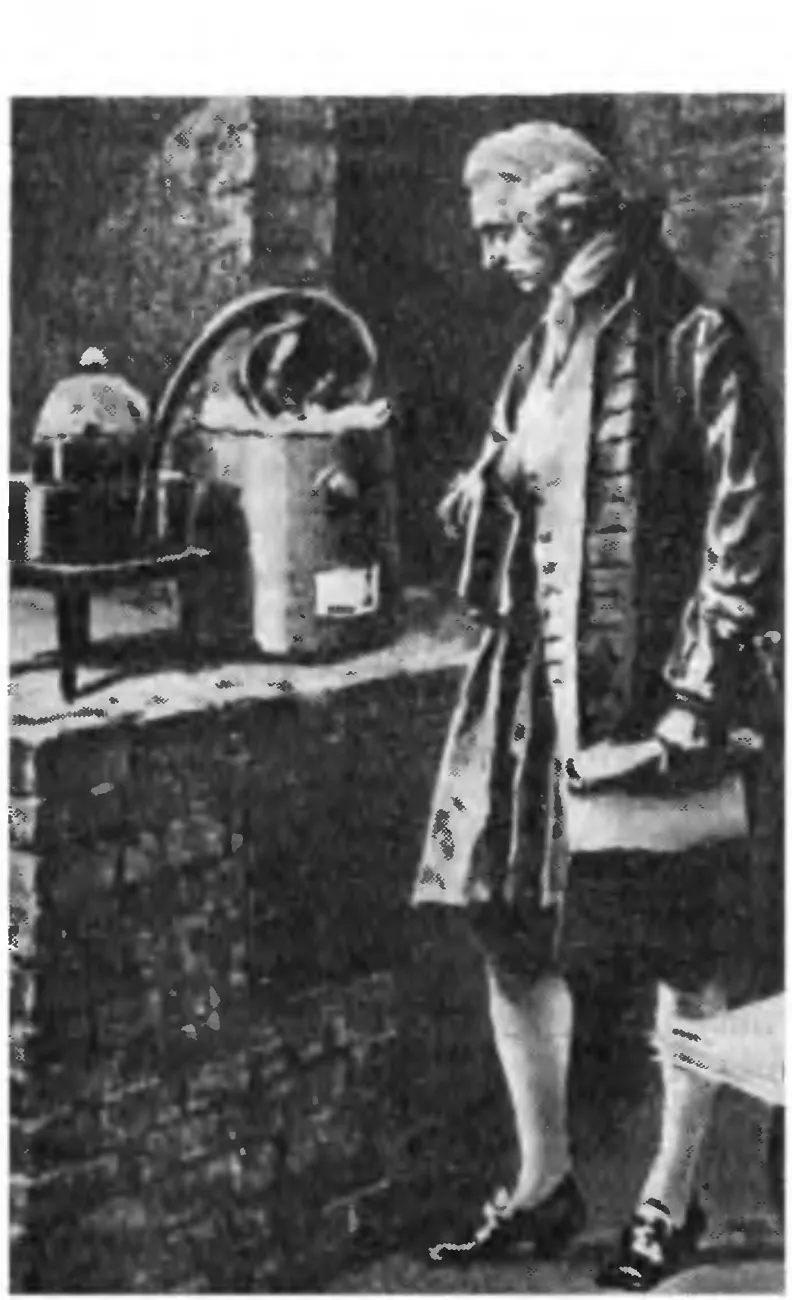
Something mysterious lay hidden in gypsum, simple as it seemed. Its pale yellow, transparent, soft crystals had long attracted the young researcher's attention. He was particularly interested in how gypsum behaved in water. Gypsum was easily ground to a powder, but left in water for some time it made the water so hard that soap would not lather in it. A glass tube ending in a hollow bulb that held a few grains of sand did not sink when placed in water: the bulb with the sand went down towards the bottom of the vessel, but the thin end of the tube stayed above the surface. When the researcher placed the same tube in gypsum water, he found that its thin end now rose somewhat higher above the surface than in pure water. Lavoisier called this tube a hydrometer (today we call the instrument an areometer). With it the densities of liquids could be determined very quickly. He often discussed this property of the instrument with his friend Guettard, but so far they had not managed to work out the nature of the interaction between gypsum and water.
“It is perfectly clear,” Lavoisier said, “that the gypsum passes into the water. My hydrometer shows it.”
“There is no doubt of that. You know, after all, that water, as the chemists believe, turns into earth and earth into water. In this case the earth is the gypsum.”
“Yes, some of our scientists do indeed say so, but it seems to me that these ideas are not quite exact, and more than that, not even correct. Here, for instance, Antoine Deparcieux proposes the following way of examining water: evaporate it to a dry residue and weigh that, that is, find the weight of the earth the water contained.”
“Deparcieux's method is doubtful,” replied Guettard, “for, according to Jean Baptiste Le Roy, it is impossible to obtain distilled water that contains no earth*.”
“Yes! There are many unclear problems here still. I shall take up the study of the properties of water in earnest.”
“And what do you mean to do?”
“This. You already know about my hydrometer. I shall put it in distilled water and mark with a line on the tube the point to which it sinks, and then mark with a new line the point to which it sinks in a saturated solution of common salt. In this way, by a fairly simple method, I shall be able to determine the density of natural waters.”
“But you are not taking Le Roy's view of the matter into account.”
“True. If what he says is right, I shall not be able to obtain standard distilled water, and this method will not solve the problem. That is why the first thing is to find out whether water can be purified by distillation, and if it can, how.”
“The problem is no less interesting than the one described in your first two papers on gypsum8.”
These papers were the grounds on which Lavoisier was elected an adjoint of the Paris Academy of Sciences in 17688а. The academicians, convinced of Lavoisier's ability to set out his thoughts briefly and clearly, made the young scientist secretary of several scientific commissions. The reports Lavoisier drew up on the work of these commissions were remarkable for their exceptional clarity and precision.
Alongside his scientific work at the Academy, Lavoisier went on experimenting in his own laboratory. He proved that water distilled twice is practically free of all impurities and has the properties of rainwater, and so can be regarded as the purest natural water. Lavoisier's experiments called for a great deal of money, and his salary from the Academy was not enough for them. Lavoisier had to look for further sources of income9. A convenient opportunity soon presented itself.
To provide the treasury with a steady income, the French government granted the right to collect indirect taxes to a joint-stock company, the “General Farm”10. To obtain this right the members of the “General Farm” had to pay the state an enormous sum and then collect the taxes. This system, however, was open to abuse. Nevertheless Lavoisier decided to join the “General Farm”. Now he had to turn to his father for financial support. Monsieur Lavoisier was at work in his office, as always.
“To what do I owe this visit, Monsieur Lavoisier the younger?” asked his father in an injured tone. “Thank God you have not yet forgotten the way to the office.”
“Father, I think you have understood by now that I shall never make an advocate. My interests lie elsewhere. I am drawn to science, its secrets, its riddles.”
“Yes, but science needs money, and you have none.”
“That is just what I have come to see you about.”
“Well, here is a surprise. Come, let us hear it.”
“I want to join the ‘General Farm’. I have a favour to ask: stand surety for me with the National Bank, and then I shall be able to get a loan of five million francs.”
“Why, with that money you could buy half of France!” his father exclaimed indignantly.
“With that sum I shall cover a third of the shares, and then within five years I shall not only pay it back but become the owner of a large fortune.”
“You are starting a dangerous game. But since you have made up your mind, I shall try to help you.”
“Thank you, Father.”
Monsieur Laurent Lavoisier's standing helped his son, and the loan was obtained. The director of the “General Farm”, Jacques Paulze, gave Lavoisier a host of commissions, and he set to work with all the zeal of youth.
For three years Lavoisier travelled about France, writing reports and drawing up accounts. He was one of the most active members of the “General Farm”. The pursuit of science needed money, and it was only for this that he had embarked on the risky venture of the “General Farm”. With the money he earned Lavoisier equipped a rich laboratory, where the young scientist spent several hours every day. On his journeys about the country Lavoisier studied the natural mineral waters. From morning till late at night he worked either on accounts in the office of the “General Farm” or in the laboratory. He also attended the meetings of the Academy regularly. He was always busy, affairs pressed on him from every side, and not a minute was left for rest. But one day a holiday burst into the scientist's hard working life: he fell passionately in love.
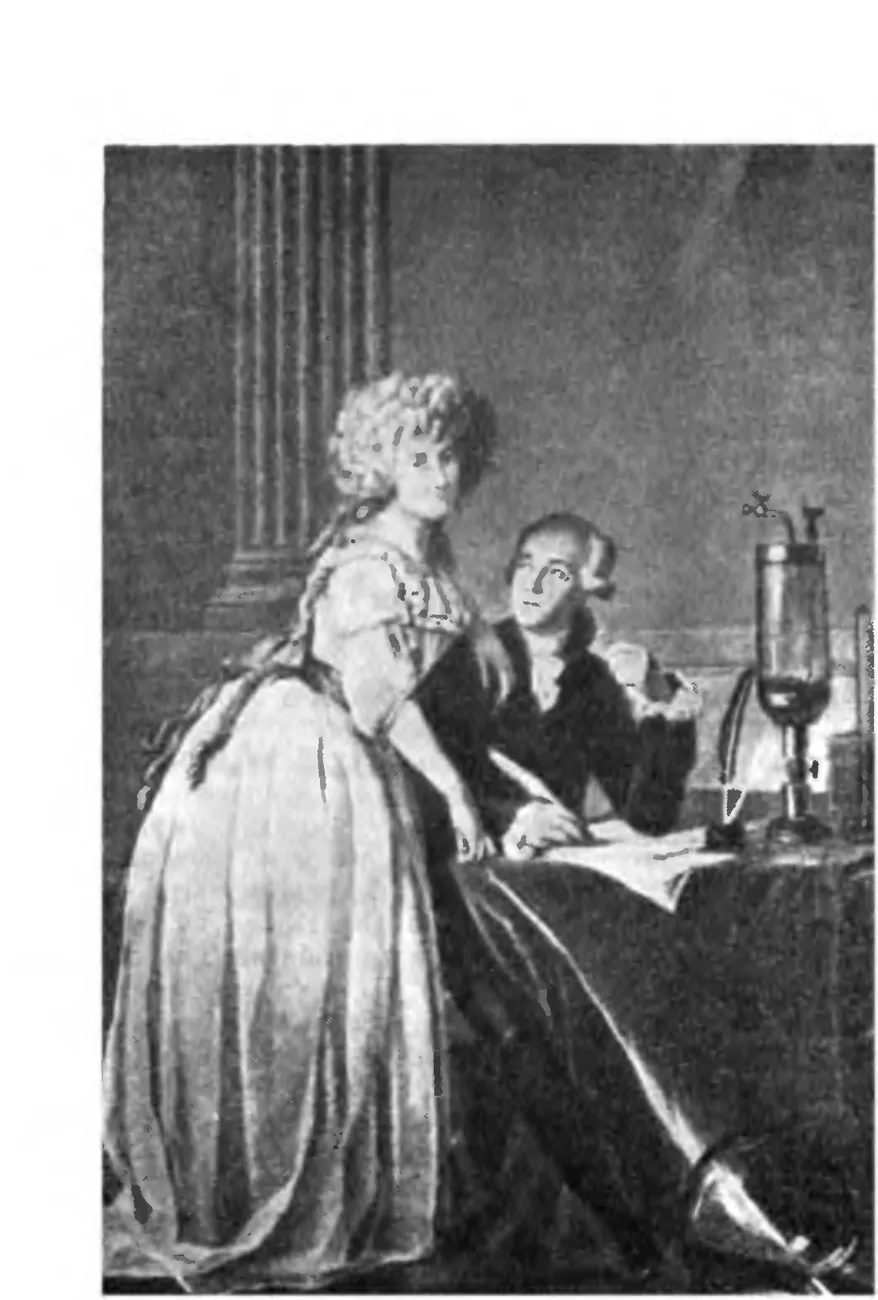
They met in the office of her father, Jacques Paulze, director of the “Farm”. Lavoisier greeted her politely and bent over his documents. But, strangely, the blue eyes of Marie Anne Paulze drew him like a magnet, and he looked at her again. The girl was looking at Antoine too. A smile flickered across her face. It seemed to him that the world had at once become brighter, better, more beautiful, and suddenly he understood clearly that he could not live a single day without that smile of hers. Soon he asked for the hand of Anne Marie Paulze. A splendid wedding was celebrated: the future Madame Lavoisier, then fourteen years olded.1, looked like a fairy-tale fairy in her white lace dress. On that day Antoine Lavoisier thought himself the happiest man in the world10а.
And he was indeed happy. Marie's refined nature, her sensitivity and her ability to understand her husband, her devotion made their marriage strong and happy.
A year later Lavoisier was elected a member of the Academy of Sciences.ed.2 In this period of his life he spent most of his time in the laboratory, where two other researchers also worked, Macquer11 and Cadet12. The main question that troubled scientists at that time concerned the nature of combustion. Many of them felt that the phlogiston theory could not explain this process, but there were not yet data convincing enough to build a new, more scientific theory. Lavoisier was no less interested in combustion than the others. Sometimes he and his fellow researchers argued so heatedly that their talk began to sound like a quarrel; but new ideas were born in these arguments.
It happened on a cold February evening. Macquer read aloud a paper which reported that a diamond heated to a high temperature “vanished” without trace13.
“Why?” Cadet wondered.
“And what has it turned into? After all, when substances burn, ash is left, but in this case there was not even that,” added Macquer.
“It seems to me that the reason should not be sought there,” said Lavoisier.
“Where, then?” Cadet asked anxiously.
“It is not all clear to me either, but I believe the surroundings evidently have some influence,” said Lavoisier.
“But the heating was done in air,” added Macquer.
“And could the air not have an influence?” Lavoisier objected.
“You are right. No one thought of checking what would happen if a diamond were heated without air.”
“There is an idea for you. Will you start work on it together?”
“Of course, and tomorrow at that.”
The next day Lavoisier brought several diamonds. Macquer prepared a thick paste of graphite. They coated the tiny precious stones with a thick layer of paste and began to heat the little black balls. Soon the balls were red-hot and began to glow like coal in a furnace. After several hours the researchers cooled the balls and cleaned off the coating. How great was their surprise when they saw that the diamonds had come through whole and unharmed14.
“Astonishing!”
“So the strange ‘vanishing’ of diamonds is somehow connected with the air. Perhaps they combine with it?” Lavoisier suggested.
“This is so unlike everything we know about combustion that it is frightening even to think of it,” said Cadet.
“And yet the experiment shows that it is so,” said Lavoisier with conviction.
The discovery was so unusual that all other problems receded into the background. Now for Lavoisier the scientist only one problem existed: combustion. He at once set about studying the burning of phosphorus and sulphur. He managed to collect all the white smoke produced when phosphorus burns. Lavoisier was even able to weigh it and establish that the smoke was heavier than the phosphorus he had started with15.
“Phosphorus combines with air!”
The thought gave the scientist no peace. With how much air? How? And the idea of an experiment was born: to burn phosphorus in a closed vessel and measure the quantities of the substances, above all of the air.
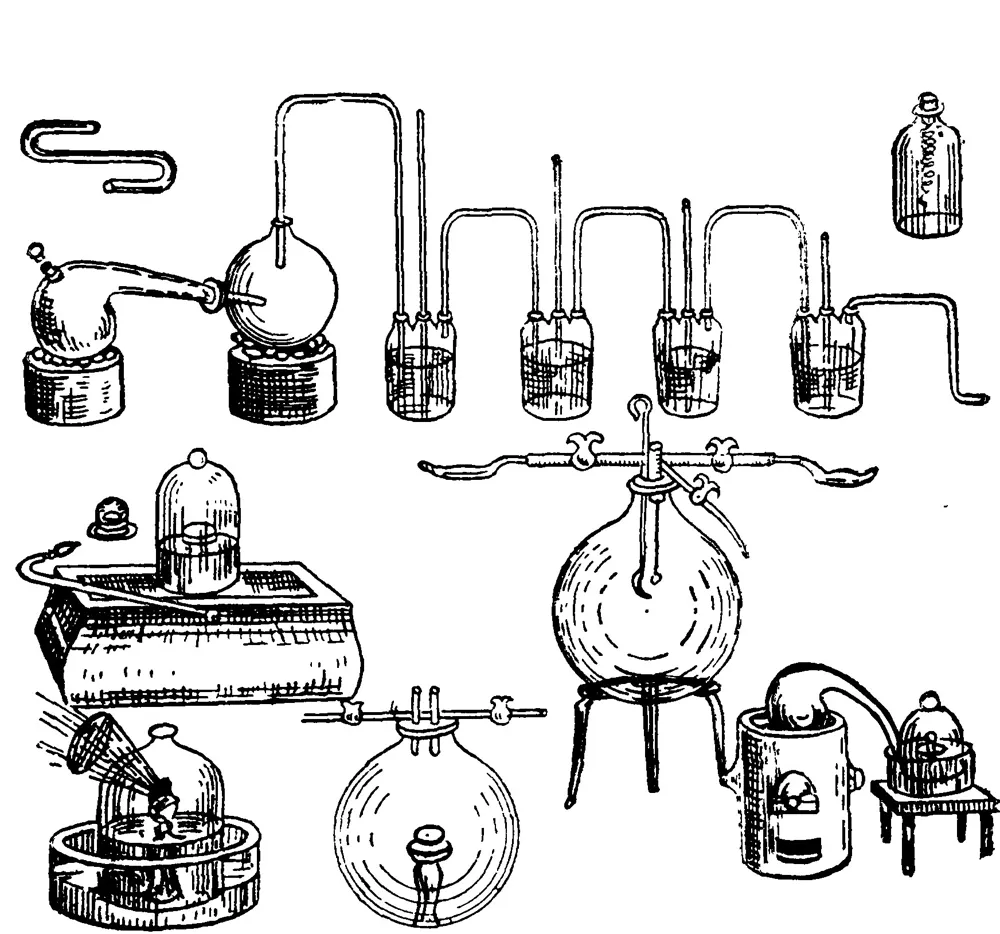
He put a dish of phosphorus on a cork stand floating on water, lit the phosphorus with a red-hot wire and quickly covered it with a glass bell jar. Thick white smoke filled the space inside. Soon the phosphorus went out, and the water began to rise and fill the bell jar. After a while the water stopped rising.
“I seem to have taken too little phosphorus. Not all the air could combine with it. The experiment must be repeated.”
But the second experiment, with twice as much phosphorus, gave the same result: the water rose to the same level. Even when the experiment was made for the tenth time it gave the same result.
“Phosphorus combines with only one fifth of the air. Can air really be a complex mixture?”
Lavoisier studied the burning of sulphur too. When it burned, it also combined with only one fifth of the air. After this Lavoisier began to investigate the calcination of metals. On prolonged heating the metals turned into a metallic calx, but when the calx was mixed with charcoal and heated to a high temperature, it turned back into metal. This process, however, gave off a gas which chemists called “fixed air” (carbon dioxide). Lavoisier understood well that combustion had to do with gases, but he still could not draw a final conclusion. And so it became necessary to study gases. What is “fixed air”? Is it contained in limestone? How is it produced when limestone is heated and turned into quicklime? Is air always absorbed in combustion? If so, which substance is the more complex, the metal or the metallic calx? The questions arose one after another, and the answers were found in the same order, leading Lavoisier to the overthrow of the doctrine of phlogiston. It was clear to him that air consists of two parts: one of them supports combustion (it combines with metals when they are calcined), the other does not support combustion, and living things die in it. In burning, bodies absorb the active part of the air, which he called “good air”16. This also explains why the product is heavier than the starting substance. Lavoisier made some of his experiments in closed vessels. He noticed that when lead, mercury and other metals were calcined in sealed glass vessels, the weight of the vessel was the same before and after heating. In spite of this, the metallic calx formed was heavier than the metal taken. We now call this great discovery the law of conservation of the weight of substances17.
A new theory of combustion was born. Not everything in it was clear yet, but Lavoisier's scientific papers already spoke of the untenability of the phlogiston theory. A theory that asserted that substances had negative weight could not be accepted. But in his discovery Lavoisier was still alone. None of the scientists dared to support him, and he had to prove the rightness of his views by himself.
Lavoisier also had to give a good deal of time to the affairs of the “General Farm”. At the beginning of 1775 he was offered the post of director of the Gunpowder and Saltpetre Administration. Busy as he was, Lavoisier agreed: it gave him splendid laboratories at his disposal and, besides, a spacious and comfortable apartment. He devoted almost a whole year to financial and administrative questions of developing the Administration.
At the same time he was investigating the materials used to make gunpowder. Lavoisier proved that saltpetre and nitric acid contain “good air”; sulphur and phosphorus also combine with this kind of air when they burn, and the substances obtained have the properties of acids.
“Perhaps all acids contain this gas?” he asked himself more than once.
Lavoisier named the new gas oxygen. Now the theory of combustion could be formulated precisely. He held that when bodies burn they combine with oxygen, and this increases their weight. Oxygen is absolutely necessary for combustion! “Fixed air” is not an element, as had been thought before. It is the product of the burning of carbon, and so it is a compound of carbon with oxygen. It became perfectly clear that metals are simple substances, and a metallic calx is a compound formed when a metal reacts with oxygen. And yet there was one question to which he could find no answer: it concerned the burning of “inflammable air”18, which was obtained when metals were dissolved in acid and which burned easily. According to the new theory the products ought to be heavier, but Lavoisier could not catch them completely, and the weight always came out smaller. There was another difficulty here too. According to the theory of acids, “inflammable air” (hydrogen) ought to form an acid when it combined with oxygen, but no acid could be obtained.
“Can the theory be wrong? Can I be mistaken?”
Lavoisier decided to discuss this difficult problem with the physicist and chemist Charles Blagden19, who had come over from England, and told him in detail about his unsuccessful experiments.
“In my view the problem can be solved,” said Blagden. “It is simply that ‘inflammable air’ forms water when it burns.”
“It cannot be!” exclaimed Lavoisier. “And yet it is not so improbable after all. Please tell me about it in more detail.”
“My friend Henry Cavendish has proved that if ordinary air is mixed with ‘inflammable air’ in a closed vessel and the mixture is fired, small drops form on the walls of the vessel, the product of the burning of the ‘inflammable air’. Cavendish established that they are drops of water.”
“An astonishing discovery. So water too is not an element but a compound substance. I should like to repeat these experiments at once and see it all for myself. Would you be so kind as to come with me to the laboratory? You could give me some advice.”
“With the greatest pleasure.”
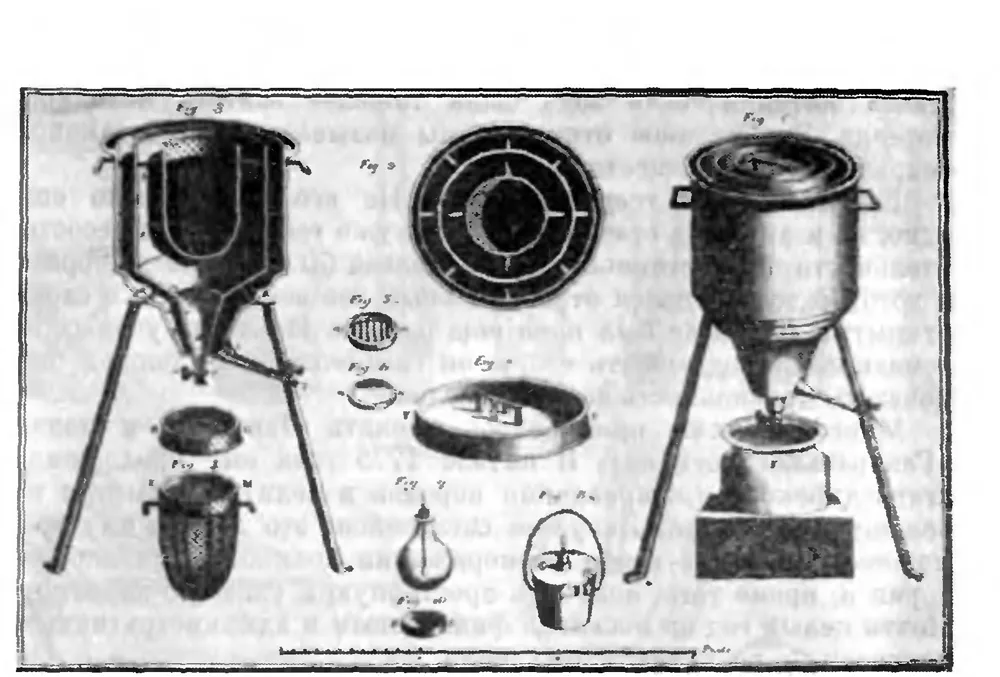
Many scientists gathered in the laboratory. Lavoisier and Laplace prepared the apparatus from a sketch Blagden drew for them. The experiment succeeded: drops of water did indeed appear on the walls of the vessel. It was carried out in haste, and no quantitative conclusions could be drawn. Lavoisier was convinced that here lay the link that would join his theories into a single chain. With his usual diligence he took up the study of water. In a short time the scientist proved that water decomposes into oxygen and “inflammable air”. When a mixture of these two gases burns, water is formed again. To prove that here too there was no error in the weights, he prepared a mixture of the two gases in a glass bell jar standing in mercury and placed the whole apparatus on a large analytical balance. Several times he burned the mixture, and every time its weight before the reaction was equal to its weight after20.
“So the law of conservation of the weight of substances is a universal law. The theory of oxidation is general too, and there are no exceptions. And ‘inflammable air’? With oxygen it gives water; it is logical to call it hydrogen, the element that gives birth to water21.”
Lavoisier set out these same ideas before the academicians, to whom he demonstrated his experiments. The French scientists still did not accept his theory. Most of them refused to recognise Lavoisier's work and accused him of borrowing his ideas from the researches of Priestley and Cavendish. The academicians declared more than once that they knew of similar experiments on the decomposition of water, meaning Gaspard Monge22. Lavoisier's priority was not recognised.
Instead of joining forces in research, the scientists argued about who had discovered the phenomenon.
Finding no support in the scientific world, Lavoisier nevertheless went on with his work. Now he was working with the well-known physicist and mathematician Pierre-Simon Laplace23. They managed to design a special apparatus with which the heat given off by burning substances could be measured. This was the so-called ice calorimeter. The researchers also made a detailed study of the heat given off by living organisms. By measuring the amount of carbon dioxide breathed out and the heat given off by the body, they proved that food “burns” in the body in a special way. The heat given off by this burning serves to keep the body at its normal temperature24.
Laplace was convinced that Lavoisier's views were right and was the first to accept his theory. In 1785 Claude Louis Berthollet, who had become very well known by then, also came out in support of Lavoisier's theory. A little later Lavoisier was supported by the most eminent chemists of the day, Antoine Fourcroy25 and Guyton de Morveau26.
Guyton de Morveau first met Lavoisier on quite a different matter.
“May I speak with you at some length about some questions which I think are very important?”
“I am at your service,” replied Lavoisier.
“I do not know how much this interests you, but the names of chemical compounds are in utter chaos.”
“I quite agree with you.”
“At the moment the chemical part of the ‘Methodical Encyclopaedia’27 is being prepared for the press. And since it is impossible to give full answers to every question with the names in use until now, I have begun to compile a new nomenclature of chemical compounds. Of course, I need the help of the leading chemists.”
“In that case you should go to Fourcroy.”
“I have done so already. I shall speak to Berthollet too. Perhaps we should all discuss this difficult problem together. For instance, even so familiar a notion as phlogiston, it would seem, is difficult to describe.”
“Phlogiston? There is no such thing as phlogiston, Monsieur de Morveau. My theory has put an end to that delusion.”
“Your theory?” Guyton de Morveau looked at Lavoisier, lost for words in astonishment. Understanding the awkwardness of the situation, Lavoisier smiled and briefly told him the main points of his theory of combustion. Guyton de Morveau listened attentively.
“On the basis of this theory I can make some suggestions. With hydrogen and oxygen, I hope, all is clear to you now. But take a metallic calx, a compound of a metal with oxygen. Let us call the compounds of the elements with oxygen oxides. Then the calx of zinc will be zinc oxide, the calx of iron iron oxide, and so on. And what is ‘fixed air’? I have already proved that it is a compound of carbon with oxygen. So it should be called carbon oxide**.”
“Wonderful! Your theory is a revolution in chemistry!”
“And your chemical nomenclature will give that revolution its impetus.”
Guyton de Morveau met Lavoisier many times to discuss this important problem. The question was one of the language of chemistry: a language that would make mutual understanding easier, a language in which all the chemical changes of substances would be expressed precisely, clearly and easily. In 1787 Guyton de Morveau published the “Method of Chemical Nomenclature”, in the making of which Lavoisier, Fourcroy and Berthollet took part27а.
At that time Lavoisier was working on one of his greatest creations, a textbook of chemistry, the need for which had long been felt. The phenomena of nature had to be explained in a new way and the foundations of the modern theories set out clearly. The new achievements of chemistry were not reflected in the old textbooks of Christophe Glaser28 and Nicolas Lémery. Lavoisier had sketched the main sections of the textbook eight years before. Now he thoroughly reworked them, and by the end of 1788 the textbook was ready. Much of the credit for preparing the manuscript belonged to Madame Lavoisier, who did the illustrations for the third part of the textbook. Now she had one more task before her: to make the plates for her drawings.
“The drawings are splendid, Marie. But the publishers insist that you make the plates yourself.”
“But I have never done that, Antoine.”
“You will manage, my dear. In fact the third part of the textbook is half yours.”
“And the first is entirely yours, Antoine. Your theory of combustion, the formation and decomposition of gases, the burning of simple substances, the formation of acids, the composition of the atmosphere and of water, the new nomenclature... None of this has been written in any textbook until now. Why, it is a revolution in chemistry, Antoine!”
“True, Marie. The new ideas have already been accepted and are arousing great interest. Have you not noticed that the second part of the textbook is built in a new way too? The tables of acids and bases and of the products of their reactions, and above all the table containing the 33 simple substances known today. I am convinced that future research will lead to the discovery of new substances that will help to extend this table.”
Lavoisier's textbook did indeed become the cornerstone of the new science of chemistry. Within a few years of its first edition it had been translated and published in many countries of Europe and in America29.
Lavoisier also took an active part in the public life of his country. In 1789 revolution broke out in France. As a deputy of the assembly in Orléans, aware of the need for change, he proposed a number of reforms, but the reactionary majority rejected his proposal.
In 1791 the government decided to dissolve the “General Farm”. A specially appointed commission was to audit the organisation's accounts up to the end of 1792 and report on its activities in detail.
When his work in the “General Farm” came to an end, Lavoisier left the Gunpowder and Saltpetre Administration as well. He and his wife now settled in a small, inconvenient apartment. Having lost the use of the laboratory at the Royal Arsenal, Lavoisier spent most of his time in the laboratory of the Commission of Weights and Measures30. Besides the administrative duties laid on Lavoisier in the commission, he was charged with determining the density of distilled water in order to create standards for measuring physical quantities. He carried out this task together with Haüy31. The work of the Commission of Weights and Measures laid the foundations of the modern metric system.
Time went by. It was already the middle of 1793, and the commission auditing the “General Farm” had still not managed to prepare its report. By a government decree of 5 June that year it was dissolved and all its papers were sealed. Lavoisier remained calm and confident, for he believed that the “Farm” had acted within the law and that there were no grounds for charging the tax farmers.
In Paris, however, all was unrest: a time had come when many questions were settled by the guillotine.
On 10 September the police came to the house where Lavoisier lived. For two days they made a thorough search, but found no documents on which a charge against the scientist could be based. Two weeks later all the members of the “Farm” were instructed to prepare an account themselves and submit it by 1 April 1794. Lavoisier set to work energetically. For him, who for twenty-five years had drawn up the accounts and reports of the “General Farm”, it was no trouble to show that all the company's affairs had been conducted according to the law32.
On 24 November 1793 the Revolutionary Committee ordered the arrest of all the members of the “Farm”.
Lavoisier was working in his study. His wife, grown pale and drawn in those days, would not leave the window: her heart was uneasy.
“Something must be done at once,” said Lavoisier.
“But what?” wept Marie.
“I shall hide for a while at the baker's. And you will go to the National Convention, to the Revolutionary Committee, and ask for a decree rehabilitating me. My scientific work, my discoveries, and finally the new science built on my discoveries are guarantee enough for leaving me at liberty and not drawing me into the investigation.”
But his wife's pleas were in vain. Everywhere Madame Lavoisier met with a polite but cold refusal. Then Lavoisier himself went to the Revolutionary Committee. He entered the prison cell of his own free will, hoping that at the trial he would be able to refute the charges.
“Antoine Laurent Lavoisier! Here is a copy of the indictment. Tomorrow you will appear before the Revolutionary Tribunal.”
At dawn he was led to the Revolutionary Tribunal with the other tax farmers. A fifteen-minute consultation with the defenders the tribunal had appointed...
The sitting of the tribunal did not last long: the accused were sentenced to death33.
On 8 May 1794 the blade of the guillotine fell on the head of the scientist of genius. France had condemned her great son to death; the world had lost one of the greatest minds of mankind.
Notes
- 1. Nicolas Louis La Caille (Lacaille) (1713–1762), a major French astronomer; he discovered more than ten thousand new stars and fourteen constellations. In 1758 he published solar tables which for the first time contained corrections for the perturbations caused by the planets. La Caille became widely known as the author of textbooks of optics and mechanics. After the death of the physicist P. Bouguer (1698–1758), the founder of photometry, he published Bouguer's fundamental work (Traité d'optique sur la gradation de la lumière, 1760). On La Caille see: Дофман Я. Г. Лавуазье. — 2-е изд. — М.: Изд-во АН СССР, 1962, с. 12—13; Колчинский И. Г., Корсунь А. А., Родригес М. Г. Астрономы: Биографический справочник. — Киев: Наукова думка, 1976, с. 141.
- 2. The Collège Mazarin (the Collège des Quatre-Nations) was a secondary school in France. It taught the children of aristocrats, of the great bourgeoisie and of prominent state officials. Its course (of seven years) included, besides mathematics, physics and chemistry, Latin and Greek, to which considerable importance was attached.
- 3. Lavoisier's father (1715–1775) was a wealthy merchant and an influential advocate, and had wide connections in scientific circles.
- 4. Lavoisier's mother (née Punctis) died when Antoine was five, and he was brought up by his aunt (Partington J. R., ук. соч., т. 3, с. 365).
- 5. Jean Étienne Guettard (1715–1768), a well-known French geologist, mineralogist and naturalist; Lavoisier's teacher and friend (Дорфман А. Г., ук. соч., с. 16—18).
- 6. Magnetite (magnetic iron ore), the natural iron(II,III) oxide Fe₃O₄, is a raw material for making iron.
- 7. Guillaume François Rouelle (1703–1770), a major French experimental chemist of the eighteenth century, a brilliant lecturer, professor, physician and pharmacist, and the founder of a school of experimental chemistry whose pupils and followers included Lavoisier, J. L. Proust and N. Leblanc (1755–1806)ed.3. Rouelle studied salts and found that they are the product of the reaction of an acid with a base (1744), distinguished between “neutral”, “acid” and “basic” salts (1754), discovered ureaed.5, and prepared pure ethyl chloride by distilling spirit of wine with tin chloride (1759). On Rouelle see Фигуровский Н. А., ук. соч., с. 284; Джуа М., ук. соч., с. 127—128; Дорфман Я. Г., ук. соч., с. 14—16; Partington J. R., ук. соч., т. 3. с. 73—76; Волков В. А. и др., Химики: Биографический справочник. — Киев: Наукова думка, 1984, с. 440.
- 8. The twenty-two-year-old Lavoisier presented his first paper (“Analysis of Gypsum”) to the Paris Academy of Sciences in February 1765 (it was published in 1768), and the second (“On Gypsum”) in March 1766.
- 8а. Adjoints were among the co-opted members of the Academy; they received no payment and had no deciding vote. As early as 1766 Lavoisier was put on the list of candidates for future elections; he was elected supernumerary adjoint for chemistry in May 1768, associate on 30 August 1774, full academician (pensionnaire) on 14 February 1778, and in 1785 director (administrative head) of the Academy (Дорфман Я. Г., ук. соч., с. 34—35; Биографии великих химиков, ук. соч., с. 83).
- 9. A different view from this traditional one is held by the Soviet scholar and biographer of Lavoisier, Professor Ya. G. Dorfman (ук. соч., с. 41).
- 10. The “General Farm” was a company for collecting taxes from the population. Making enormous profits, the tax farmers were naturally surrounded by universal popular hatred. Lavoisier's part in an enterprise of this kind is hard to understand, still less to justify (Фигуровский Н. А., ук. соч., с. 331).
- 10а. Here the author is inaccurate. Marie Anne Pierrette Paulze (1758–1836) became Lavoisier's wife in 1771, and although it was a marriage of convenience, it did indeed turn out to be a happy one. On Madame Lavoisier see: Duveen D. I. Chimia, 4, 13 (1953).
- 11. Pierre Joseph Macquer (1718–1784), professor of chemistry at the Botanical Garden in Paris, became an academician at the age of twenty-seven and was elected to the academies of Stockholm, Turin and Philadelphia. He was the author of a dictionary of chemistry and of many other books which played no small part in awakening interest in chemistry. He worked on technical questions: dyeing and the production of phosphorus; he discovered yellow prussiate of potash (potassium ferrocyanide); he was a supporter of the phlogiston theory. On Macquer see: Джуа М., ук. соч., с. 122; Савченков Ф. История химии. — СПб, 1870, с. 117—134; Partington J. R., ук. соч., т. 3, с. 80—90; Становление химии как науки, ук. соч., с. 75—77 и др.; Волков В. А. и др., ук. соч., с. 317.
- 12. Louis Claude Cadet de Gassicourt (1731–1799), a chemist and director of the famous Sèvres porcelain factory; he obtained Cadet's liquid (alkarsine), which contains arsenic and is a mixture of cacodyl oxide and dicacodyl (CH₃)₂As—As(CH₃)₂ (1760), and worked out methods of preparing many inorganic substances. Cadet, like Macquer, was a member of the Academy commission that examined Lavoisier's book “Opuscules physiques et chimiques” (1774). On Cadet see: Дорфман Я. Г., ук. соч., с. 82; Partington J. R., ук. соч., т. 3, с. 96.
- 13. This refers to the paper by Darcet and Rouelle (1772); see Partington J. R., ук. соч., т. 3, с. 382.
- 14. On the experiments of Lavoisier, Macquer, Cadet, Brisson, Baumé and Fournet de Villiers on burning diamonds see: Partington J. R., ук. соч., т. 3, с. 381—384.
- 15. On Lavoisier's research on the burning of phosphorus and sulphur see: Дорфман Я. Г., ук. соч., с. 75—92.
- 16. Lavoisier called this “air” “empyreal” or vital air (Фигуровский Н. А. Открытие элементов и происхождение их названий. — М.: Наука, 1970, с. 80).
- 17. We call the law of conservation of the weight (mass) of matter the Lomonosov–Lavoisier law. The law won wide recognition through the work of Lavoisier, who formulated it in 1789. But it was discovered by Lomonosov in 1748 and confirmed by experiment in 1756. Long before Lavoisier, Lomonosov put forward the idea that the gain in weight when metals are calcined in sealed vessels should be ascribed to particles of air. Lavoisier's outstanding achievement was the use of the balance. He regarded quantitative relations as the decisive criterion of phenomena. The grounding of the quantitative method in chemistry was, together with the creation of the oxygen theory of combustion and the development of the doctrine of chemical elements, one of the three main lines of Lavoisier's chemical work (Кедров Б. М. Три аспекта атомистики: В 3-х т. — М.: Наука, 1969. — Т. 2: Учение Дальтона: Исторический аспект, с. 113—134; Мусабеков Ю. С., Черняк А. Я., ук. соч., с. 60—69; Биографии великих химиков, ук. соч., с. 72—77; Крицман В. А., ук. соч., Ч. I, с. 92—111; Азимов А. Краткая история химии: Развитие идей и представлений в химии. — М.: Мир, 1983, с. 45—52).
- 18. H. Cavendish called hydrogen the “inflammable air” obtained from metals and thought, like all the phlogistonists, that a metal loses its phlogiston when it dissolves in acids (Фигуровский Н. А. Открытие элементов, ук. соч., с. 61).
- 19. Charles Blagden (1748–1820), an English physicist and chemist, an assistant of H. Cavendish, who told Lavoisier the results of Cavendish's and Priestley's unpublished experiments on the synthesis of water and Watt's opinion of its composition; Secretary of the Royal Society of London. In 1788 he showed that the lowering of the freezing point of a solvent is proportional to the amount of dissolved substance. On 24 June 1783, in the presence of a number of French academicians and C. Blagden, Lavoisier and Laplace made an experiment in burning a mixture of oxygen and hydrogen in suitably chosen proportions. On Blagden see Дорфман Я. Г., ук. соч., с. 167—168.
- 20. Experimenting with eudiometers and being an adherent of the phlogiston theory, H. Cavendish failed to draw the right conclusion about the composition of water, although in 1784 he knew the work of Lavoisier, who on 24 June 1783 in Paris had repeated Cavendish's experiment, obtained 5 drams (about 20 g) of water and been the first to conclude that water is a compound substance, a compound of hydrogen with oxygen. Independently of Lavoisier and Cavendish, the synthesis of water from its elements was carried out in 1783 by G. Monge, who, like Cavendish, found that two volumes of hydrogen combine with one volume of oxygen and that the weight of the water obtained is equal to the sum of the weights of the gases that combine. On the history of the synthesis of water see: Partington J. R., ук. соч., т. 3, с. 436—453; Соловьев Ю. И. История химии, ук. соч., с. 109—111.
- 21. Hydrogen was the first gas that researchers learned to tell apart from air by its inflammability, and it had long been obtained by the action of sulphuric acid on iron. Pure hydrogen was first obtained by H. Cavendish in 1766, who distinguished it from other gases and described its chemical properties (on Cavendish's experiments with hydrogen see: Меншуткин Б. Н. Курс общей химии. — Л.: Госхимтехиздат, 1933, с. 101—102); in 1781 Lavoisier obtained hydrogen from water, and since it had been shown earlier that hydrogen gives water when it burns, he named it the “begetter of water”, Hydrogene. On the origin of the name see: Фигуровский Н. А. Открытие элементов, ук. соч., с. 60—61.
- 22. Gaspard Monge (1746–1818), a French mathematician and public figure, member of the Paris Academy of Sciences from 1780, professor at the military engineering school at Mézières from 1768, and one of the founders of the École Polytechnique in Paris and a professor there from 1794. Monge did work in mathematical analysis, chemistry, optics, meteorology and practical mechanics. Starting from the experiments of Monge, who by a simple method of his own had obtained a considerable quantity of water by burning “inflammable air”, Lavoisier calculated the ratio of the volumes of the two gases that form water and attempted to establish the ratio of the weights of the gases in the synthesis of water (Дорфман Я. Г., ук. соч., с. 167—176). On Monge see: Биографический словарь деятелей естествознания и техники, ук. соч., с. 49—50; Гаспар Монж. Сб. статей к 200-летию со дня рождения. — М.: Изд-во АН СССР, 1947; Partington J. R., ук. соч., т. 3, с. 453—456; Боголюбов А. Н. Гаспар Монж. — М.: Наука, 1978; Демьянов В. П. Геометрия и «Марсельеза». — М.: Знание, 1979; Боголюбов А. Н. Математики, механики: Биографический справочник. — Киев: Наукова думка, 1983, с. 330—331.
- 23. Pierre-Simon Laplace (1749–1827), a French astronomer, physicist and mathematician, member of the Paris Academy of Sciences from 1785 and honorary member of the St Petersburg Academy of Sciences from 1802. He made a number of discoveries in mechanics, in the theory of differential equations and in the theory of probability; he was Lavoisier's partner in the experimental study of phenomena accompanied by the release and absorption of heat. These investigations, made with the ice calorimeter designed by Lavoisier and Laplace, went on for fifteen years and laid the foundations of thermochemistry. On Laplace see: Partington J. R., ук. соч., т. 3, с. 443—464 и др.; Воронцов-Вельяминов Б. А. Лаплас. — М.: Мол. гвардия, 1937. — (ЖЗЛ); Еремеева А. И. Выдающиеся астрономы мира: Рекомендательный указатель. — М.: Книга, 1966, с. 185—193; Боголюбов А. Н. Математики, механики, ук. соч., с. 271—273; Колчинский И. Г. и др., ук. соч., с. 143—144.
- 24. On Lavoisier's work on the physics and chemistry of the processes of life see: Дорфман Я. Г., ук. соч., с. 233 и сл.
- 25. Antoine-François de Fourcroy (1755–1809), a physician, a well-known chemist and a political figure of the French bourgeois revolution, member of the Paris Academy of Sciences from 1785 and foreign honorary member of the St Petersburg Academy of Sciences from 1802. He contributed to the study of the chemistry of certain physiological processes and helped to establish the antiphlogistic theory in chemistry; studying freezing mixtures, he was the first to obtain liquid ammonia, in 1799, and he isolated many compounds in a pure state. He was a prominent teacher, an organiser of public education and a populariser. Among his works is the eleven-volume “Système des connaissances chimiques”. On Fourcroy see: Джуа М., ук. соч., с. 149; Фигуровский Н. А., ук. соч., с. 384—387 и др.; Partington J. R., ук. соч., т. 3, с. 535—551; Bugge G., ук. соч., с. 356—368; Шамин А. Н. История химии белка. — М.: Наука, 1977, с. 34—40; Становление химии как науки, ук. соч., с. 75 и сл.; Волков В. А. и др., ук. соч., с. 533—534.
- 26. Louis Bernard Guyton de Morveau (1737–1816), a chemist, lawyer, man of letters, poet and prominent political figure of the French bourgeois revolution; Lavoisier's co-author in drawing up the new chemical nomenclature. In 1778 he founded a works for making saltpetre; he was the first to organise the production of soda in France, studied the properties of inorganic substances, proposed a system of new names for substances, and took part in founding the oldest chemical journal, the “Annals of Chemistry” (Annales de chimie). On Guyton de Morveau see: Джуа М., ук. соч., с. 146—147; Фигуровский Н. А., ук. соч., с. 380—384 и др.; Старосельская-Никитина О. А. Очерки по истории науки и техники периода Французской буржуазной революции 1789—1794. — М.: Изд-во АН СССР, 1946, с. 205—207 и др.; Partington J. R., ук. соч., т. 3, с. 516—534; Волков В. А. и др., ук. соч., с. 142.
- 27. The “Methodical Encyclopaedia” (Encyclopedie Methodique) was a new encyclopaedic dictionary prepared in 1779–1786, for which Guyton de Morveau was writing the article “Chemistry”. After visiting Lavoisier and becoming convinced that the new oxygen theory of combustion was right, Guyton de Morveau had to give the article a new preface in the encyclopaedia and from then on set out chemistry on the basis of Lavoisier's theory (Дорфман Я. Г., ук. соч., с. 212).
- 27а. On the history of the chemical nomenclature see: Джуа М., ук. соч., с. 146—153; Крицман В. А. Книга для чтения по неорганической химии, ук. соч., Ч. I, с. 134—143; Фигуровский Н. А. Очерк общей истории химии, ук. соч., с. 361—369; Становление химии как науки, ук. соч., с. 111—113.
- 28. Christopher (Christophe) Glaser (1628–1673), a French chemist, the teacher of N. Lémery, and the author of the textbook “Course of Chemistry” (Glaser Ch. Traite de la chimie. — Paris, 1663), which appeared at the same time as R. Boyle's “The Sceptical Chymist”. Between 1663 and 1710 the book went through thirteen or fourteen editions. In it Glaser suggested that matter has an atomic structure and maintained that chemistry complements medicine. On Glaser see: Partington J. R., ук. соч., т. 3, с. 24—26 и др.
- 29. Lavoisier's “Elementary Treatise on Chemistry”, printed in an edition of two thousand copies, quickly sold out. In the same year a second printing of the first edition appeared. In the following years (up to 1801) two more editions of Lavoisier's textbook came out. In 1789 the “Treatise” was translated into Dutch, in 1790 into English, in 1791 into Italian and in 1792 into German (Дорфман Я. Г., ук. соч., с. 232). With the creation of a new chemical language in 1787 and the publication of the “Elementary Treatise on Chemistry” in 1789, Lavoisier completed the chemical revolution, having transformed the science of chemistry in seventeen years. Of Lavoisier's works the following have been published in Russian translation: Лавуазье А. Л. Мемуары: О природе вещества, соединяющегося с металлами при прокаливании их и увеличивающего их вес. Опыты над дыханием животных. О природе воды. Экспериментальный метод. Введение к элементарному курсу химии/Под ред., с биографией А. Лавуазье и предисл. М. А. Блоха. — 2-е изд. — Л., 1931; Лавуазье А. О горении вообще. — Успехи химии, 12, 368 (1943); та же работа: в кн.: Становление химии как науки, ук. соч., с. 430—435; Лавуазье А. Предварительное рассуждение из «Начального учебника химии». — Успехи химии, 12, 359 (1943).
- 30. The Commission of Weights and Measures was set up by the Paris Academy of Sciences, and Lavoisier was appointed its treasurer and secretary (Старосельская-Никитина О. А., ук. соч., с. 144; Дорфман Я. Г., ук. соч., с. 273—274; Szabadváry F. Antoine Laurent Lavoisier: Der Forscher und seine Zeit. 1743—1794. — Budapest: Akadémiai Kiado, 1973).
- 31. René Just Haüy (1743–1822), a famous French mineralogist, the founder of crystallography, a member of the Commission of Weights and Measures, member of the Paris Academy of Sciences from 1783 and foreign honorary member of the St Petersburg Academy of Sciences from 1806. He discovered one of the basic laws of crystallography, the law of rational indices. On Haüy see: Шаскольская М. П., Шафрановский И. И. Рене Жюст Гаюи. — М.: Наука, 1981; Гаюи Р. Ж. Структура кристаллов: Избранные труды. — М.: Изд-во АН СССР, 1962. — (Классики науки).
- 32. Naturally, the activity of the “General Farm”, which engaged in financial machinations, was directed against the interests of the French people and was one of the means of its enslavement. Lavoisier, in the opinion of most of his biographers, constantly expressed his negative attitude to the French bourgeois revolution of the late eighteenth century.
- 33. Lavoisier's Soviet biographer, Professor Ya. G. Dorfman (ук. соч., с. 303—325), examined in detail and objectively the circumstances and causes that led to the trial of the tax farmers and the execution of Lavoisier.
- * The dry residue is meant.
- ** It would properly be “dioxide”, but that was not yet known at the time.
From the site's editors
- ed.1 Marie-Anne Paulze was born on 20 January 1758 and married Lavoisier on 16 December 1771: she was thirteen.
- ed.2 A year after the wedding is 1772, the year the handbook “Выдающиеся химики мира” also gives. According to note 8а, Lavoisier became an associate on 30 August 1774 and a full academician on 14 February 1778.
- ed.3 Nicolas Leblanc was born on 6 December 1742, not in 1755.
- ed.4 Lavoisier's father was Jean-Antoine Lavoisier.
- ed.5 Urea was discovered (1773) by his younger brother, Hilaire-Marin Rouelle.