1778–1850. A French chemist and physicist: he discovered the laws of the thermal expansion of gases and of combining volumes, isolated boron together with Thénard, and studied iodine and cyanogen.
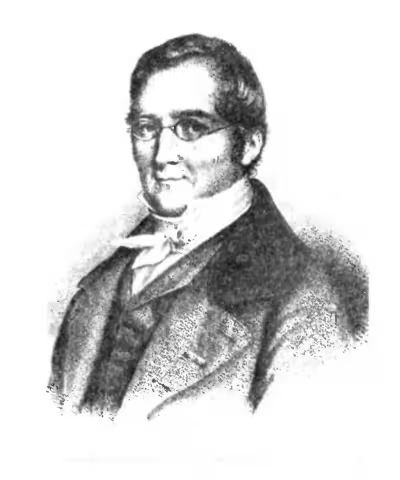
Joseph Louis Gay-Lussac (6 December 1778 – 9 May 1850) was a French chemist and physicist, a member of the Paris Academy of Sciences (from 1806) and its president in 1822 and 1834. He was born in Saint-Léonard. He graduated from the École Polytechnique in Paris (1800), where he studied under C. L. Berthollet, and went on to work there (from 1800 to 1802 as Berthollet's assistant). In 1805–1806 he travelled through Europe with the celebrated German naturalist A. Humboldt. From 1809 he was professor of chemistry at the École Polytechnique and of physics at the Sorbonne, and from 1832 professor of chemistry at the Botanical Garden in Paris.
His work covers many fields of chemistry. Independently of J. Dalton he discovered the law (1802) giving the quantitative relation between the expansion of gases and temperature at constant pressure, and also the law of combining volumes (1808), by which the volumes of gases that react stand to one another and to the volumes of the gaseous products of the reaction as whole numbers (Gay-Lussac's laws). Studying hydrochloric and hydrocyanic acids, he was the first to show that the presence of oxygen is not a necessary criterion for calling a substance an acid. He established (1811–1813) the analogy between chlorine and iodine, and prepared hydriodic and iodic acids and iodine monochloride. He studied hydrogen fluoride. Together with L. J. Thénard he isolated (1808) free boron from boric anhydride. With Thénard, and independently of H. Davy, he worked out (1808) ways of obtaining potassium and sodium by reducing their hydroxides. He studied (1810) their peroxides, and also the peroxides of calcium and barium. He determined (1815) the quantitative composition of hydrocyanic acid and established the analogy between it, the hydrohalic acids and hydrogen sulphide. He prepared and studied (1815) “cyanogen” (in today's terms, dicyanogen), which became one of the premises of the theory of compound radicals and of the theory of substitution. He was the first to plot (1819) curves of the solubility of salts in water against temperature. He improved the methods of volumetric analysis: chlorimetry (1824), alkalimetry and acidimetry (1827), and the precipitation titration of silver (1832). Together with M. E. Chevreul he took out (1825) a patent for making stearin candles. He invented (1827) a tower for recovering the oxides of nitrogen in the industrial manufacture of sulphuric acid (such towers came into use from 1842). He worked out (1829) an industrial method of making oxalic acid from sawdust. He invented (1816) the thermometrograph and a portable mercury siphon barometer. Together with T. J. Pelouze he obtained (1833) lactide by heating lactic acid.
Foreign honorary member of the St Petersburg Academy of Sciences (from 1829).
From Kaloyan Manolov's “Great Chemists”
There was unusual bustle in the house of the public prosecutor Gay-Lussac. Servants kept running from the large, festively decorated hall to the kitchen, going down to the cellar and coming back with baskets full of pears, grapes and bottles of wine. Now and then the lady of the house gave brief orders. She was very excited: that day, 6 December 1798, her son Joseph was turning twenty.
The young man whose day it was had gone out with his father for a walk along the shady streets of Saint-Léonard. Tomorrow he was to return to Paris again: in the next two years he had to complete his course at the École Polytechnique in Paris1.
The guests had already begun to arrive, and Madame Lussac received them with some embarrassment.
“And where is the hero of the day?” asked Judge Dubois, puffing heavily.
“He should be here any minute. Ah, here he is at last. Louis, the guests have got here before you,” she said to her husband with a mild reproach.ed.3
“We beg your pardon. And now to the table, gentlemen,” said the father, and took his place at the head of the table.
“Every success in your studies, Joseph.” Madame Lussac kissed her son and secretly brushed away the tears that had come to her eyes.
“Let us hope that as a scientist you will not bring shame on our name,” said the father. “Gentlemen, let us raise our glasses to the happy future of Joseph Louis Gay-Lussac!”
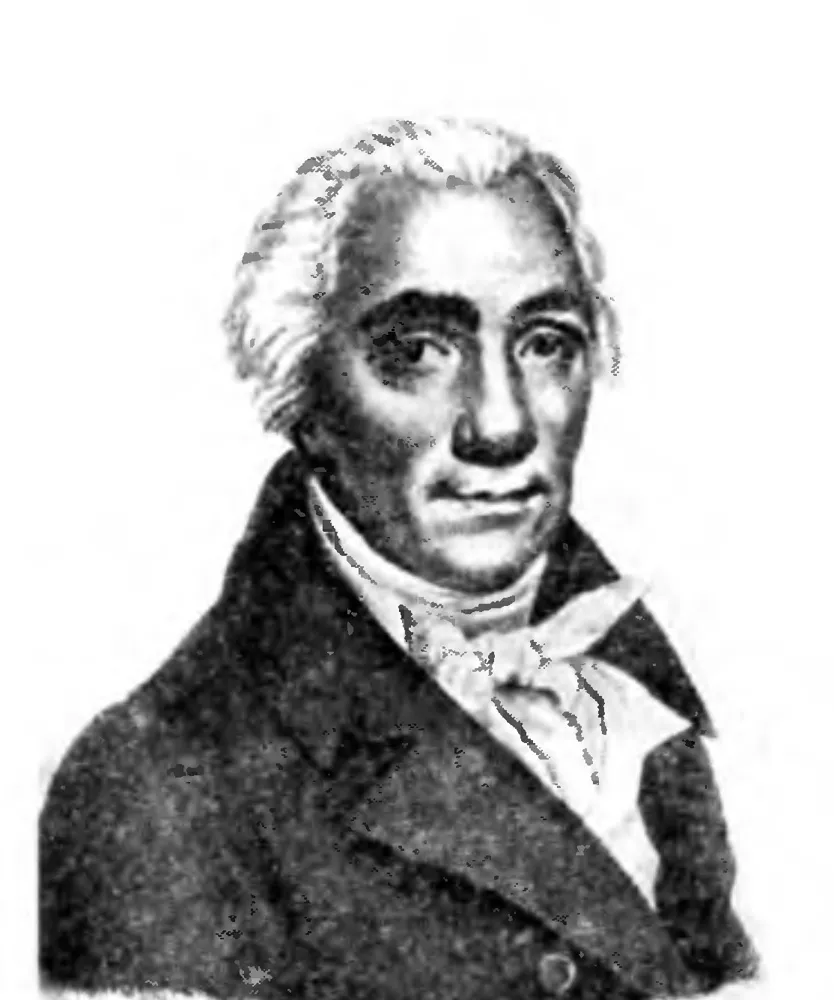
Joseph sat lost in thought, only smiling now and then and bowing politely in thanks for the guests' kind words about him. He was reserved and strict in company, brief and witty in friendly conversation. Now he was patiently waiting for the usual commonplace congratulations, which he had to listen to every year on this day, to come to an end at last.
The celebration ended, the guests went home, and Joseph went upstairs to his room. The hour was drawing near when he would once more be able to work in the laboratory he loved...
In Paris Joseph forgot everything else in the world: for him only one university existed. Once again there were the lectures on chemistry by Fourcroy and Vauquelin2, the lectures on physics by Brisson3, the work in the laboratory.
He was taught by famous professors, and the young man coped excellently with the hardest tasks. He took every job given to him with complete seriousness. Sometimes he built the instruments and apparatus he needed for his experiments himself. A model student, he was the favourite of Fourcroy and Brisson.
On leaving the École Polytechnique, Gay-Lussac went to work as assistant to Berthollet, who had not long returned from his journey to Egypt and was carrying out a great many investigations, connected mainly with his scientific dispute with Proust.
Gay-Lussac was finishing the last experiments. He wrote the data into the thick notebook in which he recorded all the results of the investigation entrusted to him as his first task, and sank wearily onto a chair.
How curious it is, the young chemist thought, that even so great a scientist as Berthollet can be mistaken. He expected the substance to give off oxygen, but in fact it absorbed it. The analyses, too, showed results opposite to those expected. Monsieur Berthollet will be upset when he learns that his suppositions have not been borne out!
Berthollet came into the spotlessly clean laboratory.
“Let us see the results, Lussac,” he said, sat down in an armchair and stared intently at the notebook. Joseph watched him with interest: Berthollet suddenly frowned, his forehead creased, and deep disappointment showed on his face. His hopes had not been fulfilled. But to a great scientist the truth is always dearer than wounded pride. And there was no doubt at all that the truth had been established. And it had been done by none other than Gay-Lussac, a young and gifted scientist just setting out on the thorny path of science.
Berthollet stood up, and his frowning face lit up with a smile. He put his hand on Gay-Lussac's shoulder and said:
“I am proud of you. A man of your talent has no right to work as anyone's assistant, even the greatest scientist's. Your eyes can see the truth and penetrate the secrets of the unknown, and that is not given to everyone. You must work on your own. From today, carry out whatever investigations you think necessary. Stay in my laboratory, if you wish. I shall be glad if one day I can call myself the teacher of such a researcher as you. I wish you happiness on your way, Gay-Lussac.”
Berthollet went out. He had quite forgotten the failure of his own investigation. He was jubilant: one more great chemist had appeared in the world, and not just anywhere, but in his, Berthollet's, laboratory! France would be proud of her son.
Gay-Lussac sat at the table, somewhat disconcerted and embarrassed by his talk with the professor. Then his thoughts returned to a question that had occupied him for a long time: the state of gases, whose properties had been treated very superficially in Professor Brisson's lectures. Lately many researchers had been studying them, but not everything was clear yet, and wrong conclusions were very often drawn. Take, for example, Alexander von Humboldt's paper on his investigation of the air. The method was plainly wrong! And from it, naturally, came wrong results.
Gay-Lussac began to check Humboldt's investigation by experiment and wrote a sharp, critical paper on it. He went on studying gases until the end of 1802, when on the strength of the data he had obtained he was able to draw a very important conclusion: every gas expands on heating according to a definite law. When the temperature rises by one degree, the volume of a gas increases by 0.00375 of its original volume. This quantity became the constant in a new law of the gaseous state, Gay-Lussac's law*,4.
At this time he was working closely with the physicist Jean-Baptiste Biot. The young scientists, who later became friends, often talked about questions connected with the study of the atmosphere and with the phenomena of terrestrial magnetism, discussed new ideas and made plans for future research. One question excited them particularly: how to rise into the atmosphere, explore its upper layers and measure the strength of the Earth's magnetic field. The idea of a balloon came to them somehow unexpectedly, but its boldness captivated them. Biot looked for materials to build the craft and for craftsmen to construct the balloon's basket. Gay-Lussac was busy preparing the apparatus and chemicals for producing hydrogen. At last 2 August 1804 arrived. The weather was still and hot: not a breath of wind, not a single cloud. At dawn they began filling the huge balloon with hydrogen. The thin silk fabric, impregnated with protective resins, gleamed in the sun. The balloon slowly swelled and, a few hours later, lifted off the ground and rose smoothly, pulling its mooring ropes taut.
Gay-Lussac and Biot took their places in the round basket.
“Cut the ropes!” Gay-Lussac commanded.
“Bon voyage!” called Berthollet, who was staying on the ground, and waved to them.
“Good luck!” cried Professor Brisson after him, but his voice was drowned in the jubilant shouts of the professors from the École Polytechnique, the Sorbonne and the Academy of Sciences, the scientific workers and the students gathered on Montmartre. The balloon swayed slightly and began to gain height. It was a rare sight. The balloon rose higher and higher. The two friends waved their arms for joy and shouted like boys.
But now the crowd seeing them off began little by little to vanish into the immense abyss beneath them. Lofty Montmartre looked like a haystack.
“Let us get to work,” said Biot.
“I have already begun observing the deviation of the magnetic needle.”
“Note the altimeter readings at once as well. What matters is what changes set in with height... Joseph, how high have we climbed?”
“5,800 metres above sea level.”
“I feel a sharp pain in my ears, and I'm dizzy.”
“Sit here. I'll try to carry on the observations alone. I still feel well.”
There was plenty of room in the round basket tied to the huge balloon. Everything had been arranged so that observations could be made in comfort. Meanwhile Biot was feeling worse and worse: he had turned pale, his face was covered with large drops of sweat, and he was shivering so that his teeth chattered.
“We must go down,” said Gay-Lussac.
“Certainly not. We have not done half of what we planned,” Biot insisted. “Take no notice of me.”
“No, no, we can't. I'm opening the valve to let out the hydrogen.”
There was a faint whistle of escaping gas. The balloon shrank slightly, then began to sink smoothly. Gay-Lussac closed the valve again.
A few hours later they landed.
The news of the brave explorers' feat caused a real sensation. Everywhere people talked of nothing but the aeronauts5. The enthusiastic talk about the first flight had not yet died down when Gay-Lussac decided to repeat the experiment. This time he meant to fly alone, to stay in the air as long as possible and to make as many measurements as he could.
A month and a half later, on 16 September 1804, Gay-Lussac went up again. The balloon reached a height of 7,016 metres. The measurements showed that even at this height the magnetic field showed almost no change. He collected samples of air at a height of 6,636 metres and later analysed them in the laboratory. The analyses showed that the air there had the same composition as near the ground.
Besides his research Gay-Lussac also had to give time to teaching students: he helped them consolidate the material of the lectures Fourcroy gave at the École Polytechnique. He also took part in the gatherings that Berthollet regularly held in the great hall of his country house at Arcueil. Many scientists met there. Gay-Lussac made many useful acquaintances in that remarkable house, unique of its kind. Settled comfortably in armchairs, those present held lively debates. The most frequent visitors were Laplace, Biot, Thénard and Arago, and sometimes, despite his great age, Brisson too called on Berthollet.
One day at Arcueil, as Gay-Lussac stood thoughtfully at the window, a man he did not know came up to him.
“Forgive me, but if I am not mistaken, you are Monsieur Gay-Lussac?”
“Yes. With whom have I the honour?”
“Alexander von Humboldt.”
“So this is the man I criticised in my paper,” thought Gay-Lussac. “An unpleasant explanation lies ahead.”
“Let us sit down,” Humboldt suggested. “I should like to talk to you.”
“I am at your service.”
“Believe me, I bear you no grudge for your criticism. It is fair, though the tone of the paper is somewhat sharp. But I put that down to your youth, my friend. Bear in mind that not everything in science is easily grasped; wrong conclusions are very often drawn and wrong theories built.”
“Yes. And on them we simply waste our strength.”
“Not to no purpose. We learn from our mistakes. If there were no mistakes, there would be no right path either. For science everything matters, both the right conclusions and the wrong ones. True, in time science finds the right answer, but it is born in the throes of the wrong one; it surfaces out of the errors we sometimes fall into. I am about to make eudiometric measurements of the air again. I shall also try to check the accuracy of the eudiometer designed by Volta6. What would you say if I asked you to work with me?”
“I accept your offer with pleasure, Monsieur von Humboldt. I too have investigated the air several times.”
“Yes, I have heard about your daring balloon flights. Do you like travelling?”
“Very much.”
“So do I,” Humboldt said with enthusiasm. “The expedition to America lasted four years; now I have allowed myself a short rest. I must work up the results of many years of work. Besides, I should like to carry out a few investigations here, and then I shall set off on an expedition again.”
“Where to this time?”
“To France, Italy and Germany. We shall make magnetic measurements at various latitudes and longitudes, determining the declination and deviation of the magnetic needle.”
“I understand. You want to determine the exact coordinates of the Earth's magnetic poles.”
“Yes. That is one of the many problems measurement can solve. I shall be very glad if you agree to come with me. At the same time other investigations can be carried out in the mobile laboratory that will be fitted out for the expedition.”
“I am afraid Professor Fourcroy will object.”
Fourcroy did indeed object: apart from Gay-Lussac there was no one to teach the students at the École Polytechnique.
Gay-Lussac and von Humboldt set to intensive work in the laboratory. At the same time, on Berthollet's advice, they prepared the equipment the expedition needed. Berthollet promised to persuade Fourcroy to give his consent. And at last Gay-Lussac was granted a year's leave to take part in Humboldt's expedition.
The scientists set off southwards in March 1805. After travelling some three or four hundred kilometres they would stop, pitch a small camp and set to work. In this way they gradually reached the southernmost point of Italy. When autumn came, the expedition went north, through Austria to the Baltic Sea. And the following year Gay-Lussac and Humboldt were back in Berlin to finish their experiments and work up the results of their research.
They studied the composition of air, adding hydrogen to it and igniting the mixture. The oxygen combined with the hydrogen to form water, and only the nitrogen was left. Gay-Lussac noticed that the volume of oxygen was always half the volume of the hydrogen it combined with. In one of the papers he prepared jointly with Humboldt he wrote: “100 volumes of oxygen always combine with 200 volumes of hydrogen to form water.” These simple volume ratios are probably connected with the atomic structure of substances. He must check, Gay-Lussac thought, whether all gases show the same picture.
But he could not continue his experiments, for he received news of the sudden death of Professor Brisson. “Everyone here is now cast down by the death of Professor Brisson...” Thénard wrote to him. “But it is quite likely that in choosing a professor of physics they will settle on you. Come to Paris as soon as you can!”
Gay-Lussac finished his investigations and returned to Paris, where teaching chemistry to the students of the École Polytechnique, lectures on physics at the Sorbonne and work in the laboratory awaited him...
At a ceremonial session of the Paris Academy of Sciences in 1806 Gay-Lussac was elected a full member.
For him the question of gases remained at the centre of attention. Establishing the simple volume ratios in which hydrogen and oxygen combine led him to think that the reactions between other gases must be studied. Gay-Lussac filled a vessel with equal volumes of nitrogen and oxygen and passed electric sparks through the mixture. The gas mixture turned into a new gaseous substance, nitric oxide, one volume of oxygen combining with one volume of nitrogen to give two volumes of nitric oxide. He studied the reactions between various gases, but the ratios between the volumes of the reacting gases and the volumes of the gaseous products always remained simple. In this way another important and fundamental law of chemistry was discovered, the law of simple volume ratios between gases7.
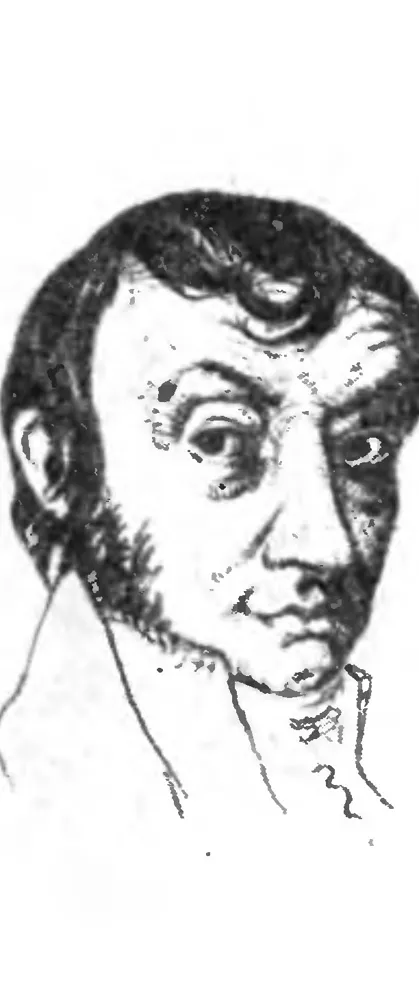
The discovery of this law gave rise to heated debate. By then all scientists had accepted Dalton's atomic hypothesis, and many of them also held the view that equal volumes of different gases contain the same number of atoms. But what were Gay-Lussac's results? One volume of nitrogen and one volume of oxygen ought to give one volume of nitric oxide, for if one atom each of the two gases, nitrogen and oxygen, combine, one compound atom of nitric oxide results. In fact, however, two volumes were obtained. Where did the mistake lie? Perhaps the number of atoms in equal volumes was different? Or perhaps Dalton's ideas about atoms were wrong? Gay-Lussac could not explain it. Later Avogadro8, and then Ampère9, showed that this comes about because gaseous substances contain not atoms but molecules. This supposition seemed most improbable, and Gay-Lussac rejected it. He gave up the atomic and molecular hypothesis, considering it imperfect. Only towards the end of his life did he become convinced of the truth stated as early as 1811 by the Italian scientist Amedeo Avogadro: the particles of a gas are molecules, and each molecule consists of two atoms.
At the same time as the discovery of the law of simple volume ratios of gases, another great discovery stirred the scientific world.
The Englishman Humphry Davy had succeeded in decomposing caustic potash and caustic soda by means of an electric current, isolating two new metals. They were as soft as wax and floated on water, reacting with it violently and bursting into flame.
A session of the Academy of Sciences was called on this account. Those present commented on the news with animation. Berthollet mounted the rostrum.
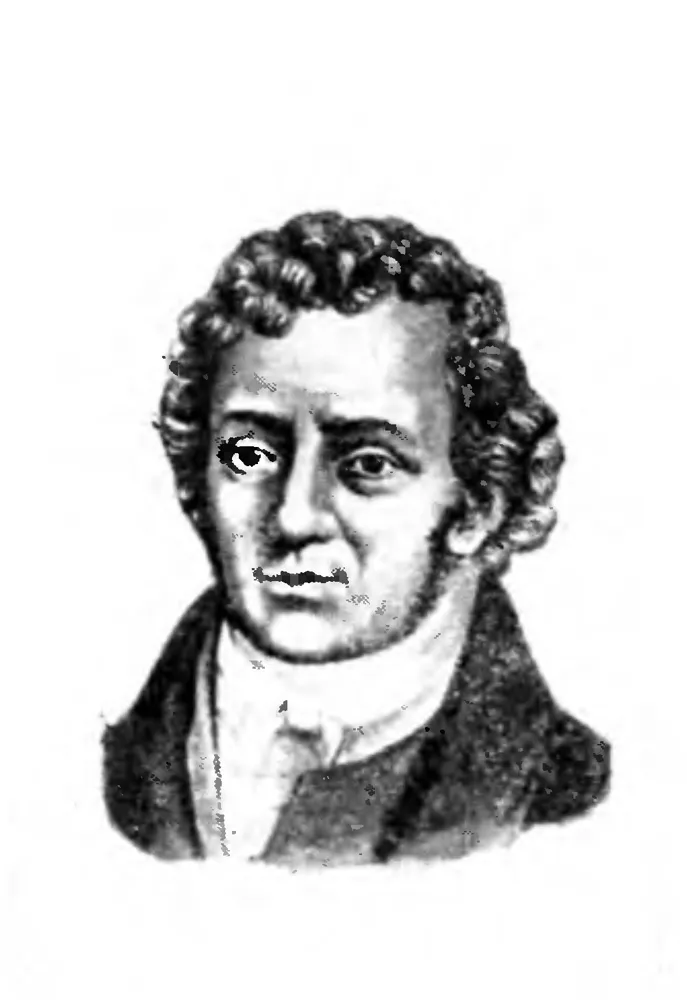
“Esteemed colleagues! You all know why we are meeting. The great success of Humphry Davy has been recognised by our government too: although we are at war with England, Davy has been awarded a decoration, which the Emperor will present to him in person.”
The hall broke into applause.
“But our government sets French scientists great tasks. These two metals must be produced in France too.”
“That will need very large funds,” Vauquelin remarked.
“The funds will be granted,” Berthollet went on. “What we need is people. Young enthusiasts and, above all, gifted ones. I put forward a proposal; you may correct me if I am wrong. In my view the most suitable candidates for this difficult task are Joseph Louis Gay-Lussac and Louis Jacques Thénard.”
Again there was applause in the hall.
The very next day work began on building a colossal electric battery. Two large rooms on the ground floor of the École Polytechnique were cleared; in the courtyard sacks of sal ammoniac and pyrolusite were unloaded, and several dozen crates full of thick sticks of zinc were piled up. In the cellars rows of tall cylindrical clay vessels were gradually set up. Workmen poured solutions into them, fitted the electrodes and welded the wires. At last everything was ready: the powerful electric battery started working.
Thénard took out of the furnace an iron crucible in which molten caustic potash glowed, and carefully poured the melt into the vessel with the electrodes. Gay-Lussac lit the burners, then carefully closed the openings and switched on the battery. Bubbles of gas at once appeared at the graphite electrode. The reaction had begun.
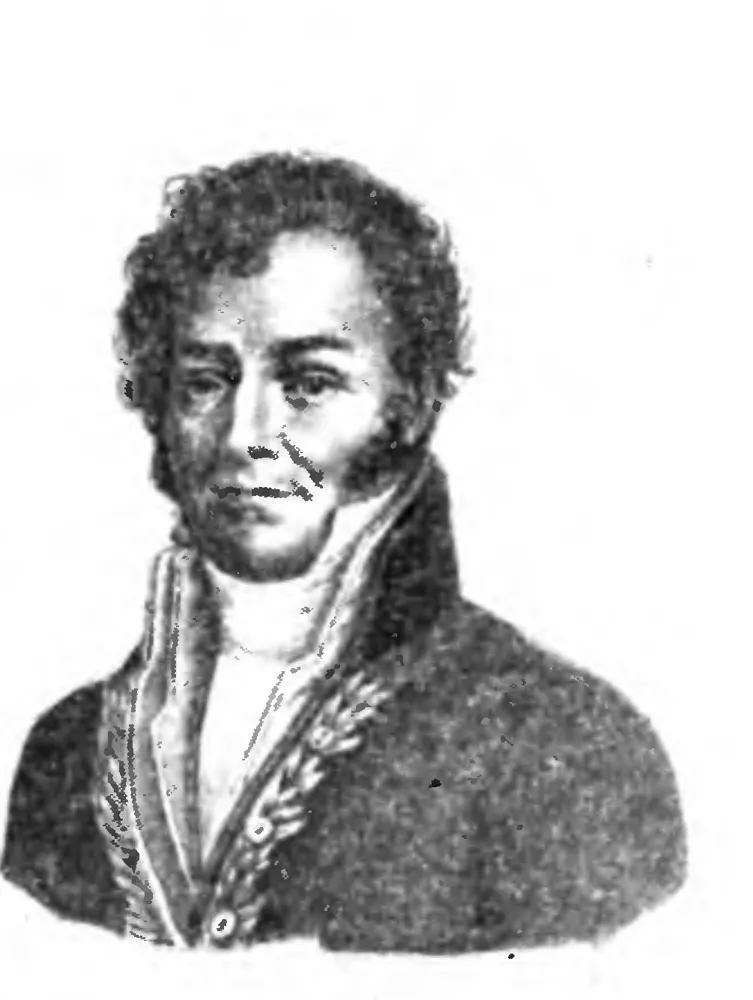
“It seems to me the potassium is coming off very slowly,” said Thénard, watching the process intently.
“We must find out how much potassium comes off in one hour and from that work out what output we can achieve,” Gay-Lussac replied.
“The amount will be small.”
“Such enormous sums spent, not to mention the labour, and such a trifling amount of metal! Why, it will cost twice as much as gold!”
“Our task is to find another, cheaper method.”
“Another method... We ought to turn to ordinary chemical salts,” Gay-Lussac said thoughtfully. “Really, Louis, why not try decomposing the base with another substance?”
The battery went on working. The metal slowly collected in the closed space above the electrodes. Weeks and months went by. In the end a trifling quantity of the new metals, potassium and sodium, was obtained. It was barely enough for a few investigations. Then Gay-Lussac and Thénard went back to the idea that had come to them at the start of the experiment: to look for other ways of obtaining these metals. They soon succeeded. The new method, in which they heated caustic potash and caustic soda with iron filings in a closed vessel, proved far better. With it much larger quantities of the metals could be obtained more simply and cheaply. The method, however, was very dangerous: there were several violent explosions, in which both scientists very nearly lost their lives. After one of them Gay-Lussac spent some forty days in bed. Despite the great danger the young scientists did not interrupt their work. Now they had plenty of potassium and sodium, which they could use freely for their experiments.
“Louis,” Gay-Lussac said to Thénard, “potassium is an extremely reactive element: it displaces many elements from their compounds. Couldn't we try to use it to obtain the element contained in boric acid?”
“An excellent idea,” said Thénard, delighted. “If boric acid is heated, it gives the oxide, but so far no one has managed to isolate the element in the oxide in the free state.”
“Well, let us try.”
Thénard took down the jar labelled “Boric acid”, poured a little of the substance into a small vessel and began to heat it. The crystals gradually melted and turned into a colourless liquid. At first it frothed, because water vapour was coming off, but soon the liquid became still, like molten glass. Thénard cooled it and began grinding it in a mortar, while Gay-Lussac took metal tongs, took a lump of potassium out of its jar and carefully cleaned its surface of the mineral oil in which it was kept. Then he cut the metal with a knife into small pieces, mixed the two substances, carefully put the mixture into a porcelain crucible, closed it tightly with a lid and began to heat it. A violent reaction began. Pale yellowish-green tongues of flame shot whistling out of the narrow gap between the crucible and the lid. Within a few minutes the crucible and lid were red-hot from the heat given off by the reaction.
“I haven't the patience to wait. Let's see what we've got.”
Gay-Lussac carefully lifted the lid. The crucible was full of a dark brown powder. The scientists set about analysing it, and a few weeks later they were convinced that this new substance was an element. They named it boron9а.
In 1809 Gay-Lussac was appointed professor of chemistry at the École Polytechnique and at the same time professor of physics at the Sorbonne. He did not, however, give up his joint research with Thénard. The great reactivity of potassium and sodium opened up wide possibilities. At that time metals were still regarded as compounds of hydrogen. The error was explained by the fact that hydrogen was given off when metals dissolved in acid. Chemists used to say: “The metal combines with the acid and gives off its hydrogen.” The error was reinforced by the fact that pure metal could easily be obtained by heating the metal's oxide with hydrogen. Today such phenomena are easy to explain, but in those days, when the exceptional part played by hydrogen in chemical reactions was not yet known and the atomic theory had only just been born, it was far from simple.
Gay-Lussac and Thénard decided to determine the quantitative ratios of hydrogen and potassium in metallic potassium, and of hydrogen and sodium in metallic sodium.
“The easiest way to do it is this,” Gay-Lussac said to Thénard. “We fill a cylinder with pure oxygen, then put a weighed piece of the metal into it and ignite the oxygen. When it has burned, we determine the amount of water and metal oxide formed.”
“We'll determine the amount of water by blowing previously dried air through the vessel, and catch the water vapour in a flask of concentrated sulphuric acid.”
They carried out the experiment. After half an hour they weighed the flask a second time, but... what a surprise!
“Joseph, there isn't a trace of water. The flask hasn't gained a single gram!”
“That's incredible! Can we have made a mistake?”
“No, a mistake is out of the question.”
“Perhaps we didn't blow the system through well enough? Let's prepare a new flask of concentrated sulphuric acid and repeat the experiment.”
The second, third... tenth experiments gave one and the same result: they could find no water.
“Then let us see what happens to the oxide.”
“Please set up the apparatus for making carbon dioxide. We'll pass dry carbon dioxide through to see how the metal oxide reacts.”
Analyses of the white substances obtained showed that the reaction of sodium oxide with carbon dioxide had formed soda in the vessel, and that of potassium oxide had formed potash. Both substances were completely anhydrous.
This observation became the starting point for new major discoveries. It was proved that potassium and sodium are elements, and the mistaken view of metals was abandoned. Soon the researchers arrived at the correct explanation of so simple a process as the reaction of metals with acids.
Lavoisier's theory of acids had led to other mistaken views. Since, according to Lavoisier, all acids must contain oxygen, scientists believed that sulphur contained oxygen, because the gas hydrogen sulphide has the properties of an acid.
Gay-Lussac and Thénard studied sulphur and phosphorus in detail. All attempts to find oxygen in these two elements were unsuccessful. It was thus established that both substances are elements and not compounds of oxygen.
Nor was the question of muriatic acid (hydrochloric acid) and oxymuriatic acid (chlorine) left aside. The opinion still prevailed that these substances contained oxygen.
“We must try to prove that there is oxygen in them,” Gay-Lussac decided.
“I can see you have already thought out a method,” said Thénard.
“Yes. It is known that at high temperature carbon takes away oxygen. We fill a tube with charcoal, heat it red-hot and pass muriatic acid through it. If the acid really contains oxygen, we shall get carbon dioxide and this element that no one yet knows, murium.”
“And of course we'll do the same with oxymuriatic acid. Perhaps we shall manage to turn it first into muriatic acid and then into murium.”
The experiments went on for several months. Despite all their efforts the researchers could not detect any oxygen. No change in the conditions of the experiment gave any result: the same gas they had started with came out of the tube.
And here was a new discovery! This yellowish-green gas, which had so long been taken for the higher oxide of the element murium, turned out to be a simple substance, a new element. At the same time Humphry Davy was studying this element in England. The new element was named chlorine, from the Greek word “chloros”, green. The green colour is one of the physical properties of chlorine.
“Then muriatic acid can be nothing other than the hydrogen compound of chlorine, and it should be called hydrogen chloride,” Gay-Lussac concluded. “And the solution of this compound in water, accordingly, hydrochloric acid.”
The news of the new discovery caused a real sensation. Almost twenty years before, Berthollet had spent ten years studying this element. Now all the theories of murium, built up with such great effort, were demolished to make way for a new element, chlorine.
At this time Bernard Courtois10 made another discovery. He used the ash of seaweed as a source of potassium in making saltpetre. It turned out, however, that this ash contained some unknown substance. It corroded copper vats and apparatus, which caused great difficulties in production. Courtois managed to isolate the substance and handed it to the chemists Clément11 and Desormes12 for study. The results of the two scientists' work showed clearly that this white substance was a compound of some element then unknown.
The autumn of 1813 came. Clément and Desormes had finished their investigations but had still not published them. One day they met Gay-Lussac in a corridor of the École Polytechnique.
“What news, Clément? What have you to delight us with this autumn?” asked Gay-Lussac.
“You must know that we have discovered a new element in the ash of seaweed.”
“A new element? Shall we go into the laboratory? I want you to tell me everything in order.” He opened the laboratory door, pushed aside the books piled on the table and began to question them:
“Have you managed to isolate it in the pure state?”
“Not yet, but the compounds it forms are unlike any compound of the elements known so far. With mercury, for instance, it forms a bright red precipitate.”
“Please bring a little of the substance. I should like to see it with my own eyes.”
“Unfortunately there is none left. A week ago Humphry Davy was in our laboratory. He too was interested in the substance, and I gave him all we had.”
Gay-Lussac fairly leapt in his chair.
“An unforgivable mistake! What a fatal mistake! To give the last of it to a foreigner. How thoughtless! Now Davy will discover this element and publish his results. The glory of the discovery will belong to England, not France.”
“I never thought of that,” Clément muttered in confusion.
“We must get ahead of Davy at all costs! This element was discovered in France, by French scientists, and now through a chance blunder the glory of its discovery will go to England! No! A thousand times no! Where is Courtois now?”
“What do you want him for?” asked Desormes.
“He must give us at least a little of the substance at once. We must start work, round-the-clock work. We must look after our country's prestige.”
Gay-Lussac ran out of the laboratory. He found Courtois, briefly explained what had happened and took from him the substance that by chance had been kept. Work in the laboratory went at full speed; they worked by day, they worked by night... And within a few days Gay-Lussac succeeded in obtaining the element in the pure state. Its small flakes shone like metal. On heating they quickly evaporated, and heavy violet vapours filled the flask. The smell of the vapours was very like that of chlorine. Like chlorine, this element combined with hydrogen to form an acid similar to hydrochloric acid. It was oxidised, and its oxide formed with water another acid, one containing oxygen.
“Let us call this element iodine,” he said to Pelouze13, a young scientist who had recently begun helping Gay-Lussac in his laboratory investigations. “‘Ioeides’ means ‘violet-coloured’ in Greek. It will always remind us of one of its characteristic properties.”
“Then the acid will be called hydriodic acid, won't it?”
“Yes, and it will be one more proof that the making of acids is not a monopoly of oxygen.”
Gay-Lussac's fears were not groundless. Humphry Davy's investigations were published at the same time as the paper by Clément, Desormes and Gay-Lussac. And yet science lost nothing by this race. On the contrary, it only gained. One more element had been discovered: iodine14.
Encouraged by his success, Gay-Lussac began to study Prussian blue, which was used as a blue pigment. The compounds of this acid had peculiar properties, and Gay-Lussac supposed that this was due to another, unknown element contained in it. He studied the properties of Prussic acid and found that with silver it forms a white precipitate. Gay-Lussac also managed to obtain its mercury salt, which by tradition ought to have been called mercury prusside. He dried this salt and put it in a flask to see what would happen to it on heating. When he began heating, Gay-Lussac noticed that the salt began to decompose. Small drops of mercury appeared at the bottom, and the flask filled with some colourless gas. Gay-Lussac studied this new gas in detail and, to his surprise, found that it contained only nitrogen and carbon.
“This gas should be called cyanogen**.”
“What does the name express?” asked Pelouze.
“Its composition,” Gay-Lussac answered him. “Carbon is denoted by C (cee), and nitrogen by N (en), so we get ‘cee–en’, or in Latin ‘cyan’.ed.4”
“And Prussic acid?”
“There is no such thing as Prussic acid, my dear Pelouze. It is hydrocyanic acid. It is analogous to hydrochloric, hydriodic and hydrosulphuric acids. In its properties cyanogen is very like chlorine.”
Gay-Lussac decided to write a paper on hydrocyanic acid. One after another he listed its properties. And its taste? He had forgotten to try what it tasted like. The scientist got up and was already making for the bottle of clear liquid, but on second thoughts decided otherwise: caution has never done a chemist any harm.
“Pelouze, ask Monsieur Sorel for a guinea pig.”
“A guinea pig? What do you want it for?”
“I want to establish the taste of the acid, but first I must try its effect on the guinea pig.”
Pelouze brought a fairly large guinea pig, and Gay-Lussac let a drop of the liquid fall on its tongue. The animal stretched out, twitched convulsively and died on the spot. The scientists exchanged a silent look: a terrible poison!
Despite the great danger the researchers went on studying hydrocyanic acid. They found that the acid reacts with chlorine to form a new compound, which they named cyanogen chloride. This laid the beginning of the theory of substitution: here, for the first time, the replacement of hydrogen by chlorine in hydrocyanic acid was clearly observed.
Besides the work aimed at discovering new elements, chemists were also concerned with another important question: new methods of analysis. To establish the composition of a substance under study quickly and successfully, accurate and reliable methods were needed.
A particular difficulty was the analysis of organic compounds, which Gay-Lussac proposed to oxidise with copper oxide. If a mixture containing an organic substance is heated with copper oxide, the carbon turns into carbon dioxide, which can be collected in a special absorption flask and then weighed. To this day it is one of the basic methods of elementary organic analysis.
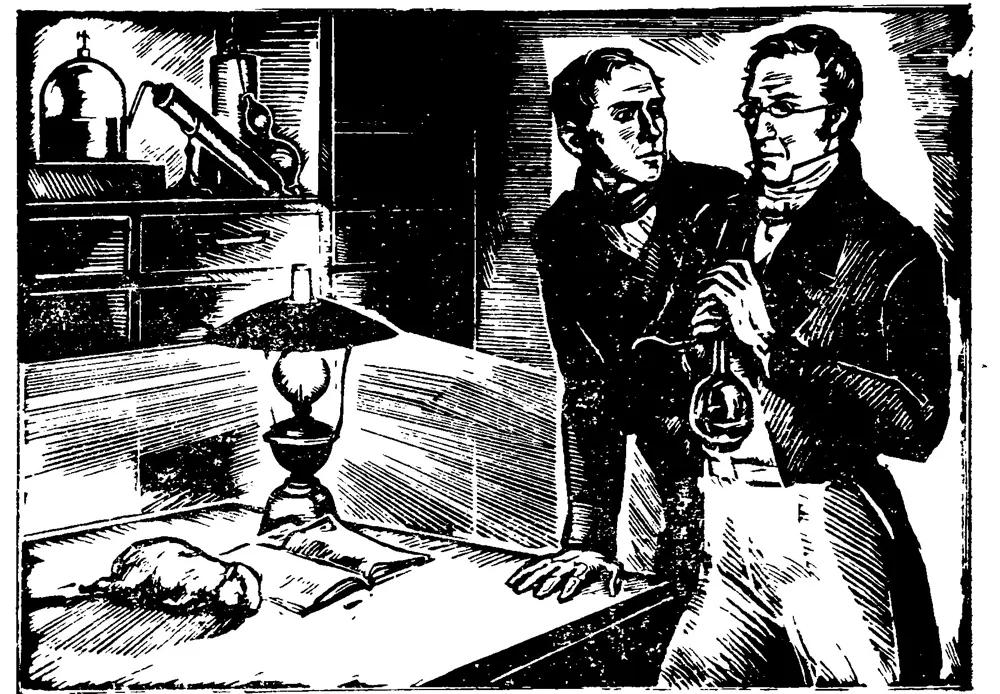
Another very valuable proposal the scientist made concerned the analysis of the silver alloys used as the basic material for making coins. The existing method of cupellation was very laborious and inaccurate. Gay-Lussac proposed a quick, easy and accurate method. He dissolved the silver alloy in nitric acid and added sodium chloride to the solution until a further drop of its solution no longer produced a white precipitate. Then he measured the volume of the solution and by a simple calculation found the percentage of silver in the alloy. This was a new method of analysis. Very soon it began to be used for analysing acids and bases. Volumetric analysis was created, one of the methods most widely used in modern analytical laboratories. The method of analysing silver alloys still bears the great scientist's name: “Gay-Lussac's method”15.
A few years later Gay-Lussac began to study the solubility of salts. He found that temperature has the strongest influence on the solubility of salts. He expressed this dependence graphically, obtaining curved lines that we now call “solubility curves”. In studying sodium sulphate Gay-Lussac found a peculiarity: two curves were obtained, one lying above the other. At that time the existence of anhydrous salts and crystal hydrates was not yet known, so the phenomenon remained inexplicable to Gay-Lussac.
Gay-Lussac's fruitful work in every field of chemistry and physics, his outstanding abilities and his talent as an experimenter won him the recognition of the scientists of Europe. In 1826 he was elected an honorary member of the Academy of Sciences in St Petersburged.1,16.
At about this time several manufacturers of sulphuric acid turned to Gay-Lussac with a request. To oxidise sulphur dioxide to sulphuric anhydride, nitrogen dioxide was added to the gas mixture containing sulphur dioxide and air. The reaction took place in large chambers, and gave sulphuric anhydride and nitric oxide. After the sulphuric anhydride had been absorbed in water, the remaining gases were released into the atmosphere through a tall chimney. But when these gases mixed with air, the nitric oxide was instantly converted into the dioxide. Huge clouds of brown gas poured out of the factory chimneys, poisoning not only every living thing around but also the people who worked at the factory. All the vegetation near the sulphuric acid works died. Like sinister volcanoes in a dead desert, they stood for ever in clouds of poisonous smoke. A solution to the problem had to be found urgently.
Gay-Lussac carried out his investigations for several years. He found that the oxides of nitrogen dissolve in sulphuric acid, and called this solution “nitrosa”. The nitrosa proved to be the salvation.
“Instead of letting the gases out of the chimney,” Gay-Lussac explained to the industrialists, “you should recover them. To do so, build a tower 10–15 metres high with an acid-proof lining, and let the gases into the bottom of the tower, while sprinkling them with sulphuric acid from the top. When the oxides of nitrogen meet the acid and combine with it, nitrosa will flow down. Only cleaned air will go out into the atmosphere.”
“But that will cost a great deal. And what are we to do with the nitrosa?”
The manufacturers argued about the problem for a long time. The argument was carried on by scientists... for thirteen years. Only in 1840 did Gay-Lussac's idea find practical application: a new tower appeared at sulphuric acid works. To this day it is called the “Gay-Lussac tower”17.
Gay-Lussac was not only an outstanding scientist; his public work is known too. In 1830 he was elected a member of the Chamber of Deputies. He carried out this honourable duty with credit for nine years. At about the same time Gay-Lussac was appointed professor of chemistry at the Paris Botanical Garden, an institution of higher learning where the natural sciences were studied.
Lectures at the university, sessions of the Chamber of Deputies and the direction of the “Annales de chimie et de physique”, the journal he edited together with the physicist Dominique François Arago, left him almost no time for research18. Besides, work in damp laboratories could not pass without leaving its mark. And although Gay-Lussac always wore thick woollen socks and boots to protect himself from the damp, he felt pains in his legs and arms more and more often. Gradually his joints began to swell. Gay-Lussac tried to pay no attention to it and went on working. Never once did he let it be seen that he was ill; never once did he complain. He fought the illness and tried to overcome it. But at the beginning of 1850 Gay-Lussac's health grew worse. He died on 9 May 1850.
...Having begun his research at a time when chemistry was strongly influenced by the dogmas of alchemy, when many elements were regarded as compounds and compounds as elements, Gay-Lussac helped to find the right answer to a number of fundamental questions of chemistry19. Thanks to his research chemistry was freed of the wrong view of metals: it turned out that when metals react with an acid, the hydrogen comes from the acid and not from the metal. Gay-Lussac proved that chlorine is an element. His investigations of hydrocyanic acid, until then called Prussic acid, showed that it contains carbon and nitrogen and not some new element. From the reactions this acid enters into, scientists became convinced that radicals exist: groups of atoms that pass unchanged from one compound to another in chemical reactions. These investigations of Gay-Lussac laid the foundation of the theory of radicals, which gave impetus to the further development of organic chemistry.
Gay-Lussac created many new methods of analysis20, improved technological processes and established important regularities for gases.
His gift as a lecturer and his vast knowledge drew listeners from every corner of Europe21.
France was at that time the greatest centre of science, and no small credit for this goes to the great Gay-Lussac. Many young scientists worked and studied under him and worthily carried on his work.
Notes
- 1. The École Polytechnique in Paris was opened by a decree of the Convention on 30 November 1794 under the name of the Central School of Public Works. Its task was to train civil and military engineers. On 1 September 1795 it was renamed the École Polytechnique, with a three-year course; students were admitted by competition and received a grant. It was headed by G. Monge; Berthollet taught the course of organic chemistry, Guyton de Morveau that of mineral chemistry, Chaptal the chemistry of plants, and Vauquelin and Fourcroy general chemistry. The École Polytechnique produced outstanding mathematicians, physical chemists and engineers: Ampère, Arago, Biot, Gay-Lussac, Cauchy, Malus, Poinsot, Poisson and others (Старосельская-Никитина О. А., ук. соч., с. 166—168).
- 2. Louis Nicolas Vauquelin (1763—1829), a well-known French chemist, the collaborator and successor of A. Fourcroy, and professor at several of the higher schools of Paris. In 1797 he discovered chromium in red Siberian ore, and in 1798 beryllium in beryl, and described their compounds; he studied the salts of thiosulphuric acid (1799) and carbon disulphide, investigated the platinum metals in 1813—1814 and discovered cyanic acid in 1818; he isolated many organic substances from natural products, asparagine for example (1805); he founded a fruitful school of chemists; after 1791 he was one of the editors of the “Annales de chimie”. On Vauquelin see: Джуа М., ук. соч., с. 149—150; Partington J. R., ук. соч., т. 3, с. 551—557; Капустинская К. А., Макареня А. А. Металл из «камня надежды»: Из истории химии бериллия. — М.: Атомиздат, 1975; Становление химии как науки, ук. соч., с. 140 и сл.
- 3. Mathurin Jacques Brisson (1723—1806), professor of physics at the Collège de Navarre, the Central School and the Lycée Bonaparte in Paris; he compiled tables of specific gravity. Brisson also took part in the publication of two chemical works, in the experiments on burning diamonds (with Macquer, Cadet, Baumé and Lavoisier) and in the work on the reduction of mercury oxide (with Lavoisier). On Brisson see: Partington J. R., ук. соч., т. 3, с. 99.
- 4. Gay-Lussac's first law, by which the change in volume of a given mass of gas at constant pressure is directly proportional to the change in temperature, was discovered in 1802.
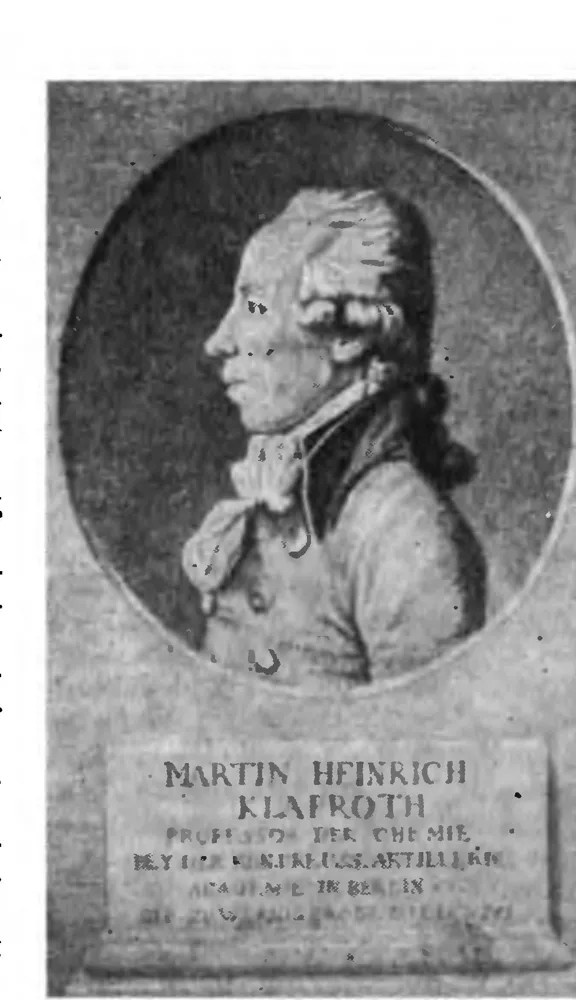
- 4а. Martin Heinrich Klaproth, a German chemist (late eighteenth century), who confirmed Gay-Lussac's conclusions on the chemical composition of certain minerals.
- 5. A few weeks before the first flight of Gay-Lussac and Biot, on 30 June 1804, the Russian academician and chemist Yakov Dmitriyevich Zakharov (1765—1836) made the first flight in the history of science undertaken for a scientific purpose. Zakharov was aloft in a balloon for 3 hours 45 minutes and carried out the whole programme of scientific research drawn up and approved by the St Petersburg Academy of Sciences. The scientific, and partly the organisational, preparation of the flight was done by Academician T. E. Lowitz, who could not take part in the flight because of his health. The programme of the flight of Gay-Lussac and Biot provided for a repetition of Zakharov's experiments (Ловиц Т. Е. Избранные труды по химии и химической технологии. — М.: Изд-во АН СССР, 1955, с. 417; Раскин Н. М. Рукописные материалы химиков второй половины XVIII в. в архиве Академии наук СССР. — М.—Л.: Изд-во АН СССР, 1957, с. 46—48; История Академии наук СССР. Т. 2 (1803—1917). — М.—Л.: Наука, 1964, с. 64; Раскин Н. М. Яков Дмитриевич Захаров: Физик и химик конца XVIII и начала XIX вв. — М.: Наука, 1979).
- 6. Alessandro Volta (1745—1827), an outstanding Italian physicist and physiologist, professor at the University of Pavia, one of the founders of the science of electric current; he made the first galvanic cell and the first battery of galvanic cells. On Volta see: Льоцци М., ук. соч., с. 194—198; Кудрявцев П. С. Курс истории физики. — 2-е изд., испр., доп. — М.: Просвещение, 1982, с. 175—178; Голин Г. М., ук. соч., с. 39—43; Храмов Ю. А., ук. соч., с. 67; Выдающиеся физики мира, ук. соч., с. 133—139.
- 7. On 31 December 1808 Gay-Lussac reported his discovery of the “law of multiple volumes”, by which “gaseous substances always interact in the simplest ratios, so that one volume of a gas always combines with an equal, or a double, or at most a triple volume of another gas”. The paper “On the Combination of Gaseous Substances” was published in 1809. Gay-Lussac's second law was an important argument in favour of Dalton's atomic theory and served as the starting point of Avogadro's research in working out his atomic and molecular theory. On the history of the discovery of Gay-Lussac's second law see: Partington J. R., ук. соч., т. 4, с. 79—85; Bugge G., ук. соч., с. 386—404; Становление химии как науки, ук. соч., с. 164 и сл.
- 8. Amedeo Avogadro (1776—1856), an Italian professor of physics at Vercelli (from 1809) and at the University of Turin (from 1820), a lawyer by training. In 1811 he discovered one of the fundamental gas laws, which bears his name. On the life and work of Avogadro see: Быков Г. В. Амедео Авогадро: Очерки жизни и деятельности. — М.: Наука, 1970; Соловьев Ю. И. История химии, ук. соч., с. 146—150; Мусабеков Ю. С., Черняк А. Я., ук. соч., с. 86—90; Крицман В. А. Замечательные ученые, ук. соч., с. 82—91; Становление химии как науки, ук. соч., с. 286 и сл.; Волков В. А. и др., ук. соч., с. 9—10.
- 9. André Marie Ampère (1775—1836), a French physicist and mathematician; in 1820 he established one of the fundamental laws of electrodynamics; he put forward the first hypothesis to explain the magnetic properties of matter. On Ampère see: Забаринский П. П. Ампер. — М.: Журн.-газетн. объединен., 1938. — (ЖЗЛ); Белькинд Л. Д. Андре-Мари Ампер, 1775—1836. — М.: Наука, 1968; Голин Г. М., ук. соч., с. 44—47; Храмов Ю. А., ук. соч., с. 14—15; Замечательные ученые, ук. соч., с. 66—81.
- 9а. Boron was isolated in 1808 by Gay-Lussac and Thénard by heating boric anhydride with metallic potassium in a copper tube. On boron see: Казаков Б. И. Блистательный путешественник. — М.: Металлургия, 1981; Фигуровский Н. А., Открытие элементов и происхождение их названий, ук. соч., с. 58; Трифонов Д. Н., Трифонов В. Д., ук. соч., с. 81—82.
- 10. Bernard Courtois (1777—1838), a French chemist, saltpetre and soap maker, and assistant to Guyton de Morveau in Dijon. Courtois studied in Paris under Fourcroy and Thénard, and from 1804 made saltpetre, sodium nitrate and soda from seaweed ash at his own works. Although in 1831, at Thénard's request, the Paris Academy of Sciences awarded Courtois a prize of 6,000 francs for the discovery of iodine (1811), he died in poverty. On Courtois see: Становление химии как науки, ук. соч., с. 191—192; Волков В. А. и др., ук. соч., с. 276.
- 11. Nicolas Clément (1779—1841), a French chemist, assistant to Guyton de Morveau at the École Polytechnique and professor at the Conservatoire des Arts et Métiers; he made a large contribution to the study of iodine, samples of which he gave to H. Davy. On Clément see: Джуа М., ук. соч., с. 221; Partington J. R., ук. соч., т. 4, с. 86—88; Волков В. А. и др., ук. соч., с. 241.
- 12. Charles Bernard Desormes (1777—1862), a French chemist, assistant to Guyton de Morveau and colleague of Clément, who later took the name Clément-Desormes. On Desormes see: Partington J. R., ук. соч., т. 4, с. 86—88; Волков В. А. и др., ук. соч., с. 167—168.
- 13. Théophile Jules Pelouze (1807—1867), a prominent French chemist, foreign corresponding member of the St Petersburg Academy of Sciences from 1856. In 1830 he became a professor at Lille, then in Paris worked with Gay-Lussac at the École Polytechnique and with Thénard and Dumas at the Collège de France. In 1848 he became president of the Commission of the Mint, and later a member of the Municipal Council. He obtained formic acid; in J. Liebig's laboratory at Giessen he studied oenanthic, mellitic, meconic and xanthogenic acids and sugar (1836); he established the composition of glycerol, was the first (1838) to obtain nitrocellulose, and determined the atomic masses of several chemical elements. Together with E. Fermi Pelouze wroteed.2 a three-volume “Course of General Chemistry” (1848—1850), the third edition of which came out in 1862—1865 in seven volumes. Since Gay-Lussac's discovery of iodine was made in 1813, he naturally could not have told Pelouze about it: Pelouze was then six years old. On Pelouze see: Partington J. R., ук. соч., т. 4, с. 395; Волков В. А. и др., ук. соч., с. 385.
- 14. The results of Clément, Desormes, Gay-Lussac and Davy were published in December 1813; the researchers concluded that the new substance was very like chlorine. Davy called it iodine, Gay-Lussac “iode”. For a detailed account of the discovery of iodine see: Partington J. R., ук. соч., т. 4, с. 85—90.
- 15. The volumetric methods Gay-Lussac worked out were very important for the development of chemistry. In his book “Instruction on the Assaying of Silver-Bearing Materials by the Wet Way” (1832) he set out chlorimetry (1824), alkalimetry and acidimetry (1828), and described volumetric methods of determining chlorine and silver (1832) by precipitation [Баталин А. Х. Аналитическая химия и пути ее развития. — Труды Оренбургского сельскохозяйственного ин-та, вып. 12, 184 (1961); Джуа М., ук. соч., с. 180; Становление химии как науки, ук. соч., с. 286 и сл.].
- 16. Gay-Lussac was elected a foreign honorary member of the St Petersburg Academy of Sciences on 9 December 1829 (Академия наук СССР: 250 лет (1724—1974)/Сост. Б. В. Левшин, Б. А. Малькевич, П. Н. Корявов. Кн. 1: Персональный состав (1724—1917). — М.: Наука, 1974, с. 366).
- 17. Gay-Lussac also worked out an industrial method of making oxalic acid from sawdust with the help of alkalis (1829).
- 18. Gay-Lussac directed the journal “Annales de chimie et de physique” from 1816.
- 19. Gay-Lussac contributed greatly to the development of chemistry: by his investigations of the phosphoric acids and the cyanide compounds of iron; by his discovery of boron (1808), phosphorus trichloride, thiosulphuric and dithionic acids (1819), fulminic acid (together with Liebig) and perchloric acid; and by introducing the methods of titration (see: Сабадвари Ф., Робинсон А., ук. соч., с. 144 и сл.).
- 20. Gay-Lussac improved the elementary analysis of organic compounds by using copper oxide as the oxidising agent (1835).
- 21. Gay-Lussac knew Italian, English and German, and sometimes lectured in them.
- * It was later established that the coefficient of volume expansion of gases is 0.00367, not 0.00375 as Gay-Lussac had found.
- ** It is now called dicyanogen.
From the site's editors
- ed.1 According to note 16 and to the handbook “Выдающиеся химики мира”, Gay-Lussac was elected an honorary member of the St Petersburg Academy of Sciences in 1829.
- ed.2 Pelouze's co-author was the French chemist Edmond Frémy (1814–1894).
- ed.3 Gay-Lussac's father was called Antoine Gay.
- ed.4 The name “cyanogen” comes from the Greek κυανός, “blue”: hydrocyanic acid was obtained from Prussian blue.