1791–1867. An English physicist and chemist: he discovered benzene and the laws of electrolysis, was the first to turn chlorine and other gases into liquids, and created the theory of the electromagnetic field.
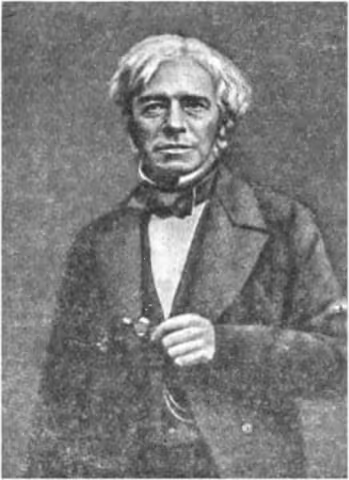
Michael Faraday (22 September 1791 – 25 August 1867) was an English physicist and chemist and a Fellow of the Royal Society of London (from 1824). He was born in London. He was self-taught. From 1813 he worked in H. Davy's laboratory at the Royal Institution in London (its director from 1825), and from 1827 he was a professor at the Royal Institution.
He was one of the founders of quantitative electrochemistry. He worked (1815–1818) on the chemical analysis of limestone; to improve the quality of steel he investigated alloys of iron and studied the effect of various additions on the quality of steel. He was the first to obtain (1823) chlorine in the liquid state, and then hydrogen sulphide, carbon dioxide, ammonia and nitrogen dioxide. He also liquefied arsine, hydrogen iodide, hydrogen bromide and phosphine, and ethylene. He discovered (1825) benzene and studied its physical and some of its chemical properties. He obtained (1826) the α- and β-sulphonic acids of naphthalene and prepared fifteen of their salts. He began (1826) the study of natural rubber. He showed that ethylene could be chlorinated photochemically fifteen years before J. B. A. Dumas discovered the substitution reaction (metalepsy). He was one of the pioneers in the study of catalytic reactions. He tried (1825) to synthesise ammonia from nitrogen and hydrogen by the action of potassium hydroxide in the presence of metals. He regarded adsorption on the surface of solid catalysts as a purely physical phenomenon. He was the first to obtain (1828) ethylsulphuric acid, by the reaction of ethylene with sulphuric acid. He worked to improve the quality of optical glass (1824–1830). He obtained a heavy lead glass, with which he discovered the magnetic rotation of the plane of polarisation. He established (1833–1836) the quantitative laws of electrolysis. His services to physics were immense. He did research in electromagnetism. He created the theory of the electromagnetic field. He introduced the concept of permittivity.
He was a member of many academies of sciences and learned societies, and a foreign member of the St Petersburg Academy of Sciences (from 1831).
From Kaloyan Manolov's “Great Chemists”
The air in the bindery was heavy with the smell of joiner's glue. Settled among piles of books, the workmen chatted cheerfully and stitched the printed sheets with a will. Michael1 was gluing a thick volume of the Encyclopaedia Britannica. He dreamt of reading it all, from cover to cover, of learning everything that mankind had gathered in the long years of its existence. But he could read only in the dinner break, when his workmates went out of the shop for a breath of fresh air. Then he would sit down and open the section on “Electricity”. How much that is unknown this force holds! If man masters it, it will be of great use to him. These thoughts never left Michael.
“Michael, I'm starting on the ‘Conversations on Chemistry’1а. If you're interested in the book, I can put it aside for you,” said one of his workmates.
“Thank you, do. I'll look through it after work.”
Outside the window dusk was gathering. Everyone had already left the shop. Michael sat down by the window and opened the book, whose author, a Mrs Marceted.1, he had never heard of before. Quickly leafing through a few pages, he became absorbed in his reading. How had it never occurred to him that chemistry held no fewer possibilities than electricity? It too still had many riddles unsolved.
Someone tapped lightly on the window, breaking his train of thought. Michael looked up.
“What is it, Mother? What are you doing here?”
Mrs Faraday looked at her son through the glass without a word. “How he is drawn to learning. If only there were the means to let him study. But what can his father's smithy give, when it has four more mouths to feed?”
“You've never stayed so late before, Michael, so I began to worry. It's dark outside already. That's enough reading. You'll ruin your eyes.”
“Do you know, Mother, today I've discovered another wonderful science: chemistry. I'm going to get to the bottom of its secrets. If only you knew how much I want to be an educated man.”
Mrs Faraday could barely hold back her tears:
“God bless you, son. Work hard, but remember that a man needs rest sometimes too.”
Mother and son walked slowly home. The hard work in the bindery and the reading in the breaks did tire Michael, of course, but a sound, healthy sleep restored his strength, and early in the morning he was striding briskly along Teal Street to work again.
In Teal Street every passer-by usually noticed the large signboard: “George Riebau, Bookseller and Bookbinder”.ed.4
George Riebau owned some of the best-known bookshops in London. He had long noticed Michael's love of books and his eagerness for learning, and so always gave him only scientific works to bind. Michael had been working there for seven years now, knew his trade well, and his master was entirely satisfied with him.
One day Michael picked up a pile of thick, richly bound volumes and took them into the bookshop. The owner was talking with a gentleman Michael did not know. Michael greeted them politely and laid the books on the counter.
“I've brought the ‘Philosophical Transactions of the Royal Society’2. A little late, I'm afraid: I wanted to read some of the papers,” Faraday said quietly.
“Never mind. Sooner or later these fine books will take their place in some private library.”
“What shall I do next?”
“Forgive me for being so tactless as to interrupt,” said a tall young man who had been standing silently by a bookshelf, turning to Faraday. “Wasn't it you I saw yesterday evening at the meeting of the Philosophical Society?”
“Very likely. I was indeed there,” Faraday replied.
“What you said was extremely interesting. I would never have thought that you worked in a shop.”
“One has to earn a living, Mr…”
“Dean Dance,” the stranger introduced himself.ed.3
“Michael Faraday,” said Michael, with a polite bow. “I've been a member of the society for a year now.”
“I should be glad to see you at my house. There we could talk at our leisure about some questions that interest us both.”
“Thank you, sir. I shall certainly take up your kind invitation.”
Dance, a young man well educated for those times, took to Faraday at once. They became friends: both were keen on science, and this bound them together; but while for Dance science was simply a pastime, for Faraday it was something lofty and all-powerful, which gave boundless happiness to anyone who penetrated its secrets.
Michael Faraday's seven years as Riebau's apprentice came to an end, and he was made a journeyman. Now he worked in the bindery of de la Roche. By nature Michael was hard-working, kind and modest, but his quarrelsome French master found a reason to scold him every time. De la Roche squeezed the last drop out of his workmen, was bitter and heartless, and this weighed on Michael. He withdrew into himself and grew even more silent. Now he could no longer read in the breaks as before: de la Roche never allowed such liberties.
One day at the end of May 1812 Dance came into the bindery.
“What can I do for you, sir?” de la Roche asked him with a forced smile.
“I should like to speak to Michael Faraday.”
The smile vanished from the Frenchman's face. “That is impossible, it is working hours,” de la Roche replied coldly.
“But I have something extremely important to tell him.”
“Important? To whom? To my journeyman? I beg you, sir, do not disturb the order of my shop!”
Michael, hearing them talk, went over to Dance.
“Let's go outside, Dean.”
“Faraday, you will regret this! Outrageous! Without my permission!”
The friends left the shop.
“Michael, he'll sack you! Why did you do it?”
“I'd made up my mind to leave him anyway. I can't stand that brute any longer, and I don't care for the work here either. I'll look for something else.”
“Do you know why I came?”
“No, I can't guess.”
“In an hour Davy's lecture begins. This year he's giving his last four lectures in the great lecture theatre of the Royal Institution3. Would you like to hear him?”
And there they were in the lecture theatre. Faraday listened closely and took notes of the famous Davy's lecture. For two weeks Michael lived for one thing alone: to get to his lectures. At home he carefully wrote out everything he had heard and made many drawings to illustrate the text. It seemed to him that he too could become a scientist. What if he wrote to the President of the Royal Society, Sir Joseph Banks, enclosed his notes and drawings, and asked to be taken on as an assistant in some laboratory? Michael thought the letter over carefully and took it to the post. But no answer came. At twenty-one, however, a young man is seldom downcast for long and easily finds the strength to get over his setbacks.
Michael decided to write to Davy. This time he was lucky: he held tight in his hands a short note that was for him the most precious gift in the world.
“Call at the laboratory in Kenningstown Streeted.5 on Wednesday. 14.8.1812. Yours respectfully, Davy.”
On the appointed day Michael walked into the professor's laboratory.
“So it was you who sent the letter, young man?” said Davy, making his acquaintance. “What are you doing at present?”
“I'm a bookbinder. Hundreds of books pass through my hands. I read many of them.”
“What interests you most?”
“Chemistry and physics. I want to become a chemist. My dream is to devote my life to science.”
“Look here, my dear Faraday, science demands not only devotion but knowledge. You are no longer young, and you have hardly any grounding. It is too late to start now. You would do better to go back to the bindery and go on reading interesting books. Your plans strike me as naive.”
Crushed by Davy's words, Faraday made for the door, but suddenly stopped and said with conviction:
“I beg your pardon for the trouble I have caused you. And yet I ask you, take me on in the laboratory, if only as a labourer. I will be the most devoted of servants.”
A few days later Michael again received a note from Davy. He could not sleep a wink all night. What would tomorrow bring? Now a new life was beginning for him. Faraday was taken on as an assistant in Davy's laboratory. Twenty-five shillings a week and the two rooms given to him were more than enough reward for Faraday, who loved science and asked little. Michael's duties were not only to clean the rooms. He did, of course, wash the glassware and carry the chemicals, but sometimes he helped Davy with his experiments. After an explosion in the laboratory had seriously damaged the scientist's eyesight, Davy constantly needed an assistant to follow the course of the work, record the readings of the instruments and write down the data. Faraday did everything without fail and with astonishing precision. He worked in the laboratory from early morning till late at night. When he had put everything in perfect order, he would open his books and study doggedly. There was a great deal to learn to become a real assistant to the great Davy.
A year went by. Davy was pleased with Faraday: he had never met such devotion to the work.
“Michael, in two weeks my wife and I are leaving on a long journey through Europe. I have ordered a small travelling laboratory to be made ready. Everything needed will fit into two chests. Wherever we are, I shall be able to work, but I need an assistant. Would you agree to come with us?”
“You know what science means to me, Mr Davy. I shall be infinitely happy if you do me this honour.”
“Besides you, servants are to come too. One of them will look after the luggage, the other will act as our valet.”
In the autumn of 1813 Davy's carriage left London. The servants, who knew the whims of the spoilt Lady Davy, did not go with them and were paid off. Now all their duties fell on the shoulders of a single servant: Michael Faraday. He loaded and unloaded the luggage, brushed the clothes, ran round the Paris shops to make purchases for Mrs Davy, served dinner, and only after the evening coffee disappeared into the laboratory. There his books were waiting. Michael complained of nothing; he was happy that he could work in a laboratory and learn from his master, the master of experiment, Professor Davy.
From Paris they went on to Montpellier, then to Florence, to Rome and, at last, to Naples.
Lady Jane Davy quickly tired of everything; she had no wish to see the beauties of the city and chose to rest alone at the hotel. Davy and Faraday set off together for Vesuvius.
“Here is another great riddle before which we are powerless at present.”
“Yes, we are truly helpless before these great forces of nature.”
“Michael, have you brought the sack? We are sure to find interesting minerals on the slopes of the volcano. Let us climb up to the crater. It may well be that one of these minerals contains new elements, not yet discovered.”
To Davy's enormous luggage was now added a sack of minerals. And the trunks, already too heavy to lift, held Tuscan earth that Michael had collected on a trip round the country near Florence. But what are the troubles of carrying luggage when you have the great honour of being in the company of the most learned men!
Michael would always remember the hours spent in the palace of the Duke of Tuscany. For all his eloquence, Davy could not convince the duke that diamond consists of pure carbon. The duke took a diamond ring from his finger and held it out to Davy.
“You maintain that this beautiful diamond consists of carbon. Burn it! Then I shall believe you.”
“What madness! Your diamond is a fortune.”
“Do not trouble yourself. The Duke of Tuscany has jewels enough.”
“Faraday,” said Davy, turning to Michael, who stood modestly behind his chair, “bring the large burning glass. Get the apparatus ready for the burning. Let us try to convince the duke.”
Soon everything was ready. Michael assembled the apparatus, quickly and precisely as always. He placed the diamond in a small chamber heated by a strong flame and directed onto the sparkling gem a powerful beam of sunlight gathered by a lens. After a while the ring melted, but the diamond itself remained as it was. The duke watched with self-satisfaction. But not for long. When the temperature became high enough, the diamond began to shrink before their eyes and in the end vanished altogether. The duke was astounded:
“Amazing! My diamond has evaporated!” he said.
“Not evaporated: it has burnt,” Davy corrected him…
And how could he forget the meeting with the great Volta? For Faraday, Milan meant not the opera. For him it was the city where Volta lived and worked. Faraday remembered almost word for word the conversation between the two greatest authorities on electricity, Davy and Volta. To reproduce lightning in one's own laboratory, who had ever heard of such a thing! That is what a scientist Volta was.
The journey through Europe lasted a whole year and a half, but Michael hardly noticed it. On their return to London he was taken back on the staff of the Royal Institution, but now as an assistant in charge of the apparatus.
Together with Davy he began a detailed study of the combustion of gases. They had to find out the cause of the explosions in coal mines.
“I am told that the new set of glass tubes we ordered from Blacksmith's works will be delivered today,” said Davy.
“Will we have enough tubes of small diameter?” asked Michael.
“I hope so. Put the tubes of medium diameter into the apparatus, and we will change them one by one.”
“Very well. Everything will be ready tomorrow.”
“Faraday, would you not like to carry out some research of your own?”
“It is my dearest wish,” said Michael, in a voice choked with emotion.
“Try analysing the Tuscan earth. You must get used to working on your own.”
Now time no longer existed for Michael. He knew only that there was the laboratory and real work. A few months later Faraday wrote his first scientific paper. “Sir Humphry Davy suggested that I make this analysis as my first trial in chemistry. At that time my fear was greater than my confidence, and my confidence smaller than my knowledge. I have never been taught how original scientific papers should be written, but an exact description of the work will help in understanding its substance,” wrote Faraday, submitting his work to the judgement of his readers.
Davy helped Faraday to publish the paper in the chemical journal of the Royal Institution. That was in 1816. The next year Faraday published six more scientific papers. Now the young scientist felt more sure of himself. He set his own problems and found ways of solving them, though he often lacked the knowledge. Thus Faraday made a detailed study of the passage of gases through capillary tubes and found that the lighter the gas, the faster it passes through the capillary. This paved the way for the discovery of the law of gaseous diffusion, but Faraday, unfortunately, knew no mathematics and so did not see the regularities that stood out so plainly from his results. That was done later by Thomas Graham.
In the summer of 1819 a stranger walked into the laboratory where Faraday worked. His hair was touched with silver, though he carried himself very briskly. Faraday looked at the visitor enquiringly.
“My name is James Stodart, and I own a works making cutting tools. And you, if I am not mistaken, are Michael Faraday?”
“Yes. What can I do for you?”
“I have been talking with Mr Wollaston4, a Fellow of the Royal Society, and he recommended you to me. The matter is this. Our knives, saws, blades and other wares are made of very strong, sharp steel, but they have a great drawback: they rust. I need the help of an expert who will find an alloy that does not rust.”
“I understand: you need a stainless steel.”
“Would you not like to take up this problem? You will have my full support. Besides, I have business connections with Mr Green and the Pixley company of Sheffield. At their ironworks you will find everything you need for your research.”
“A fascinating task, but a responsible one too. To be frank, I would hardly dare accept your offer.”
“Put your doubts aside, sir. Only tell me whether you would like to take up this work. I will see to everything else.”
“I agree.”
“Then let us waste no time. I have already made some enquiries and can give you some information. Crucible steel has been brought to us from India which rusts, but very slowly. The British Museum keeps several meteorites; they consist of iron but, imagine, they do not rust. I think they should be analysed first. Evidently they contain elements that give them the ability not to rust. Perhaps it would make sense to begin with an analysis?”
“Let us try. Will you bring the samples?”
“I have them with me. Here are two fragments of the meteorite that fell in Kent five years ago. And here are filings of the Indian steel.”
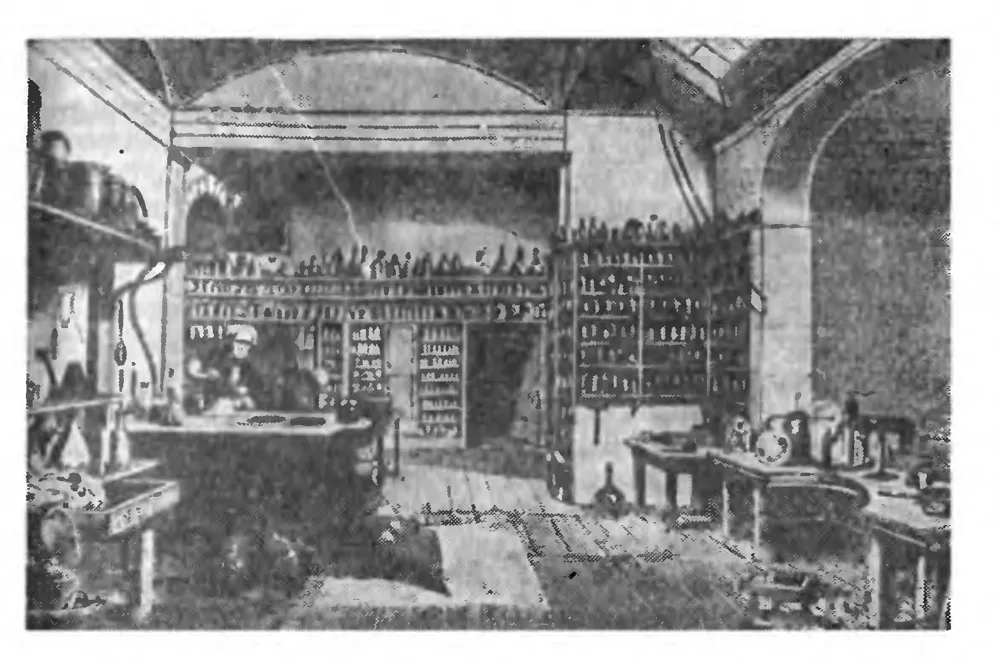
Michael set to work at once. He took a piece of the meteorite to the workshop to have it turned into fine filings. Faraday put some of the filings in a beaker, poured sulphuric acid over them and began to heat it. The filings gradually dissolved, and a pale green solution formed in the beaker. The analysis could begin. In his laboratory notebook Michael wrote down: the analysis of the meteorite showed the presence of iron and nickel.
A few days later he was again talking with the manufacturer Stodart.
“Now I need iron ore, nickel ore and a great many other things. Take the list; I have put everything down in it.”
“Where will the furnace be set up?”
“There is room enough in the basement of the Royal Institution. We have already started work. We shall build a small furnace so that we can make all kinds of alloys of iron. Besides the alloy with nickel, we shall study alloys with platinum, palladium, rhodium, silver, gold, chromium, tin, titanium, osmium and iridium.”
“I hope we shall be able to get the platinum metals from Mr Wollaston. He prepares them in fairly large quantities.”
When the experiments with chromium and nickel steel had succeeded, Faraday and Stodart went to Sheffield, where they set up the production of such alloys on a large scale. For this purpose Green let them have one of his small furnaces. Unfortunately no one but Stodart took any interest in this work of Faraday's. And when Stodart died suddenly in 1823, Faraday gathered up hundreds of samples of steel and locked them in a large chest that stood in the basement of the Institution. He never went back to this research, for he had become absorbed in other problems no less interesting.
Alongside his study of steel Faraday carried out research of another kind. Thus he found that the action of chlorine or iodine vapour on Dutch liquid* gives a crystalline substance**. By the action of chlorine on various organic substances Faraday obtained several more compounds of this kind. He analysed them and established their composition. One of them we call today tetrachloroethylene. At that time organic chemistry did not yet exist as a science; Faraday called the compounds he had obtained chlorides of carbon5.
The year 1821 was a memorable one in the scientist's life. In recognition of Faraday's ability and work, the Fellows of the Royal Society elected him chief superintendent of the laboratories of the Institution.ed.6 In the same year he married the daughter of a London jeweller, Sarah Barnard.
The newly-weds settled in a home of their own: at that time it took up several rooms in an annexe of the Royal Institution. They lived very modestly. His wife knew how to make for Faraday an atmosphere in which he could work in peace. He went on working closely with Davy. Now they were taken up with the problem of liquefying gases. By greatly increasing the pressure Faraday succeeded in obtaining liquid chlorine, a yellowish-green liquid. The work was hampered by the fact that in many cases the pressure turned out to be too low to liquefy the gases: the pumps, after all, were far from perfect.
“To create a high enough pressure we must evidently go about it some other way,” Davy said thoughtfully.
“In my opinion a pump is the best means for the purpose,” Faraday replied.
“No, I have another idea. I think that if we choose substances that give off a gas when they are mixed, and seal the vessel quickly, the gas formed will create a very high pressure.”
“But for that we need strong metal vessels, and then we shall not be able to watch what is happening.”
“Let us try experiments with thick-walled glass tubes. If we seal a tube at both ends and bend it in the shape of a bow, we shall have a very convenient vessel to work with. In one limb we will put the chemicals that produce the gas, and the other limb we will plunge into a freezing mixture to collect the liquefied gas there.”
“The experiment is extremely dangerous, but the idea is ingenious and worth putting to the test.”
Faraday prepared a glass tube. One end was sealed, and when the tube had cooled the scientists put common salt and sulphuric acid into it. Heavy, choking fumes began to come out of the tube, but the experimenters at once sealed its other end. Davy put the empty limb of the tube in an ice bath and began gently to heat the other, which held the mixture of salt and acid. Soon a colourless, transparent liquid appeared in the cooled limb of the tube: liquefied hydrogen chloride. This success heartened Davy and Faraday, and they set to work hard on liquefying gases. Very often, however, the bent glass tubes, even of very thick glass, could not withstand the high pressure and exploded. In spite of the great danger Faraday succeeded in liquefying sulphur dioxide, hydrogen sulphide, carbon dioxide, ammonia, nitrogen oxide and some other gases as well. The scientists tried to obtain liquid oxygen, nitrogen and silicon tetrafluoride, but all their attempts were so far unsuccessful. The tubes exploded with terrible force; the bold experimenters risked their lives. Faraday and Davy carried out these experiments at a time when very little was known about the properties of gases. It was not yet known that every gas has a critical temperature above which it cannot be liquefied under any conditions. The gases that Faraday failed to liquefy had critical temperatures far below 0 °C. He could not reach such temperatures by ordinary cooling of the vessels, and as a result all his efforts were in vain.
The research on liquefying gases was interrupted by unexpected news brought by Davy. He came into the laboratory and, holding out to Faraday a newly published number of a scientific journal, said, breathless with excitement:
“Read this paper! It has some very interesting information. The Danish physicist Oersted has discovered that a magnetic needle is deflected when it is near a conductor carrying an electric current.”
“That confirms my idea,” Faraday exclaimed excitedly. “I have always thought that electricity and magnetism are of one and the same nature. But how does the author explain the deflection?”
“There is no explanation yet; only the fact itself is reported.”
“To check it we can repeat the experiments described. Perhaps we shall manage to get to the heart of the phenomenon.”
The scientists began their experiments, but Faraday soon had to carry on the work alone, as Davy had taken up other research. At the end of 1821 Faraday finished his experiments. Jubilant, he left the laboratory and went home, to his haven of peace.
“Sarah, today I have two things to celebrate. First, I have found the final statement of a new law: a magnetic needle is deflected exactly at right angles to the direction of the electric current. And second, I have built an apparatus in which a magnet can rotate continuously round a fixed conductor.”
“Michael, I understand little of these things, but I am truly glad if it means so much to you.”
Faraday established the principle of the electric motor, but he did not manage to carry the idea through to the end6.
The Faradays saw in the new year of 1822 in peace and happiness. That year and the years that followed were exceptionally fruitful for the scientist.
The Fellows of the Royal Society understood that the young superintendent of the Institution's laboratories, Michael Faraday, had grown into a scientist through his perseverance and his thirst for knowledge. On the proposal of Wollaston and Herschel7, and with the approval of the majority, Faraday was elected a Fellow of the Royal Society of London. That was in 1824. A year later the Society organised a course of lectures that Faraday gave every Friday.ed.7 He soon won a reputation as an excellent lecturer. He knew how to explain the most difficult and tangled questions clearly and simply. His lectures were attended not only by students but by many people with an interest in science. In 1827 he was elected professor.ed.8
At this time Faraday began to work closely with Herschel. The young Herschel was studying light. For his research he needed a great variety of optical instruments. To make them, special optical glass was required. Herschel turned to Faraday for help.
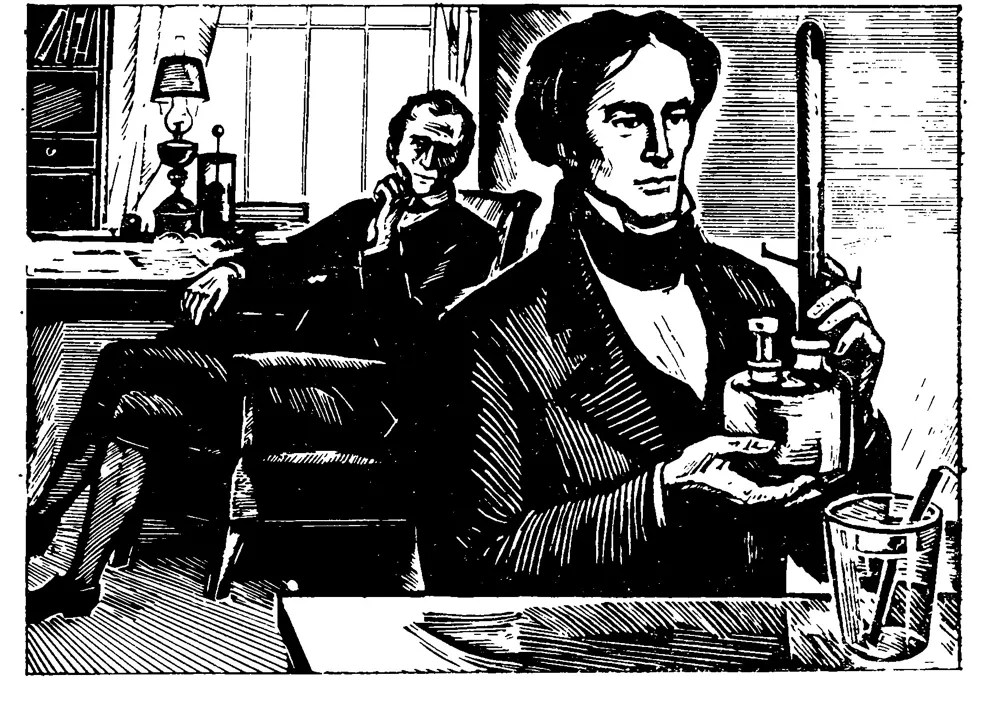
“George Dollond8 has met all my wishes and built some very elaborate instruments, but the quality of the glass in the lenses does not satisfy me. I need glass with better refracting properties. May I venture, Mr Faraday, to ask for your help?”
“In what way?”
“Try to create a glass with good refracting properties.”
“Very well, I will try to help you. The furnace in the basement of the Institution where steel was once made is still there. We will carry out the first experiments in it. To begin with we shall need only a few special crucibles.”
For almost five years Faraday made and studied all kinds of glass. He obtained a heavy borosilicate glass with very good optical properties9. Other kinds of glass were obtained as well. Little by little, however, Faraday lost interest in this work. Electricity still fascinated him. But his apparatus for research had long been gathering dust: after Davy's death no one had worked on these questions. In the summer of 1831 Faraday left all his other research and gave himself wholly to this problem. In a short time he discovered the principle of the transformer and the dynamo, and the phenomenon of electromagnetic induction. He found particularly interesting the questions connected with the passage of an electric current through various substances. Faraday established that aqueous solutions of some substances conduct an electric current. The two ends of the conductor that he dipped into the solution of the electrolyte he called electrodes10. At this time he often met and talked with Reverend Whewelled.2,11, who worked on the history of science.
“When I turn the disc of the electrical machine, the electricity it produces flows through the electrodes into the solution. It causes the dissolved substance to break down into two kinds of particles: cations (carrying a positive charge) and anions (carrying a negative charge). Then the cations go to the cathode and the anions to the anode. There they lose their charges and turn into neutral substances. That is the scheme of the process of electrolysis,” Faraday explained.
“Will this process be of practical importance?”
“Of course. Even before the nature of the phenomenon was understood, Davy used it to obtain potassium, sodium, calcium and a number of other metals.”
“Curious.”
“I can show you something really curious. Look. This piece of paper is soaked in a solution of potassium iodide. I connect both conductors to it and begin to turn the disc of the electrical machine. You see, a brown spot has formed near one electrode. That is the anode. Notice how the spot is gradually growing.”
“Yes, and the longer you turn the disc, the larger the brown spot becomes.”
“Free iodine is being given off. But something else is more important. You can see for yourself the fundamental law: the amount of substance liberated at the electrodes is directly proportional to the quantity of electricity that has passed through the solution.”
Whewell's eye fell on a flask filled with some solution. Two test tubes filled with solution were dipped into it.
“And what is this?”
“This is a volta-electrometer. The law of electrolysis that I have just shown you can be used to measure the quantity of electricity. If a current is passed through this solution, hydrogen and oxygen collect in the test tubes. The more of these gases collect, the greater the quantity of electricity that has passed through the solution.”
“A most ingenious device.”
“With this instrument I tested what the result would be if the same quantity of electricity were passed through different solutions. And do you know what I found?”
Whewell waited with interest for the answer.
“The amounts of substances liberated by the same quantity of electricity are to each other as their chemical equivalents.”
These were two great laws: the first and second laws of electrolysis.
“You know, Whewell, I think I am beginning to grow old.”
“You are still full of energy, Faraday. What are you talking about?”
“My legs have begun to ache badly. I have rheumatism, you see.”
“Then why not take a rest? Go somewhere in the south and get some treatment.”
“I have already decided to go to Switzerland with my wife.”
Two years in Switzerlanded.9 eased Faraday's suffering only a little. From 1835 he gave fewer lectures. Later he had to limit the time he gave to research as well. Yet the scientist could not live without his laboratory. His mind was constantly on electricity, that mysterious, unexplored force which arises when a conductor moves in a magnetic field, which decomposes substances and turns a piece of metal into a magnet.
“The space around a conductor acquires special properties. An electromagnetic field is created there, and the intensity of this field can be described by means of electromagnetic lines of force…” wrote Faraday.
For the first time the scientist began to speak of electromagnetic lines of force and the electromagnetic field12. To explain the substance of his discoveries, however, mathematical treatment was needed, and that was beyond Faraday. Only later did his ideas receive their brilliant development in James Clerk Maxwell's13 mathematical theory of the electromagnetic field.
Only in his old age did Faraday receive from Queen Victoria the gift of a large and comfortable house. Here he spent the last years of his life. Scientists and industrialists often came to him for advice. But his illness did not allow him to do scientific work systematically.
Faraday died on 25 August 1867 at his desk at Hampton Court, near London, and was buried in Highgate Cemetery in London.
Notes
- 1. M. Faraday was born at Newington Butts (now in Greater London) on 22 September 1791.
- 1а. The popular book “Conversations on Chemistry” by the wife of the London physician Marcet played a great part in Faraday's life. It awoke in him an interest in experimental science (Кудрявцев П. С. Фарадей. — М.: Просвещение, 1969, с. 8).
- 2. The first volume of the “Philosophical Transactions of the Royal Society” came out on 6 March 1665. After that, numbers of the journal appeared monthly. On the death of the Society's secretary, H. Oldenburg, publication stopped for five years, but it resumed in 1683 and continues to this day. The Royal Society of London celebrated the tercentenary of its journal in 1965 (Копелевич Ю. Х. Возникновение научных академий. — Л.: Наука, 1974, с. 69).
- 3. The Royal Institution was founded on 5 March 1799 by B. Thompson (Count Rumford). At first it was meant for the spreading of knowledge and for “teaching the application of science to the common purposes of life”; later it was turned into a scientific institute where research was done and lectures on natural science were given (Мак-Дональд Д., ук. соч., с. 14—18).
- 4. William Hyde Wollaston (1766—1828), an outstanding English chemist, physician and physicist and one of the first defenders of the foundations of atomic theory; he discovered rhodium (1803) and palladium (1805). On Wollaston see: Джуа М., ук. соч., с. 175—177 и сл.; Красовицкая Т. И., Плоткин С. Я. Вопросы истории естествознания и техники, вып. 4 (45), 41 (1973); Становление химии как науки, ук. соч., с. 194 и др.ed.10
- 5. Faraday did wide-ranging research in organic chemistry. Studying the condensed residues of lighting gas (made from coal), in 1825 he obtained two unknown hydrocarbons, studied their physical and chemical properties in detail and reported on them to the Royal Society on 16 June 1825. Liebig later proposed calling one of the substances benzene (Faraday correctly predicted the formula of benzene). The second hydrocarbon was named butylene. Faraday was the first to study the composition of natural rubber (1826) and gave its approximate formula, about 8 atoms of hydrogen to 5 atoms of carbon; he was the first to attempt a chemical synthesis of ammonia from nitrogen and hydrogen (1825); in 1828 he obtained ethylsulphuric acid (Мусабеков Ю. С., Черняк А. Я., ук. соч., с. 118).
- 6. In his paper “On some new electro-magnetical motions, and on the theory of magnetism” Faraday gave an exceptionally clear physical interpretation of the problem of turning electrical energy into mechanical energy. For a Russian translation of this paper see: Ефремов Д. В., Радовский М. И. Электродвигатель в его историческом развитии. — М.—Л.: Изд-во АН СССР, 1936, с. 1—20.
- 7. John Frederick William Herschel (1792—1871), an English astronomer and an honorary foreign member of the St Petersburg Academy of Sciences. Faraday was much influenced by the ideas of Herschel, who saw in the deflection of a magnetic needle by a current a helical symmetry like the rotation of the plane of polarisation of a ray of light as it passes through certain bodies. The experiments Faraday made in 1834, and repeated in 1838, to detect an action of the electric field on light did not, however, give the result he hoped for. On Herschel see: Колчинский И. Г. и др., ук. соч., с. 74; Еремеева А. И. Выдающиеся астрономы мира, ук. соч., с. 174—181.
- 8. George Dollond (1774—1852), one of a hereditary English family of instrument makers.
- 9. In the course of his work on improving the quality of optical glass (1824—1830) Faraday obtained a heavy lead glass that answered the needs of optics well. This glass was used in microscopes and prisms. Twenty years later, using his “heavy glass”, Faraday discovered the rotation of the plane of polarisation of light. The phenomenon Faraday discovered played a large part in the development of stereochemistry.
- 10. Faraday proposed a number of electrochemical terms that have become firmly established in science: electrolysis (from the Greek, decomposition by electricity), electrode (the way of electricity), cathode (the way down), anode (the way up), ion (going), electrolyte (a substance or solution subjected to electrolysis), anion, cation, dielectric (Меншуткин Б. Н., ук. соч., с. 176—177; Химия и жизнь, № 2, 1973; Выдающиеся физики мира, ук. соч., с. 175—183; Радовский М. И. Фарадей. — М.: Мол. гвардия, 1936. — (ЖЗЛ); Bugge G., ук. соч., с. 417—427; Голин Г. М., ук. соч., с. 52—55; История учения о химическом процессе, ук. соч., с. 134 и сл.; Азимов А. Краткая история химии: Развитие идей и представлений в химии. Пер. с англ. — М.: Мир, 1983, с. 65—68.
- 11. The Reverend William Whewell (1794—1866), an English classical scholar and historian of science and a colleague of Faraday's, who took part in the campaign to bring new terminology into electrochemistry; in his “Philosophy of the Inductive Sciences” (1840) he used the word “scientist” for the first time. On Whewell see: Химия и жизнь, № 2, 38 (1973); Мамчур Е. А. Тр. XIII Межд. конгресса по истории науки. Секция I. — М., 1974, с. 322—325.
- 12. Faraday was a materialist physicist who believed that all the forces of nature can be converted into one another, but he opposed atomism. Nevertheless A. G. Stoletov wrote: “Never since the time of Galileo has the world seen so many astonishing and varied discoveries come out of a single head, and it will hardly soon see another Faraday…” On Faraday's philosophical views see: Кудрявцев П. С. Фарадей. — М.: Просвещение, 1968. — (Люди науки).
- 13. James Clerk Maxwell (1831—1879), an outstanding English physicist and a great populariser of science, the first director (from 1871) of the Cavendish Laboratory of the University of Cambridge, the creator of the theory of the electromagnetic field (together with Faraday) and of the electromagnetic theory of light; in 1860 he discovered the law of the distribution of the velocities of gas molecules. On Maxwell see: Мак-Дональд Д., ук. соч., с. 63—115; Биографический словарь, ук. соч., т. 2, с. 9; Выдающиеся физики мира, ук. соч., с. 246—253; Томсон Д. П. Дух науки. — М.: Знание, 1970, с. 27—31; Карцев В. П. Приключения великих уравнений. — М.: Знание, 1971. — (Жизнь замечательных идей); Гернек Ф. Пионеры атомного века: Великие исследователи от Максвелла до Гейзенберга. Пер. с нем. — М.: Прогресс, 1974, с. 37—53; Карцев В. П. Максвелл. — М.: Мол. гвардия, 1974. — (ЖЗЛ); Кудрявцев П. С. Максвелл. — М.: Просвещение, 1976. — (Люди науки).
- * Ethylene chloride.
- ** Hexachloroethane. — Editor's note.
From the site's editors
- ed.1 The author of “Conversations on Chemistry” (1806) was Jane Marcet (1769–1858), the wife of the London physician Alexander Marcet.
- ed.2 Reverend is a form of address to a clergyman, not a name: what is meant is the Reverend William Whewell.
- ed.3 The tickets to Davy's lectures were given to Faraday by William Dance, a member of the Royal Institution.
- ed.4 George Riebau's shop was in Blandford Street.
- ed.5 The Royal Institution is in Albemarle Street.
- ed.6 Faraday was made Superintendent of the House and Laboratory of the Royal Institution in 1821 by the Institution's managers, not by the Royal Society.
- ed.7 Faraday began the Friday Evening Discourses at the Royal Institution in 1826; the Royal Society had nothing to do with them.
- ed.8 Faraday became Fullerian Professor of Chemistry at the Royal Institution in 1833; the handbook “Выдающиеся химики мира” also gives 1827.
- ed.9 Faraday and his wife spent a few months of 1841 in Switzerland.
- ed.10 Wollaston discovered palladium in 1802 and rhodium in 1804.