1778–1829. An English chemist and physicist and one of the founders of electrochemistry: by electrolysis he obtained potassium, sodium, calcium, barium and magnesium, and he invented the miners' safety lamp.
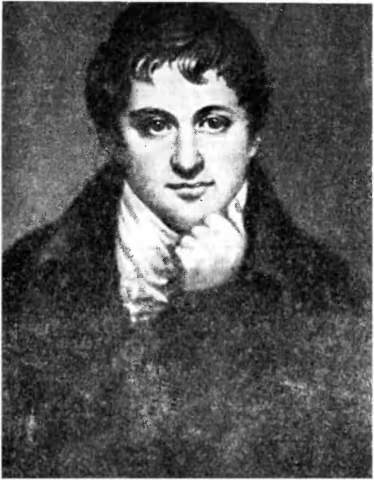
Humphry Davy (17 December 1778 – 29 May 1829) was an English chemist and physicist, a Fellow of the Royal Society of London (from 1803) and its President from 1820 to 1827. He was born in Penzance (Cornwall). From 1795 to 1798 he was apprenticed to an apothecary; from 1798 he ran the laboratory of the Pneumatic Institution near Bristol, and from 1802 he was a professor at the Royal Institution in London. From 1807 to 1812 he was the permanent Secretary of the Royal Society of London.
His chemical work belongs to inorganic chemistry and to electrochemistry, of which he was one of the founders. He discovered (1799) the intoxicating and anaesthetic action of nitrogen(I) oxide (nitrous oxide) and determined its composition. He studied (1800) the electrolysis of water and confirmed that it is decomposed into hydrogen and oxygen. He put forward (1807) an electrochemical theory of chemical affinity, according to which, when a chemical compound forms, the electric charges belonging to the combining simple bodies neutralise, or equalise, one another, and the greater the difference between these charges, the more stable the compound. By the electrolysis of molten salts and alkalis he obtained potassium, sodium (1807), barium, calcium, an amalgam of strontium, and magnesium (1808). Independently of J. L. Gay-Lussac and L. J. Thénard he obtained (1808) elemental boron by heating boric acid. He confirmed (1810) the elementary nature of chlorine. Independently of P. L. Dulong he proposed (1815) the hydrogen theory of acids. He designed (1815) the miners' safety lamp. He discovered (1817–1820) the catalytic action of platinum and palladium and prepared “platinum black” (1817). He obtained (1818) metallic lithium.
He was a foreign honorary member of the St Petersburg Academy of Sciences (from 1826).
From Kaloyan Manolov's “Great Chemists”
The smooth blue sea was already glittering in the first rays of the rising sun. At that early hour two skinny boys were struggling towards a rock that towered in the distance: here the sea came almost right up to the sheer cliff, leaving only a narrow strip of grey sand and shingle. The children slipped, fell, got up again and clambered from stone to stone, but they kept steadily on towards their goal.
“Well, here we are at last,” said Humphry. “Do you see those dark holes?”
“In the rock?”
“Yes. They are caves. I wonder who dug them and why. Perhaps they are forgotten mines?”
“Well, why have you stopped? Let's go in.”
“We must light a candle first. It's dark in a cave.”
“I've brought a rope. If we tie one end to a big stone and pay out the coil bit by bit, it will help us find the way out and we won't get lost.”
They were old abandoned mines where tin had once been dug. Not long before, Humphry had stumbled on them and told Pete about his discovery. The friends had resolved to get inside those gloomy, mysterious caves whatever happened. They wandered for a long time through the half-collapsed galleries, and their childish imagination, of course, painted fantastic pictures.
When the boys came out again, the sun had almost sunk below the horizon.
“Father will be cross,” Pete said miserably. “A whole day wasted: we searched and searched and never found any treasure.”
“Perhaps other people came here before us and took it all away?”
“If only we could catch some fish, at least we'd have some excuse.”
“Let's go to the rock. You've no idea how many fish there are there. I'll catch you some in no time, and then we'll head home.”
Some time later the little treasure hunters, pleased with themselves and carrying a fine catch, were making their way back to the farm...
Dusk had fallen when Humphry pushed open the garden gate and stopped on the path. Light from the windows fell in a pale patch on the flower bed in front of the house. Humphry guessed at once: the light was in the big room, so the family had already had supper. Father was probably busy with his woodcarving. He had learned the craft back in London, since he had to earn his living somehow. Later he inherited the farm and settled there, but he never gave up the work he loved, and whenever he had a free moment he still carved quaint little figures out of soft wood.
Humphry decided to slip in through the back door into the kitchen. Mother would not scold. She would forgive him when she saw how many fish he had caught. As he passed the big room in the corridor, Humphry was surprised to see Mr Smith the schoolmaster sitting in an armchair, talking to his parents about something. The boy listened.
“Your son has exceptional gifts, Mr Davy. At eleven he reads any work of literature as if he were a real actor1.”
“Yes, sir. At five he already read so smoothly and so fast that I could hardly keep up with him: I'm not much of a scholar myself,” his mother put in.
“It isn't only his reading, Mr Davy. He already knows everything he could find in our textbooks. He ought to be sent to school in Penzance. You will find good teachers there. He is a clever boy and is sure to get on in life.”
“That's a tempting idea, sir. We shall take your advice and go to Penzance.”
Humphry had no wish at all to leave the rocky shores of Cornwall, but his father's mind was made up. The attic in John Tonkin's house, where they stayed, seemed very cosy to him. Here he would live quite on his own; from the window he could admire the surf, the sunrise and the sunset, and... write poetry. Nature had always stirred him, and he expressed his feelings in sonorous sonnets.
Now that his father had gone home and Humphry was living alone in Penzance, he felt completely free; no one interfered with his studies. He himself knew what to read and what to do.
But his father's sudden death upset all his plans. Davy now had to give up the chemical experiments that had absorbed him so much of late: the money his mother sent was not even enough for food. His chemical laboratory, which he had set up in a big chest, had been locked for many days.
The widow Davy could not feed five children on the income from the farm alone, so she sold it and moved to Penzance. She opened a milliner's shop in the town, but even this did not relieve her poverty. Besides, she had to think seriously about Humphry's future.
“I should like your advice, Father,” she said to Mr Tonkin one day. He had adopted her when she was left an orphan as a child, and in gratitude Mrs Davy always called him “Father”. “You know how hard things are for me now.”
“Yes, Grace, I'll try to help you in any way I can.”
“I don't know how to thank you for it, but I wanted to talk about something else. Don't you think it's time we found Humphry some occupation?”
“That's true enough, but his teachers think the boy is exceptionally able. We must try to help him go on with his education.”
“I shouldn't like to take him away from his studies either. What would you say if he went to Mr John Borlase's apothecary's shop?”
“A good idea. With Borlase he will learn not only the secrets of chemistry but something of medicine too. Mr Borlase is a very good doctor with a large practice.”
“If Hum wishes, in time he could go to Edinburgh and train as a doctor there. Not at all bad for someone like our Humphry: he does love every living thing so.”
Humphry was overjoyed at his mother's decision. Now he would be doing what he loved. Science drew him like a magnet and made him throw himself wholeheartedly into his work in Borlase's laboratory. His dream of becoming a doctor led him into the library, which held a rich collection of medical books. Among the thick folios he once dug out Lavoisier's textbook of chemistry, and then Nicholson's “Dictionary of Chemistry”1а. Once he had become acquainted with the works of chemists, young Davy realised that chemistry was his true calling. He began investigations far more complex than the first naive experiments he had once made in Mr Tonkin's attic. Davy's love of chemistry soon became known beyond his family and friends in Penzance. Word of it reached Thomas Beddoes2, who needed a good chemist and called at Borlase's shop for that purpose.
“I should like to meet Humphry Davy.”
“By all means. He works in the little laboratory in the outbuilding,” Borlase replied, and he led the visitor across the yard to the other building.
“Hum, someone's asking for you. Mr Beddoes from Clifton.”
“What can I do for you?”
“I am setting up a Pneumatic Institution,” said Beddoes. “You probably know how powerfully oxygen acts on living organisms. The aim of our institution is to study the action of various gases on the human body. We may be able to find gases with healing properties, or perhaps we shall discover those that do people harm.”
“That is interesting,” said Davy. “But how can I help in this work?”
“Since I am a physicist,ed.4 I cannot possibly cope with the chemical problems that are bound to arise in our research. We need a good chemist who will not only prepare the various gases but will also be able to carry out all sorts of experiments. A certain Davies told me about you; he became acquainted with your work a year ago. In his opinion we could not find a more suitable man. I have come with the intention of inviting you to Clifton. You will have well-equipped laboratories and several assistants at your disposal.”
They quickly came to terms about their future work together. The first task given to Davy was to study the properties of nitrous oxide. According to the American scientist Samuel Mitchill3, this gas, taken in through the respiratory organs, caused acute illness in man. But Davy established that nitrous oxide was perfectly harmless to the body.
One day Davy prepared a large quantity of this gas and left it in large vessels on the floor. Beddoes came into the laboratory.
“I am very pleased with your progress, Davy. I see that our institution is fulfilling its purpose.”
As they talked, Beddoes turned clumsily and caught with his hand a large iron stand, which, as it fell, knocked over the vessels of nitrous oxide. Beddoes bent down and began to pick up the broken glass.
“Please forgive me,” he muttered in embarrassment. “I'll get you new vessels. It's only a pity all that work has been wasted.”
“No matter. We'll do the experiments again, that's all. I wanted to see how this gas would act if it were breathed for a long time. Now here...”
Davy did not manage to finish his thought. His eyes widened in astonishment. Dr Beddoes, who was known as a very reserved and dry man, was suddenly staring at him with a strange smile.
“Humphry, you are a great joker. How could you put an iron stand next to the jars? And how loudly they rang!” And he burst out laughing so that the whole laboratory rang.
“A merry business indeed,” Davy agreed, and he began to laugh too.
The two scientists stood facing each other and could not stop laughing. The unusual noise drew the attention of an assistant from the neighbouring laboratory. Opening the door, he froze on the threshold: “Have they lost their minds?” The assistant held his nose and shouted:
“Come out, quick! You need fresh air. You've poisoned yourselves!”
In the open air Beddoes and Davy did indeed gradually come to their senses. But their headaches would not go away, which showed that this “harmless gas” had acted powerfully on their bodies4.
“Your gas made me terribly merry, and now my head is splitting.”
“We must walk about in the air a little longer. Still, there is some good in this unpleasant accident: we have discovered a new property of the gas. We only need to air the laboratory thoroughly.”
Davy went to Beddoes's house, where two rooms had been set aside for him. One he made his bedroom, the other a study, where he spent long hours composing poems and sonnets and finding rest in them. Much of the credit for Davy's continuing love of poetry belonged to Mrs Beddoes. Well-known English poets and writers of the day often gathered at her house; they recognised the scientist's remarkable literary gifts and accepted him into their circle. Samuel Coleridge, Robert Southey and William Wordsworth5 helped Davy to publish many of his poems. And yet he loved chemistry more than anything in the world, finding a poetry of its own in tireless research.
“Mr Davy, there's an interesting article printed here. Dr Beddoes asked you to look at it,” an assistant said to him, handing him the latest number of the “Philosophical Transactions of the Royal Society”.
Davy became absorbed in his reading. His attention was caught by a paper by Nicholson and Carlisle, “The Decomposition of Water by the Electric Current of a Galvanic Cell”6.
“Tom, this really is interesting! They obtain hydrogen and oxygen by decomposing water. That means other substances can be decomposed by an electric current in the same way. Mightn't we be able to use the same method to obtain other substances still unknown?”
“How did they do it?” asked Tom.
“Let's try to repeat it. Fetch the galvanic battery that was made ready for Dr Beddoes.”
The work captivated Davy. Now he was interested only in the action of electric current on different substances. He made special vessels in which he placed the substances and passed a current through them. He ordered special moulds in which he set the electrodes. The first results so encouraged him that he would have worked on the problem for many more years, had not Count Rumford7 appeared in his laboratory one day.
“We are founding an institution,” he said, “which will be in London. We have decided to call it the Institution for the Promotion of Science and the Diffusion of Useful Knowledge. We intend not only to give lectures to students but also to carry out scientific research.”
“I feel awkward about letting down Dr Beddoes, with whom I have worked for a good while, but your offer is tempting, and I think he will understand.”
“You will hold the post of assistant in chemistry.”
At first the Count did not take to Davy, who had grown up on a farm and knew little of the refined manners of high society. Very soon, however, he realised that his first impression of the scientist had misled him. A long conversation, more like a gruelling examination, convinced Count Rumford that he had before him a man of rare talent and exceptional eloquence.
At the beginning of 1801 Davy moved to London and took up the modest post of assistant. The very next year he was a professor. His very first lectures, given to packed halls, won him fame as a brilliant speaker. In a short time Davy became one of the most popular men in London. The Royal Institution became a place of pilgrimage not only for students, scientists and amateurs of science. The most beautiful women in London flocked there too, listening with delight to the famous lecturer, though they did not understand a word of what he was saying.
Everyone wanted to see the scientist everywhere: at first nights in the theatre and at official receptions, in literary salons and in the respectable houses of English beauties who gave dinner parties in his honour. But all this bustle did not turn the young scientist's head. Davy went on lecturing on applied chemistry and agricultural chemistry and doing research in mineralogy, metallurgy, tanning and agricultural chemistry. But success did not always attend him in science. Davy had not had a good grounding in childhood; in his youth he had sometimes had to dig out elementary truths for himself. And he gave up his research in mineralogy, because that field demanded a sound knowledge of analytical chemistry, which he lacked. He also had to give up his research on tanning. But he did well in agricultural chemistry. An old acquaintance of his, Sir Thomas Bernard, who owned large estates, offered him a plot of land near his family seat at Roehampton to test some of his ideas. Davy often went there to see for himself the results obtained by the staff of his laboratory.
“Ralph, what was this bed manured with? And why is there no label on it with the name of the fertiliser?” he asked his assistant one day on arriving from London.
“There was a label, Mr Davy, but it must have got lost somewhere. This oat crop was dressed with wood ash. Look how thickly the ears have come up.”
“Excellent. For several years now our experiments have been giving good results. We have learned to control the growth of plants by adding to the soil the substances they need.”
“Yesterday Mr Mekerow came here. He was pleased with his barley crop and said he owed it to Professor Davy. He very much wants to meet you.”
“I want to meet him too, and not only him but the other farmers who have given us useful advice about manuring the soil. We must collect detailed information from them. And then I shall write a textbook of agricultural chemistry.”
Besides agricultural chemistry, he remained interested in the chemical action of electricity. The experiments begun at Clifton had given very promising results, and he meant to continue the research. But Davy was short of time and could not carry out his plans. Only in 1806 did he manage to set his observations in this field in order. He presented them in a lecture, “On Some Chemical Agencies of Electricity”, which he delivered before the Royal Society and which brought him fresh success. People began to speak of Davy as the author of a great discovery. A truly unheard-of sensation: electricity in chemistry!
Inspired by his achievements and by universal recognition, the scientist launched extensive work in the laboratory. His first investigations led him to discover two new metals8, but this was not enough. Davy knew almost nothing about their properties, because he could not obtain the metals in large quantities. The new metals, potassium and sodium9, were extremely reactive.
At first the investigator tried to decompose solutions of caustic soda and caustic potash with an electric current. As soon as he switched on the battery, the solution began to froth with the gases given off and grew very hot. Analysis of the gases showed, however, that only the water was being decomposed, while the alkali remained unchanged. If the water was in the way, then the process should probably be carried out without it, the scientist decided. The substances must be melted. To obtain a higher temperature, Davy blew a thin stream of oxygen into the flame of a spirit lamp and held a piece of alkali in it on a platinum spoon. In a few minutes the alkali melted, forming a clear liquid. Davy connected the spoon to the positive pole of the battery and touched the surface of the melt with a platinum wire connected to the negative pole. Bubbles appeared in the melt, and a bright flame sprang up near the platinum wire. It was a beautiful sight, and Davy watched it in admiration.
“Richard, reverse the poles of the battery!”
The assistant did as he was told. Now the flame appeared near the platinum spoon, and the gas bubbles were given off at the wire.
“Yes. The alkali is being decomposed, but the products are surely burning up,” the scientist summed up his observations. “We must now try melting the caustic potash by electricity.”
They did the experiment in the same platinum spoon but without a flame, and they succeeded in melting the alkali with the electric current. What the investigators saw was even more beautiful. Tiny silvery droplets appeared near the platinum wire.
“They look just like mercury!” Davy exclaimed, but he saw his mistake at once, for the very next moment the droplets caught fire. Sometimes a drop grew larger, caught fire and burst with a crackle into dozens of tiny particles, which fell to the ground with a faint whistle like microscopic glowing meteorites.
When the experiment was over and the spoon had cooled, Davy broke up the solidified melt to examine it more closely.
“Look, here a tiny particle of the metal has survived.”
He picked up the piece of melt with tweezers, but it was instantly covered with a white crust and crumbled to powder.
“Let's try reversing the poles. Connect the spoon to the negative pole. The metal ought to collect at the bottom and will probably survive.”
Davy's hopes were not fulfilled. The small drops were lighter than the melt: they rose to the surface and caught fire at once. The experiments were repeated many times: sometimes there were explosions that destroyed the contents of the spoon, and sometimes larger particles of the metal remained.
“No, something's wrong. Let's try putting the alkali in a platinum crucible and covering it with a porcelain lid. We'll connect the crucible to the negative pole, and the positive pole will be a platinum wire passed through a small hole in the lid.”
Richard carried out all his master's instructions quickly and precisely.
Davy was not only an experimenter. A supporter of the theory of Grotthuss10, according to which an electric current decomposes substances into two parts, one positively and one negatively charged, he sought to explain the processes.
“The positive part of a substance is attracted by the negative pole, and the negative part by the positive pole. That is how a compound is split into two parts. Once their electric charges are neutralised, we can obtain both substances and establish the composition of the original compound.”
“And we still can't isolate our metals,” Richard said in disappointment.
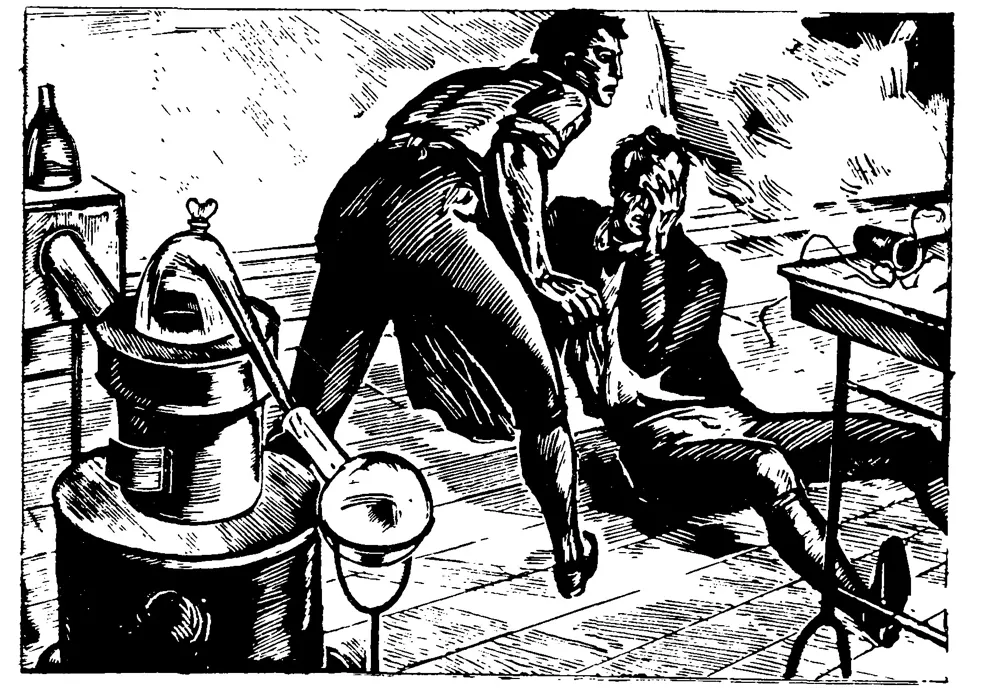
“Not quite. We are getting them, only not in sufficient quantity. I hope that in time we shall manage to get more. If I plunge the crucible into water, the metal ought to survive the rapid cooling.”
Davy switched off the current, took the hot crucible with tongs and touched the surface of the water with its bottom several times. Then, satisfied that the crucible had cooled enough, he carefully lowered it into a bowl of water. The water boiled up at once, bubbling, and suddenly caught fire. A deafening explosion rang out in the laboratory.
“Richard! My eyes!”
Staff from the neighbouring laboratories came running at the sound of the explosion. Davy lay on the floor, his hands over his blood-covered face. A doctor was called. Fortunately the injury was not dangerous: small fragments of the bowl had cut the scientist's face in only a few places. But Davy felt a sharp pain in his right eye.
“Dr Stewart, I think some glass has got into my eye.”
“The eye has not been touched, Mr Davy. Perhaps some chemical got into it? What was in the bowl?”
“Only water,” Richard answered.
“No, not only water. I plunged the new metal into it, and that is what caused the explosion. Some substance must have formed in the process.”
“Quick, bring clean water,” cried the doctor in alarm. “The eye must be washed out thoroughly...”
Several months passed. The wounds on Davy's face had long since healed, but the scientist could not see with his right eye.ed.5
“Will it really stay like this all my life?” Davy said dejectedly. “It's a blessing that only one eye was hurt. I can see, if badly, and so I can work.”
“These metals are astonishingly active,” said Richard, changing the subject to take his mind off it.
“We have already proved that soda and potash yield two different metals, sodium and potassium. Both are soft, lighter than water, and react with it so violently that a flame appears.”
Sir Bernard came into the laboratory.
“I congratulate you, Davy.”
The scientist looked at him enquiringly.
“The Emperor Napoleon has issued a decree awarding the English scientist Humphry Davy a medal for his services to the study of electricity.”
“A great honour indeed,” said Davy.
“The award is to be received in Paris.”
“But how? We are at war with France!” Richard broke in.
“All the Fellows of the Royal Society are of the opinion that the award should not be accepted,” said Bernard. “We have no right to accept it from the hands of the enemy, but we are proud that even our enemies recognise our achievements. Your achievements, Davy.”
“I cannot agree with you, Sir Bernard,” Davy objected. “I work for the sake of science, for the sake of all mankind. If scientists have ever fought, it has only been for the triumph of an idea, for the establishment of the truth. So I have firmly decided to go to France.”
The ceremonies, both in the Palace of Versailles and in the great hall of the Sorbonne, were solemn and lavish. But they tired the scientist so much that he even took to his bed. And when he recovered, he set about his research with fresh enthusiasm.
It seemed to him that not everything fitted together in Berthollet's theory of oxymuriatic acid. This yellow-green gas, which Berthollet called oxymuriatic acid, contained no oxygen. Davy knew that carbon takes oxygen from its compounds, but he could not separate any from this yellow-green gas. Yet a lighted candle went on burning when it was placed in a vessel filled with oxymuriatic acid, and at the same time the green colour disappeared and the colourless choking gas that formed was absorbed by water. All this contradicted the theory of combustion proposed by Lavoisier.
Davy set out his researches in his work “Elements of Chemical Philosophy”: “Oxymuriatic acid is not a compound,” he wrote. “It is a simple substance and supports combustion as oxygen does. Consequently, the role of oxygen in combustion should not be considered exclusive, as Lavoisier maintained. On the other hand, hydrochloric acid contains no oxygen, which shows that acids can exist without oxygen. So Lavoisier's doctrine that oxygen must be present in acids is wrong”11.
In 1812 Davy finished his “Elements of Agricultural Chemistry”12. In the same year he received the highest honour in England.
On 8 April 1812 lines of carriages filled the square by Westminster Abbeyed.6: on that memorable day the flower of London society gathered under the vaults of the majestic church to witness Humphry Davy being raised to the nobility. The organ sounded solemnly... Then the music fell silent, and from the direction of the high altar, surrounded by clergy, the Prince of the English crown appeared. He walked majestically up to the kneeling Davy and, touching his shoulder with a gilded sword, pronounced:
“Your services to the advancement of science have made you worthy of the rank of lord.ed.1 From this day Sir Humphry Davy is a knight of the English throne12а!”
A solemn service began.
Two days after he was raised to the rank of lord, Davy married a rich widow, Jane Apreece13, and a few months later they set off on their wedding journey. Davy took with him a special portable laboratory and decided that on the journey he could manage perfectly well with one assistant. The choice fell on Michael Faraday.
The Davys' journey through Europe lasted a full eighteen months. When they returned home, news reached them of a disaster in the coal mines: for several months terrible explosions had been occurring in the pits of Newcastle and Cardiff, and thousands of miners had been killed. National mourning was declared in England.
The Society for Preventing Accidents in Coal Mines offered a special prize for the invention of a safety lamp for use in the mines. A deputation from the society, led by its chairman, asked Davy to help them solve this difficult problem. And Davy agreed. Large vessels of the dangerous gas that the miners called “firedamp”* were sent to him. Davy and Faraday set about a careful study of its properties and of the conditions under which it ignites and causes devastating explosions.
“The only possibility is to let in the air needed to keep the lamp burning through narrow tubes and to let the gas out through tubes just as narrow. We must study how the flame travels along them and find at what diameter of tube the flame will go out.”
“I see what you mean,” said Faraday. “If the flame goes out in narrow tubes, then even if there is “firedamp” in the pit, it cannot be exploded by the flame of the lamp.”
“Exactly. Now we must get hold of tubes of different diameters and begin systematic experiments.”
For almost a whole year they carried on their research, and at last, at the beginning of 1816, they succeeded in designing the lamp. Davy replaced the glass of the miner's lamp with a very fine metal gauze. The gases passed freely through the small openings of the gauze, but the flame could not get out and ignite the dangerous gas. The lamp proved very effective and was soon in the widest use in the coal workings. The miners were freed for ever from a terrible danger13а. For this service Davy was awarded the Order of Rumforded.2, and in 1820 he was elected President of the Royal Society13б.
Davy's researches were very varied, but throughout his life he never lost his interest in electricity. And not only because he had achieved great success in this field. The theories of the day still gave no complete explanation of electrical phenomena, and the nature of electricity itself remained obscure. More and more new experiments were needed. The efforts of Ørsted14, Faraday and other scientists had already given remarkable results, but this was only the beginning.
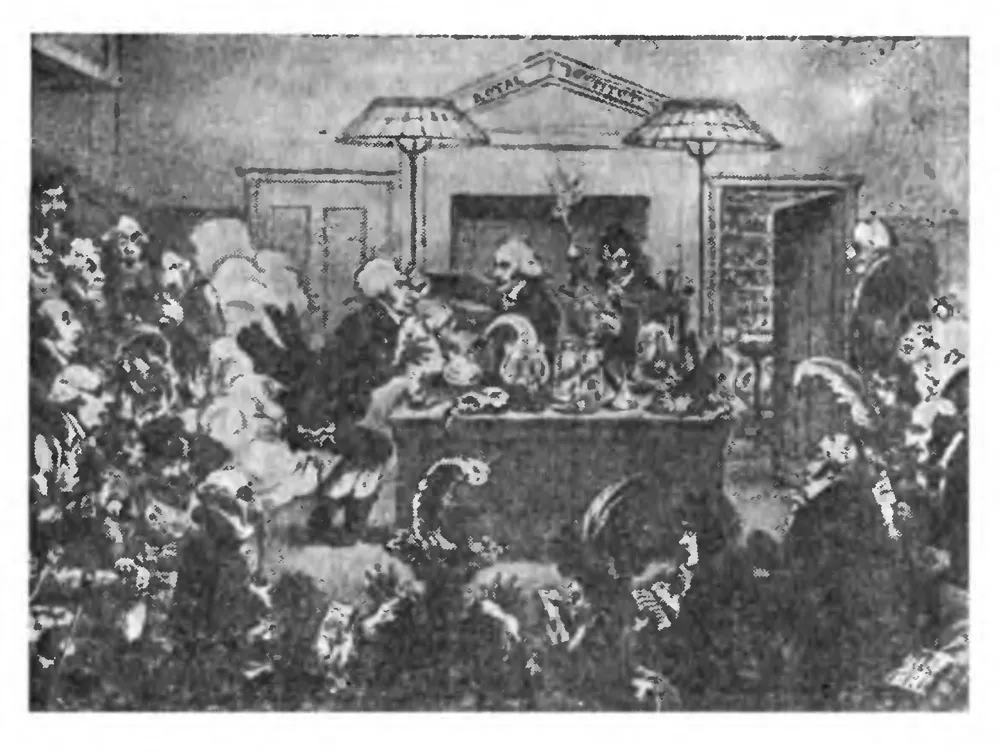
Davy had a special laboratory intended for the study of electrical phenomena. Besides the battery and an electrical machine, it held a great variety of measuring instruments, vessels of special shapes for measuring the electrical conductivity of substances, and other scientific apparatus.
“The resistance that conductors offer to an electric current is specific, and it can serve as an additional characteristic of the substance they are made of,” Davy said, summing up a long piece of work.
“There is certainly a difference in resistance, but I don't see any law in it yet,” objected Faraday, who was preparing a glass tube for the next experiment.
“True, it is very difficult to generalise for different substances, but for a single substance the problem is much simpler. And we already have some data on that.”
Faraday came over to the table. The figures that filled several pages showed convincingly that the resistance of the substance they were studying depended on the length and cross-section of the conductor. It increased as the temperature rose.
Work in the laboratory, meetings of the Royal Society... Davy worked with inexhaustible energy, but overwork and an old illness made themselves felt more and more often. Several times he went to Italy for treatment, then to Switzerland, but these journeys changed little. In 1828 Davy fell ill again. He was living at the time in a country villa by a beautiful lake not far from Geneva. Lady Davy never went with him on these journeys. She preferred to keep well away from her sick husband and amuse herself in London society. In the middle of May, however, she came to Geneva, and Davy's brother John15 arrived there too.
“Jane, I am fated to die happy, for my dear ones are beside me,” Davy murmured, barely audibly.
“Don't talk, darling,” said Lady Davy. “It may do you harm. We are here, and you will soon be well.”
Humphry Davy lay motionless, his eyes half closed. His breathing was barely perceptible; his strength was slowly ebbing away. He died on 29 May 1829.
Notes
- 1. H. Davy was born on 17 December 1778 in the small town of Penzance in south-west England.
- 1а. William Nicholson (1753—1815), an English chemist and military engineer, author of a “Dictionary of Chemistry” and publisher of a scientific journal known as “Nicholson's Journal”; in 1800 he observed the chemical decomposition of water. On Nicholson see Partington J. R., ук. соч., т. 4, с. 19—21; Сабадвари Ф., Робинсон А., ук. соч., с. 191, 289.
- 2. Thomas Beddoes (1760—1808), author of works on medicine and hygiene and an opponent of the phlogiston theory. In 1798 he founded the Pneumatic Institution at Clifton, where he studied the effect of gases on the body; he wrote (with J. Watt) a book on the possible use of gases in medicine (1794—1796). On Beddoes see Partington J. R., ук. соч., т. 4, с. 29—30.
- 3. Samuel Latham Mitchill (1764—1831), professor of chemistry at Columbia College (New York); the first populariser and champion of Lavoisier's theory in America.
- 4. From 1798 at the Pneumatic Institution Davy studied the action of gases (nitrous oxide, hydrogen, carbon dioxide, methane) on the human body, conducting the experiments mainly on himself. He discovered the exhilarating (“laughing”) and, later, the anaesthetic action of nitrous oxide. Davy remarked that the pain-relieving action of this gas might be used in surgery in the future.
- 5. Samuel Taylor Coleridge (1772—1834), Robert Southey (1774—1843) and William Wordsworth (1770—1850), Romantic poets of the so-called “Lake School” in English poetry. Davy's language was always rich and fresh, and Coleridge claimed that he attended the scientist's lectures not only to widen his scientific knowledge but also to enrich the stock of words he needed as a poet. In Southey's words, “Davy has all the elements of a poet; he only wants the art.” See Мак-Дональд Д. Фарадей, Максвелл, Кельвин. — М.: Атомиздат, 1967, с. 71.
- 6. In 1800 W. Nicholson, Anthony Carlisle (1768—1840) and William Cruickshank (1745—1810) worked on the decomposition of water by means of the voltaic arced.3; they established that water is thereby decomposed into hydrogen and oxygen. This experiment was later repeated and described by Davy (Ладенбург А., ук. соч., с. 64; Становление химии как науки, ук. соч., с. 183).
- 7. Benjamin Thompson (Count Rumford) (1753—1814), an English physicist; he was born in America, lived in Bavaria from 1784 and in France from 1803. One of the founders of the mechanical theory of heat (1798), he studied the absorption of light by bodies. On Rumford see Розенберг Ф. История физики. Ч. 3, вып. 1—2. — М.—Л.: ОНТИ, 1935—1936; Кудрявцев П. С. Курс истории физики, ук. соч., с. 200; Храмов Ю. А., ук. соч., с. 238—239.
- 8. This refers to Davy's discovery in 1807 of potassium and sodium by the electrolysis of solid caustic potash and caustic soda. In 1808 he obtained barium, calcium, strontium and magnesium by electrolysis, and then isolated boron from boric acid (independently of Gay-Lussac and Thénard). See Мусабеков Ю. С., Черняк А. Я., ук. соч., с. 96—102; Могилевский Б. Л. Гемфри Дэви. — М.: Мол. гвардия, 1937. — (ЖЗЛ); Сабадвари Ф., Робинсон А., ук. соч., с. 192 и сл.
- 9. Davy named the new metals potassium and sodium, but soon L. W. Gilbert, the editor of the journal “Annalen der Physik”, proposed calling the new metals “Kalium” and “Natronium” respectively, and Berzelius amended the latter name to “Natrium” (since “natron” is Arabic for “soda”) (Фигуровский Н. А. Открытие элементов и происхождение их названий. — М.: Наука, 1970, с. 76, 93; Трифонов Д. Н., Трифонов В. Д., ук. соч., с. 93—96).
- 10. Christian Johann Dietrich von Grotthuss (Theodor Grotthuss) (1785—1822), a celebrated physicist and chemist. In 1805 he was the first to propose a theory of electrolysis, which became the basis of the theory of electrolytic dissociation. He studied the chemical action of light and electricity, and in 1818 he formulated the first law of photochemistry, which bears his name. On Grotthuss see Страдынь Я. П. Теодор Гроттгус (1785—1822). — М.: Наука, 1966; Мусабеков Ю. С., Черняк А. Я., ук. соч., с. 111—115; Partington J. R., ук. соч., т. 4, с. 25—28; История учения о химическом процессе. — М.: Наука, 1981, с. 128—130 и др. — (Всеобщая история химии); Волков В. А. и др., ук. соч., с. 154—155.
- 11. In 1808, while studying chlorine, Davy proved that it is an element. Investigating the nature of the halogens, he rejected Lavoisier's theory that every acid must contain oxygen and developed his own theory of acids. Davy also made a thorough study of the nature of iodine and tried to isolate fluorine.
- 12. Davy's lectures on agricultural chemistry were published in 1813 as a separate book, “Elements of Agricultural Chemistry”. The book ran to four editions. It was also translated into Russian: Основания земледельческой химии, изложенные сиром Гумфри Дэви. — СПб, 1832.
- 12а. In 1803 Davy became a Fellow of the Royal Society of London; he was its Secretary from 1807 to 1812 and its President from 1820 to 1827. He was awarded the Copley (1805), Rumford (1816) and Royal (1828) Medals.
- 13. Davy's wife was a distant relative of the great English novelist Walter Scott.
- 13а. For a detailed history of the invention of the Davy lamp see Страдынь Я. П. Тр. Ин-та истории естествознания и техники, 39, 66 (1962).
- 13б. On 20 December 1826 Davy was elected an honorary member of the St Petersburg Academy of Sciences.
- 14. Hans Christian Ørsted (1777—1851), a well-known Danish physicist and an honorary foreign member of the St Petersburg Academy of Sciences. Beginning with chemistry and philosophy, he turned to the study of electricity, inspired by the work of the Italian physicist A. Volta. He developed methods of obtaining aluminium chloride and metallic aluminium, invented the piezometer, studied the compressibility of liquids and laid the foundation of the systematic investigation of electromagnetism. On Ørsted see Нильсен И. Р. Физика в школе, № 4, 11 (1939); Храмов Ю. А., ук. соч., с. 312; Научное открытие и его восприятие / Под ред. С. Р. Микулинского, М. Г. Ярошевского. — М.: Наука, 1971, с. 156—167; Замечательные ученые, ук. соч., с. 92—100; Выдающиеся физики мира, ук. соч., с. 159—163.
- 15. John Davy (1790—1868) discovered phosgene (1811) and published memoirs of his brother H. Davy. On J. Davy see Джуа М., ук. соч., с. 205, 225.
- * An explosive mixture of methane and oxygen (CH₄+2O₂). — Editor's note.
From the site's editors
- ed.1 Davy was never a lord: in 1812 he was made a knight (hence “Sir”), and in 1818 he was created a baronet.
- ed.2 Not an order but the Rumford Medal of the Royal Society of London (1816).
- ed.3 In 1800 water was decomposed by the current of a voltaic pile; the electric arc was described later by Davy himself.
- ed.4 Thomas Beddoes was a physician; the Russian edition took the word for “physicist”.
- ed.5 Davy was badly hurt in the eye in 1812, by an explosion of nitrogen trichloride, NCl₃, not in his work with potassium.
- ed.6 Davy was knighted by the Prince Regent at court on 8 April 1812, not in Westminster Abbey.