1766–1844. An English chemist and physicist and the founder of chemical atomism: he introduced the idea of atomic weight and discovered the law of multiple proportions and the law of partial pressures of gases.
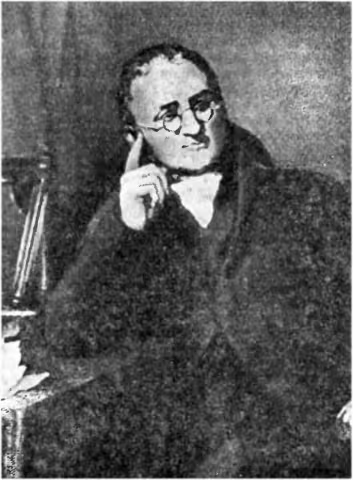
John Dalton (6 September 1766 – 27 July 1844) was an English chemist and physicist and a Fellow of the Royal Society of London (from 1822). He was born at Eaglesfield (Cumberland). He was self-educated. From 1781 to 1793 he taught mathematics at a school in Kendal, and from 1793 he taught physics and mathematics at the New College in Manchester.
His main research up to 1800–1803 was in physics, his later work in chemistry. From 1787 he kept meteorological records, and he studied the colour of the sky, the nature of heat, and the refraction and reflection of light. From this work came his theory of the evaporation and mixing of gases. He described (1794) the defect of vision that came to be called Daltonism. He discovered three laws which formed the core of his physical atomism and his theory of gas mixtures: the law of partial pressures of gases (1802), the law relating the expansion of gases at constant pressure to temperature (1802, independently of J. L. Gay-Lussac), and the law relating the solubility of gases to their partial pressures (1803). This work led him to the chemical problem of how the composition of substances is related to their structure. He put forward and argued (1803–1804) the main tenets of chemical atomism and introduced the fundamental idea of atomic weight. He discovered (1804) the law of multiple proportions: when two elements form several compounds, the masses of one element that combine with a fixed mass of the other stand to one another as whole numbers. He drew up (1803) the first table of the relative atomic weights of hydrogen, nitrogen, carbon, sulphur and phosphorus, taking the atomic weight of hydrogen as unity. He proposed (1804) a system of chemical symbols for “simple” and “compound” atoms. From 1808 he worked to refine particular points of the atomic theory and to make its substance clear. He was the author of “A New System of Chemical Philosophy” (1808–1827), a work that became known throughout the world.
He was a member of many academies of sciences and learned societies.
From Kaloyan Manolov's “Great Chemists”
The ring of a brass handbell announced the end of lessons. The children buzzed like bees in a hive, stuffed their slates into their bags and ran out into the yard in a crowd. Their teacher, a thin youth of about fifteen, rolled up the charts lying on the desk and walked unhurriedly out of the classroom. He loved this low but solid school building. Only two years earlier he too had sat here at a desk listening to Mr Fletcher, and now he was teaching children himself in his native village of Eaglesfield1.
The youth, whom the Quakers of Eaglesfield had scarcely noticed before, had suddenly become Mr John Dalton, and everyone bowed to him respectfully. Why, Mr John Dalton! And does he know a great deal? Well, of course. His teacher, Mr John Fletcher, had taught him mathematics, geometry and navigation. And John had read books besides; he had learned curious things, and all by himself, for no one had helped him through the difficulties. He knew enough for Mr Fletcher to conclude, after mature reflection, that no one could help him better than John in teaching the Quaker children, and that was why he had taken young Dalton on as his assistant.
How wonderful it is to be a teacher! To pass on knowledge, to see the children's eyes light up with joy... Lost in thought, John did not notice the tall man coming towards him.
“Good afternoon, John! What are you thinking about so hard?”
“Good afternoon, Mr Robinson! Were you coming to see me?”
“To see you, of course. You haven't shown your face at my house for three whole days. You're not ill, I hope?”
“No, not at all. What is there to tell? The pay I get at the school isn't enough to live on, so I have to earn a little extra. Just now is the best time for planting cabbages. Yesterday and the day before we all worked together, my brother Jonathan, my little sister Mary and I. The harvest promises to be good this year.”
“You are a true Quaker, John. Quiet, humble and hard-working, just as our faith teaches us to be.”
“Let's leave that, Mr Robinson. Tell me instead why you wanted me.”
“I have a surprise for you. I've finished a new barometer. Now we shall be able to measure the pressure of the atmosphere more accurately.”
Talking about the various instruments that Mr Elihu Robinson skilfully made with his own hands, they quickened their pace and before they knew it they were at the house of this gifted craftsman. It stood at the very top of a hill. Mr Robinson had set up some of his instruments on special wooden stands right in the garden, and with them he kept a constant watch on the weather. Not long before, John Dalton had begun to help him in this work: Mr Robinson's investigations interested him enormously. To find the connection between barometric pressure, temperature, the humidity of the air, the strength of the wind and the amount of precipitation, rain or snow, was not only fascinating in itself but also of practical importance to a countryman. And if they could discover the intricate laws that govern these phenomena, they would be able to forecast the weather! And what a boon that would be, say, to sailors! And to farmers too.
John spent a long time admiring the new barometer. Then they made their regular observations, wrote down the results and went home1а.
From far off he could hear the steady clatter of the loom. His father and mother worked from early morning till late at night. Jonathan and Mary helped their parents. As a child John too had tried to help them. But now he had accepted Mr Fletcher's offer of work at the school. Even so, there was still not enough money. John kept feeling that he was a burden. How unjust life was! Why had his mother and father been given nothing but hardship and toil? It was no small thing to feed six children! They looked after the children as best they could, and yet in the winter his youngest sister had died, and after her his brother Tom, who had been sickly and often ill, most likely because he did not get enough to eat. How could he make life easier for the family, John wondered. Perhaps he should try his luck elsewhere and leave Eaglesfield? After all, he was educated enough to earn his own living. Why not go to Carlisle and look for work there?
A few days later John left home. In Carlisle he could not find suitable work, but in Mrs Mekuin's bookshop he was advised to go to Kendal. A teacher of mathematics was wanted there, or so it seemed.
The autumn of 1781 found John in Kendal. The room he was given in the boys' boarding house attached to the school was modestly furnished. John changed nothing in it: a life full of hardship had not taught him extravagance. And yet in his new room the young teacher felt as if he were in a palace. His shelves were groaning with books. Books were his true wealth. And when he opened the door of the school library he felt richer still. Now John Dalton had every opportunity to widen his knowledge, and he read, and read, and read.
Alongside his reading John did not neglect his favourite occupation, the constant watching of the weather. He hung on the wall the barometer that Mr Robinson had given him on the eve of his departure, and he set up a rain gauge in the garden. One after another, various glass instruments appeared on the table in Dalton's room. He bought them, and sometimes made them himself from phials and little tubes. How much in nature was still unexplained! He had to work, he had to find the key that would open the door to nature's hiding places. But where to begin? With physics? Medicine? Chemistry? Meteorology?
John was greatly vexed by a red cockerel which always knew, with astonishing accuracy, when it was going to rain or when a storm was coming. Then it would perch on the wooden fence and crow at the top of its voice. “Why can a bird forecast the weather when I cannot?” Dalton put in order the data he had been scrupulously gathering for several years. He compared the temperature of the air and the pressure and tried to unravel the secrets of the weather. He learned that there lived in Kendal a man who also made such observations. Dalton decided to make his acquaintance. Everyone in the district knew Mr John Gough2, and so he easily found his house.
“Mr John Gough?” he asked politely as he came in.
“Yes, that is I,” replied Mr Gough. He remained sitting with his back to Dalton. John could see only his grey hair falling in waves to his shoulders.
“Come closer and give me your hand. Who are you?”
“John Dalton, the mathematics master at the Friends' School.” He held out his hand to Gough and only then noticed that he was blind.
“I can feel from your hand that something is troubling you. It must be that you are put out because I cannot see?”
“Forgive me, but people say you are an excellent experimenter. I cannot understand it at all.”
“What you see with your eyes, my dear Mr Dalton, is as nothing compared with what can be known by reason.”
“I entirely agree with you. But how do you carry out your experiments all the same?”
“It is not difficult. I shall show you now how to assemble the apparatus and how to fill the vessels without spilling a drop of liquid, without dropping or breaking even the finest glass tube. It is all a matter of skill and patience.”
Mr Gough stood up and went over to a large table. On it, in perfect order, stood vessels of every kind.
“Now then. Here we put the iron stand. From this box we take a metal clamp. Then a flask, and in this bag there are corks...”
He reached out confidently in a particular direction and took what he needed. The precision of his movements could be compared with that of the most perfect automaton.
Dalton watched in admiration. That was what real strength of will meant. They talked for a long time, and Dalton was given much valuable advice about the experiments he intended to make. He called on this remarkable man more and more often. The days went by, and little by little they became friends. Dalton tried to help Gough in his experiments, but Gough almost always did everything himself. From time to time, settled comfortably in an armchair, Dalton would question Mr Gough about phenomena he had not understood until then.
Alongside their investigations of the air3 they made regular meteorological observations. Dalton also worked hard at mathematics, making use of the rich collection of books in the school library. Little by little he began to devise new mathematical problems and solutions of his own, and soon afterwards he wrote his first scientific papers in that field. Dalton, ever in search of knowledge, very soon won the respect not only of his colleagues but of the townspeople of Kendal. Within four years he had become head of the school. At this time he grew close to Dr Charles Hutton, the editor of several journals of the Royal Military Academy. Intended for a wide public, they often printed articles of a scientific nature on their pages. This came from Dr Hutton's wish to make science popular. Dalton became one of the regular contributors to these almanacs, and many of his scientific papers were published in them. For his contribution to mathematics and philosophy he received several high awards. The name of John Dalton was by now known beyond Kendal.
In September 1787 Chester Could came to see Dalton from Manchester.
“As you may know, last year the Presbyterians opened the New College in the town. I teach there.”
“Pleased to meet you.”
“And I have come to you on a special errand. The secretary of the Literary and Philosophical Society, Mr Smith, has formed the very highest opinion of you. He has told us more than once of your fruitful work, and so we should like to ask you to give a course of lectures at the New College.”
“What subject do you have in mind?”
“Natural philosophy. We should be glad if you could begin the lectures without delay.”
“I agree. Let us try to fix the first lecture for October.”
Dalton lectured in Manchester and then in Kendal. People listened to him with interest, for he dealt with questions of the first scientific importance, but he had no gift for oratory and could not set an audience on fire. Even so, the course was valued at its true worth. The principal of the college, Mackenzie, told Dalton how pleased he was.
“My sincere thanks, Mr Dalton. I should be very glad if you would agree to move to us in Manchester.”
“Unfortunately I cannot leave the school in Kendal.”
“I understand. That is your duty, but you must think of your own future too. In Manchester we have more scope for creative work.”
“Perhaps you are right. In any case your offer gives me serious cause for thought.”
Dalton worked in Kendal for several more years, and in 1793 he moved to Manchester. He brought with him the manuscript of “Meteorological Observations and Essays”4, which delighted the publisher Penswill. Besides describing the barometer, the thermometer, the hygrometer and other instruments and apparatus and setting out the results of many years of observations, Dalton gave in it a masterly analysis of the formation of clouds, evaporation, the distribution of rainfall, the northerly morning winds and much else. The manuscript was printed at once, and the book was received with great interest.
Dalton liked his new work. Besides his teaching at the college he gave private lessons, chiefly in mathematics. A year after his arrival in Manchester Dalton was elected a member of the Literary and Philosophical Society5. He regularly attended all its meetings, at which the members reported the results of their research. And in the autumn of 1794 he read a paper on colour blindness6. As a child he had noticed that his brother Jonathan could not tell colours apart. Sometimes the red top they used to spin as children looked green to Jonathan, and when their sister once put on a new green dress, Jonathan decided it was red. Later, in Kendal and then in Manchester, Dalton began to notice this defect of vision in himself as well, though in him it showed itself to a somewhat lesser degree. The scientist set about a detailed study of the phenomenon: he made dozens of experiments with coloured tiles, arranged them in various orders and wrote down the colours. Then he made experiments on schoolchildren. Dalton found that some of his pupils could not distinguish colours at all, while others often confused them. They saw green as red or the other way round, but there were also some who confused blue and yellow. Today we call this particular defect of vision Daltonism.
Manchester really did offer a wide field for scientific work: rich libraries, all sorts of societies, publishing houses. Remarkable scientists worked there too, in Manchester. With them Dalton discussed the problems that interested him, took their advice and listened to their criticism. His scientific interests grew ever wider, and soon he saw clearly that teaching at the college was distracting him from what was most sacred to him: science. The years were flying by, and he was squandering precious time at the blackboard with chalk and duster in hand. But he still needed the means to live. Should he perhaps confine himself to private lessons? The well-to-do families of the town preferred to have private tutors come to the house. In Manchester Dalton's name was spoken with reverence; he was respected as a scientist, and any rich man would have counted it a great piece of luck if Dalton agreed to tutor in his house. He would have to try, but only at two shillings an hour, no less. On that sum the widow of Piit the shoemaker fed herself and her two children for a whole week. And since you wish John Dalton to teach your children, gentlemen, kindly open your purses!
In 1799 Dalton left the New College and became not only the most expensive but also the most respected private teacher in Manchester. His time was now his own. He taught in rich families for no more than two hours a day, and then he worked at science. His attention was drawn more and more to gases and mixtures of gases. The air, after all, is a mixture of gases too.
“To characterise a gas you need to know its pressure. The same is true of a mixture of gases. But what is the pressure of each gas in a mixture, and is there any connection between them?” Dalton was setting out the programme of his coming research to his friend Stevens.
“The problem is interesting,” Stevens remarked. “But have you any idea how to go about the research?”
“The simplest thing would be to find two gases one of which can easily be removed from the mixture, so as to measure the pressure of the mixture and of the gas on its own. There are other ways too, of course. But let us see what this experiment shows.”
The results were interesting. The pressure of a given gas enclosed in a vessel of constant volume remained the same. Then Dalton let in a second gas. The mixture so obtained had a higher pressure, but it was equal to the sum of the pressures of the two gases. The pressure of each gas on its own remained unchanged.
“It follows from my experiments that the pressure of a mixture of gases is equal to the sum of the pressures the gases have when each is put into this vessel separately under the same conditions. If the pressure of a single gas in a mixture is called its partial pressure, then this regularity can be stated thus: the pressure of a mixture of gases is equal to the sum of the partial pressures of the gases of which it is made up.” Dalton put down his pen and fell to thinking. “Important conclusions can be drawn from this! Clearly, the state of a gas in a vessel does not depend on the presence of other gases. That, of course, is easily explained by their corpuscular structure. So the corpuscles, or atoms, of one gas are spread evenly among the atoms of the other gas but behave as if the other gas were not in the vessel at all.”
Again he fell to thinking: but what, in essence, do we know about atoms? Do they exist in nature, or are they merely a philosophical category? If atoms exist, then all the properties of substances and all the laws ought to be explained on the basis of the atomic theory. But can the theories of Kirwan7 and Higgins8 really be called atomic? How do they differ from the theories of Boyle and Newton? That is what chemistry lacks: a true theory of the structure of matter!
Carried away by the new idea, Dalton threw himself into persistent research. The laboratory, the library, theoretical conclusions at his desk... First of all he had to form a clear idea of atoms. What were their characteristic features? Did the atoms of one element differ from those of another? Was there not some way, tiny as they were and invisible to the naked eye, of establishing their weight, shape and size...
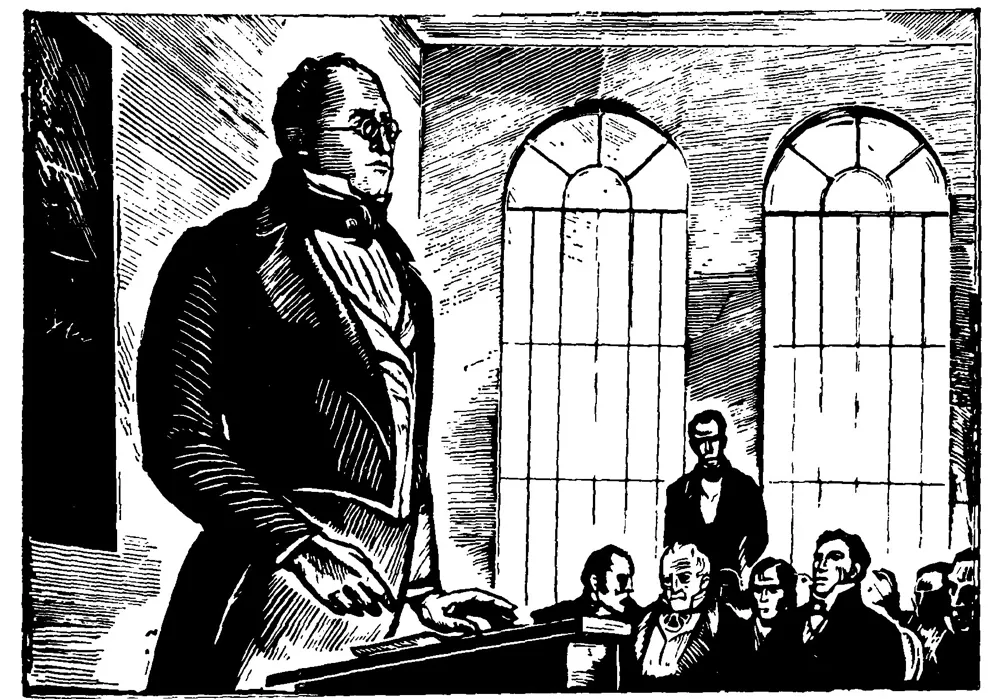
A few years of intense work, and the results were not long in coming. 21 October 1803. This evening they would become known to the members of the Manchester Literary and Philosophical Society as well. Standing at the lectern, John Dalton was presenting his chemical atomic theory9.
“In conclusion I should like to sum up the main points of my theory. All the earlier theories of corpuscles agree that they are small, identical spheres. I, however, hold that the atoms (the smallest indivisible particles) of one element are alike among themselves but differ from the atoms of other elements. If nothing definite can be said about their size at present, something can be said about their chief physical property: atoms have weight. In support of this, allow me to read my second paper as well: ‘First Table of the Relative Weights of the Ultimate Particles of Gaseous and Other Bodies’. An atom cannot be isolated and weighed. If we assume that atoms combine with one another in the simplest ratios, analyse compound substances, and then compare the percentages by weight of the elements with the percentage by weight of the lightest of them, we can obtain interesting values. These figures show how many times heavier the atom of one element is than the atom of the lightest element. Please look at the first table of these weights. It is before you. The lightest element has turned out to be hydrogen. This means that its atomic weight should conventionally be taken as unity...”
Dalton spoke with enthusiasm, and those present listened to him with great interest. All of them accepted, in one way or another, that substances are made up of atoms, but such a theory, such detailed notions, which not only explained the properties of substances but also gave an idea of their structure, no one had heard until then. Dalton drew little circles on the blackboard, setting them side by side in twos, threes or fours. These were the first formulae of the simplest compounds10.
Dalton's new theory caught the attention of the wider scientific community. He was invited to give a course of lectures in London11. A few weeks later he returned to Manchester to carry on the work he had begun on determining atomic weights.
Certain particular cases gave him no little trouble. Copper, for instance, is oxidised by oxygen and forms two oxides, a black one and a red one. Nitrogen too gives several different oxides. How was this to be explained? But he knew that Proust had studied both oxides of copper. His analyses had shown that the black oxide contains 80% copper and the red one 89%. Other investigators had made analyses as well, and their figures did not differ much from Proust's. That was enough to begin the calculations.
Sometimes Dalton came across results in the literature that had been obtained by only one scientist. Then he repeated the analyses to make sure they were reliable, and only after that did he go on to calculate the atomic weight. Many of the atomic weights he obtained were inaccurate, because he had found the atomic weight of oxygen to be 7, not 1612. In fact what Dalton calculated is what we now call the equivalent weight, that is, the part by weight of a given element that carries one unit of valency. The oxygen atom has a valency of two, so one unit of valency is carried by an amount by weight equal to half its atomic weight. Dalton did not manage to obtain the exact value of the equivalent weight of oxygen. The error came from imperfect methods of analysis, which gave inaccurate results.
Dalton concentrated on the quantities. In black copper oxide* 20 parts by weight of oxygen combine with 80 parts by weight of copper. If the atomic weight of oxygen is 7, then 7 parts by weight of it will combine with the amount of copper by weight that represents its atomic weight. Dalton worked out the proportion and got the number 28. In red copper oxide** 11 parts by weight of oxygen combine with 89 parts by weight of copper. For 7 parts by weight he got the number 56. Dalton stared in surprise at the numbers 28 and 56***.
“But the second number is twice the first! I wonder what comes out for the oxides of nitrogen?” he exclaimed, calculating at feverish speed.
“The same! One number is twice the other. Perhaps atoms have the property of combining with one another in different ratios by weight?”
The thought seemed thrilling.
“Yes. That is just how it is. In the black oxide one atom of oxygen is combined with one atom of copper, and in the red oxide with two.”
So it was no accident: it was a fundamental property of matter. The law of multiple proportions by weight was a law of nature. Dalton told Stevens of his discovery.
“It all comes down to the capacity of atoms to combine with one another. If an atom of oxygen combines with an atom of copper, one substance is formed, but if an atom of oxygen combines with two atoms of copper, a different oxide results. Naturally the amount of copper in the first compound stands to its amount in the second as one to two.”
“Your atomic theory has proved itself,” Stevens smiled.
“Some still call it a hypothesis, but believe me, it is the truth. Every result I obtain convinces me of it.”
“Listen, John, you are becoming persona grata, my friend. Last year you were invited to Edinburgh and Glasgow, and this year...”
...This year the governing body of the Manchester Literary and Philosophical Society decided to elect John Dalton its vice-president. The formal election took place in May 1808. The Royal Society of London again invited Dalton to lecture.ed.5 At the end of 1809 he went to London, where he met and talked with the leading scientists of England, visited their laboratories and acquainted himself with their work. He talked especially often with Humphry Davy. The young investigator was brimming with ideas. Dalton saw the new elements Davy had discovered, potassium and sodium. He watched with interest as a small piece of the metal floated on water with a yellow flame flickering above it.
“A remarkable discovery, sir.”
“Your services to chemistry are no less, Mr Dalton. The discovery of the law of multiple proportions is far more important than the discovery of an element. To say nothing of such an achievement as the atomic theory.”
They were silent for a while, then Davy went on:
“It would be a great honour for the Royal Society of London to elect you a Fellow, Mr Dalton. Will you allow me to put forward the proposal?”
“I beg you, Sir Humphry, do not.ed.6 I love Manchester and its Society. It does not matter to science where a scientist lives; what matters is what he gives it.”
“As you wish, Mr Dalton, but I should not refuse: there are far more opportunities here.”
“I am of a different opinion, sir. Promise me you will not do it.”
A few weeks later Dalton returned to Manchester. For all the exceptional modesty of his character, the scientist's fame grew from day to day. He was talked of now beyond the borders of England. Dalton's atomic theory caught the interest of the scientists of Europe. In 1816 Dalton was elected a corresponding member of the Paris Academy of Sciences. The following year he was elected president of the Society in Manchester, and in 1818 the English government appointed him scientific expert to the expedition of Sir John Ross13, who handed the scientist the appointment in person.
“What will my duties on the expedition amount to?” asked Dalton.
“To be frank, you will have a good many: you are to direct the meteorological and physical research.”
“And what is the aim of the expedition?”
“The North Pole. We shall try to explore the Arctic regions and reach the pole.”
“I am flattered by your offer, but I prefer to remain in England. It seems to me that the questions I am working on here are of greater importance to science. There, in the icy Arctic, I could not pursue the problems I love.”
“Is that your final decision?”
“It is.”
“I am very sorry, Mr Dalton. The expedition will miss your knowledge.”
But Dalton preferred quiet work in his study, not wishing to scatter his efforts and waste precious time. His research on determining atomic weights went on. The results he obtained grew ever more accurate. New ideas came, interesting conjectures arose, and he had to recalculate and correct the results of analyses by many scientists. Dalton had already published new tables of atomic weights several times. Some figures in them stayed the same, others were twice and sometimes three times as large as those published before. The number of elements whose atomic weights had been determined grew steadily. Not only English scientists but scientists in France, Germany, Italy, Sweden and Russia followed his achievements closely. Yet everyone thought it strange that a scientist with a worldwide reputation was not a Fellow of the Royal Society. Without obtaining Dalton's consent, Davy decided to put forward the proposal for his election after all, and in 1822 Dalton became a Fellow of the Society. Soon afterwards he went to France.
The scientific circles of Paris gave Dalton a warm welcome. He attended several meetings, read a number of papers and talked with many scientists. His meeting with Gay-Lussac, who showed Dalton his laboratories, was especially warm.
“Science is a boundless ocean,” said Gay-Lussac, continuing the conversation they had begun.
“You are right. One need only arm oneself with a reliable compass to reach the shore,” Dalton agreed.
“But it seems to me that we shall never reach that shore. As we draw near to it we discover new horizons, we set out towards them, and once again the boundless expanses of the ocean lie before us.”
“Such is the lot of the investigator: to search for ever, to strive for ever towards the unknown.”
“Your atomic theory opens a new era in chemistry, Mr Dalton.”
“I am glad we think alike. But my theory is far from complete. There is a great deal of work to be done, and with my modest means that is not so easy.”
“What do you intend to do in the future?”
“Of course I cannot rest on what I have achieved: discoveries of new elements are being reported very often now. Hundreds of experiments must be made and their atomic weights determined. I am still working on improving the methods of determining atomic weights. About many things we can only make conjectures. Here, for example: simple substances, the elements, consist of simple atoms, and compound substances of compound atoms. How do simple atoms combine to form compound ones? We do not know. How many simple atoms go to make up a compound one? We do not know that either. How, for example, are we to establish how many atoms of hydrogen and oxygen form a compound atom of water?”
“Yes. New proofs are needed.”
“Of course. The future is calling us. Some day, perhaps, science will solve the mystery of atoms.”
“You are already on the way.”
“But I am still very far from the goal, my esteemed colleague.”
Dalton searched, analysed, calculated, made conjectures... With every day his thoughts and ideas took on a clearer shape and grew into a coherent, complete theory of the atom.
Dalton's great scientific work was winning universal recognition. In 1826 the English government awarded the scientist a gold medaled.7 for his discoveries in chemistry and physics, and above all for creating the atomic theory. The medal was presented at a ceremonial meeting of the Royal Society of London. Sir Humphry Davy gave a long address. In the years that followed Dalton was elected an honorary member of the academy of sciences in Berlin, of a learned society in Moscow14 and of the academy in Munich.
In France, to mark its recognition of the achievements of the world's outstanding scientists, the Paris Academy of Sciences elected an honorary council of its own. It consisted of the eleven best-known scientists in Europe.ed.8 English science was represented on it by Humphry Davy. After his death his place was taken by John Dalton. In 1831 Dalton was invited from York to honour with his presence the founding meeting of the British Association for the Advancement of Science. In 1832 Dalton received the highest distinction of the University of Oxford15.
For the ceremony the hall was festively lit. The vice-chancellor of the university, in a scarlet gown, made a speech in Latin. On high-backed wooden chairs set out on a specially built platform sat John Dalton, Michael Faraday, David Brewster16 and Robert Brown. The whole hall was attentive. The Latin speech flowed smoothly on.
“Long live the professors! Long live the doctors of civil law!” the vice-chancellor declared in conclusion.
The music struck up. Everyone rose. The vice-chancellor went up to the scientists, who were deeply moved, and put a scarlet silk gown over Dalton's shoulders. Faraday, Brewster and Brown were robed in the same gown of honour.
Dalton was happy. Who would have thought it? A modest, hard-working Quaker had lived to see such honours! His heart was full of pride: he had done his duty as a scientist, he had given his strength, his mind and his love to science.
The English government could no longer ignore Dalton's circumstances, and in 1833 it granted him a pension. The government's decision was read out at a ceremonial meeting at the University of Cambridge.
The great hall was hung with costly paintings in gilt frames. From the rostrum Professor Sedgwick spoke of Dalton's services to science:
“In consideration of the immense contribution to science of the honourable John Dalton, the government has instructed me to convey to him its respect and its decision to grant him an annual pension of 150 pounds sterling.”
A storm of applause broke out. Dalton, in his scarlet gown, rose and bowed low to the gathering.
Deeply moved, Dalton went out into the park to walk a little and calm himself before setting off home.
“Mr Dalton!”
He turned round: before him stood a tall man in a black tailcoat.
“I am from Manchester. I have been sent to you on a special errand. The town council of Manchester considers that making you a freeman of the town does not fully express its gratitude to you. It has therefore been decided to place your bust in the largest hall in Manchester, the Town Hall. The best sculptor in London has already agreed to take the commission. We should ask you, in this connection, to come to Manchester.”
“I am sincerely grateful to you. If I were not afraid of offending the citizens of Manchester by refusing, I should certainly refuse. You may tell the mayor from me that I shall certainly come and shall settle in Manchester for good.”
Dalton was once again among the members of the Manchester Literary and Philosophical Society. He went on working hard and reading papers.
The unveiling of the scientist's monument, however, was overshadowed by the sudden death of Dalton's brother Jonathan.
The brothers had been deeply attached to each other all their lives. Dalton mourned his beloved brother for a long time. He himself did not fear death; he did not think about it. And although Dalton was far from young, he dreamed of work and of new discoveries. But with old age illnesses overcame him more and more often, and work grew ever harder. On 27 July 1844 Dalton died.
The news of John Dalton's death shook Manchester. In the half-lit hall of the Town Hall, where the coffin with the body of the deceased had been placed, there was a deathly silence. Day and night people came to pay their last respects to the great genius. For two weeks the stream of people did not stop: for two weeks England took leave of her son.
12 August 1844. Flags at half-mast in the streets of the town. People crowded on the pavements, on balconies and at windows. To the sound of funeral music the procession moved slowly towards Ardwick cemetery. Behind the coffin walked scientists and people far removed from science, who had never heard that atoms existed. Yet they too understood that a great scientist had died, one mourned not only by his own country but by the whole world...
With bowed head England accompanied the great John Dalton on his last journey.
Notes
- 1. J. Dalton was born on 6 September 1766.
- 1а. Dalton made meteorological observations all his life (and it was by working through their results that he was able to discover the gas laws). He kept daily records with the greatest care and registered more than 200,000 observations. He made his last entry a few hours before his death. See: Bugge G., ук. соч., с. 378—385.
- 2. John Gough (1757–1825) had a wide knowledge of many fields; he taught Dalton languages (Greek, Latin, French) and mathematics.
- 3. Dalton began his scientific research in 1787 with observations and the experimental study of the air. Крицман В. А. Роберт Бойль, Джон Дальтон, Амедео Авогадро: Создатели атомно-молекулярного учения в химии. — М.: Просвещение, 1978. — (Люди науки).
- 4. Dalton's first scientific work published on his own was the book “Meteorological Observations and Essays” (1793); the second edition appeared 41 years later. In this book one can find the first, not yet entirely clear outlines of Dalton's later discoveries, on which see: Становление химии как науки, ук. соч., с. 8 и сл.
- 5. On the initiative of Robert Owen (1771–1858), the English utopian socialist and one of the forerunners of scientific socialism, Dalton became a member of the Manchester Literary and Philosophical Society in 1794; in 1800 he was elected its secretary, in May 1808 its vice-president, and from 1817 to the end of his life he was its president. Dalton read 119 papers to the Society; all of them were published.
- 6. Dalton's paper “Extraordinary Facts relating to the Vision of Colours” (1794).
- 7. Richard Kirwan (1733–1812), a well-known English chemist and the author of one of the atomic theories, worked a great deal in mineralogy and geology and wrote four large works on phlogiston, whose existence he long defended; he was one of the last to come over to Lavoisier's theory. On Kirwan see: Partington J. R., ук. соч., т. 3, с. 660—671; Становление химии как науки, ук. соч., с. 88 и сл.ed.1
- 8. On W. Higgins's atomic theory see: Меншуткин Б. Н. Химия и пути ее развития. М.—Л.: Изд-во АН СССР, 1937, с. 157—158; Джуа М., ук. соч., с. 145—146 и сл.; Кедров Б. М. Три аспекта атомистики: Учение Дальтона. — М.: Наука, 1969.
- 9. On 6 September 1803 Dalton wrote the first table of atomic weights in his laboratory notebook. He first mentioned the atomic theory in the paper “On the Absorption of Gases by Water and Other Liquids”, read on 21 October 1803 to the Manchester Literary and Philosophical Society. The paper was published in 1805.
- 10. On Dalton's atomic theory in detail see Джуа М., ук. соч., с. 169; Соловьев Ю. И., ук. соч., с. 117—132; Partington J. R., ук. соч., т. 3, с. 782—786; Крицман В. А., ук. соч., ч. I, с. 111—122; Биографии великих химиков, ук. соч., с. 88—93; Мусабеков Ю. С., Черняк А. Я., ук. соч., с. 80—85. Dalton developed the atomic theory in his second book, “A New System of Chemical Philosophy”. Dalton's name is linked with a number of fundamental discoveries in physics and chemistry that he made on the basis of his research on gases: the law of partial pressures (1801), the law of the uniform expansion of gases on heating (1802), the law of multiple proportions (1803), and the phenomenon of polymerism (in the example of ethylene and butylene).
- 11. In December 1803 and January 1804 Dalton gave a course of lectures on relative atomic weights at the Royal Institution in London.
- 12. In determining the atomic weight of oxygen Dalton started from the composition of water, which in his view consisted of one atom of hydrogen and one atom of oxygen. According to Lavoisier's analyses water consists of 85% oxygen and 15% hydrogen (with O = 16 and H = 1, of 88.88% O and 11.12% H). Dalton first calculated the atomic weight of oxygen as 5.5, but on the basis of the analyses of Gay-Lussac and Humboldt, according to which water contains 87.4% O and 12.6% H, he took it to be 7 (Джуа М., ук. соч., с. 171).
- 13. John Ross (1777–1856), an English navigator and Arctic explorer (the Ross Sea, the Ross Ice Shelf).ed.3
- 14. Dalton was elected an honorary member of the Moscow Society of Lovers of Natural Science.ed.4
- 15. The University of Oxford conferred on Dalton the degree of Doctor of Civil Law. Of the natural scientists of the time, only M. Faraday was given the same honour.
- 16. David Brewster (1781–1868), an English physicist and a Fellow of the Royal Society of London. He described chromatic polarisation in uniaxial and biaxial crystals (1813–1814); studying the polarisation of light on reflection, he established the law that bears his name; he designed lenses for lighthouses, invented the kaleidoscope (1817) and improved the stereoscope. He was the author of a major biography of Newton. On Brewster see: Храмов Ю. А., ук. соч., с. 48.ed.2
- * Occurs in nature as the black mineral tenorite, or melaconite, CuO. — Editor's note.
- ** Occurs in nature as the red mineral cuprite, Cu₂O. — Editor's note.
- *** The correct values, 64 and 128, are obtained with an atomic weight of oxygen of 16.
From the site's editors
- ed.1 Richard Kirwan was an Irish chemist: he was born in County Galway and lived in London and Dublin.
- ed.2 David Brewster was a Scottish physicist.
- ed.3 The Ross Sea and the Ross Ice Shelf in the Antarctic are named after his nephew, James Clark Ross (1800–1862).
- ed.4 The Society of Lovers of Natural Science, Anthropology and Ethnography was founded in Moscow in 1863, after Dalton died; the Moscow Society of Naturalists is probably meant.
- ed.5 Dalton gave his London lectures at the Royal Institution, in 1803–1804 and 1809–1810, not at the Royal Society.
- ed.6 In 1809 Davy was not yet “Sir”: he was knighted in 1812.
- ed.7 This was the Royal Medal, founded by George IV and awarded by the Royal Society; it was first given in 1826, and Dalton was among the first to receive it.
- ed.8 The Paris Academy of Sciences had eight foreign associates (associés étrangers); Dalton was elected to Davy's place in 1830.