1627–1691. An English physicist and chemist and one of the founders of chemistry as a science: he defined the chemical element and discovered Boyle's law.
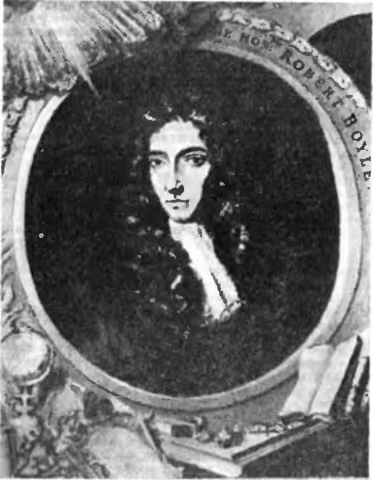
Robert Boyle (25 January 1627 – 30 December 1691) was an English physicist and chemist and a Fellow of the Royal Society of London (from 1663). He was born at Lismore (Ireland). He was educated at Eton College (1635–1638) and at the Academy of Geneva (1639–1644). From 1644 he lived on his estate at Stalbridge, where he carried out chemical research, and from 1656 in Oxford. In 1668 he moved to London.
His scientific work was devoted to establishing the experimental method in physics and chemistry and to developing the atomic theory. His research in physics led him to discover (1660)ed.2 the law by which the volume of air changes with its pressure (discovered independently by the French physicist E. Mariotte, hence the Boyle–Mariotte law). His research did much to establish chemistry as a science. From an experimental, quantitative study of the calcination of metals, of combustion, of the dry distillation of wood and of the transformations of salts, acids and alkalis, he introduced (1654) the idea of analysing the composition of bodies. In “The Sceptical Chymist” (1661) he defined elements as “primary and simple, entirely unmixed bodies, which are not made of one another but are the ingredients of which all so-called mixed bodies are made and into which they can in the end be resolved”. He introduced (1661) the idea of primary corpuscles as elements and secondary corpuscles as compound bodies. He explained the different states of aggregation of bodies. He obtained (1660) acetone by distilling potassium acetate. He worked out (1680) a new way of making phosphorus, and obtained phosphoric acid and hydrogen phosphide. He was the first (1663) to use indicators to detect acids and alkalis.
In Oxford he took part in founding the scientific society that in 1662 became the Royal Society of London.
From Kaloyan Manolov's “Great Chemists”
For more than a year now a bloody civil war had been raging in England. The republicans, led by Cromwell, were waging a fierce struggle against the king's supporters. The royal army suffered defeat after defeat. In one of the battles a wealthy landowner, Richard Boyle, Duke of Corked.1, was killed.
A cold grey murk had settled over London. On that gloomy evening the Boyle family was solemnly marking the anniversary of the Duke's death.
In the great hall Lady Ranelagh had ordered all the candelabra lit. The guests invited for this sad occasion — among them the well-known poet John Milton — talked quietly at a long oak table. At its head sat the hostess, Lady Ranelagh, one of the Duke of Cork's fourteen children. On either side of her sat her brothers: the elder, Lord Broghill, and the eighteen-year-old Robert Boyle1.
Robert drained his glass and covered his eyes with his hand. Before his mind's eye rose the Ireland dear to his heart... Lismore Castle, where he was born and spent his childhood; the college at Eton; his faithful tutor and teacher Marcombes; fascinating travels through Italy and France; years of hard study in Geneva. And now here he was in London...
His brother's words brought him back to the present:
“We shall always remember our father. He was strict, at times even stern with us children, yet he helped each of us find our calling in life. I took up literature, and Father did not stand in my way at all, although at heart he had marked me out for a soldier's career. Robert dreamed of science from childhood. ‘If you want to be a scholar, study,’ Father used to say. He hired the best teachers for my brother and sent him to study in Italy and then in Switzerland.”
Lady Katherine Ranelagh furtively brushed away a tear and said quietly:
“Gentlemen, I invite you all into the green room. There we may take our minds a little off these sad memories.”
It was in this room that the Duke's daughter usually received the scholars, men of letters and politicians who were famous at the time. Heated arguments had been held there more than once, and Robert Boyle, on his return to London, had become one of the regulars at these gatherings. But the future scientist dreamed of moving on from abstract disputes to real work.
For several days now unusual debates had been going on in his sister's house. This time Lady Ranelagh's guest was the Frenchman René Descartes, Cartesius1а. And Robert Boyle had become one of his most serious opponents. On that sad evening they took up the conversation broken off the day before:
“All the same, I cannot agree with you,” Boyle said to Descartes. “Reason should not be placed above everything. Francis Bacon2 said: ‘Knowledge is power, and power is knowledge.’ But where does knowledge come from?”
“I can foresee your answer,” exclaimed Descartes. “‘From experience.’”
“Of course. Experience is the best teacher.”
“But what would your experience be without reason? Everything that science gives us is the fruit of reason.”
“I by no means deny the role of reason,” Boyle remarked. “I may seem trite, but I should like to quote Bacon once more: ‘The philosopher... should not act like the spider, spending his reason on intricate webs; he should act like the bee, gathering facts and turning them into honey by means of reason.’ Your teaching on the material world is built on the ideas of Democritus3, who held that bodies are made of tiny indivisible particles — atoms. Today many philosophers and natural philosophers hold this view, but you will agree that the teaching of Aristotle4 still prevails. His four elements (fire, air, water, earth) and the three principles of the alchemists (mercury, sulphur, salt) are accepted by all.”
The scholars' argument went on for a long time, but one thought gave young Boyle no peace: could Aristotle be right? Could all bodies really consist of only four elements? And if so, why had the alchemists failed to find the philosopher's stone and with it turn every substance into gold? The question had to be settled by experiment. “Nothing from words, everything from experience”5 — that was the true motto of science.
Many natural philosophers supported Boyle in this. They often met at one of their number's houses to discuss the results of their experiments together and draw the necessary theoretical conclusions. Some of them had large laboratories. Young Boyle, too, dreamed of a laboratory of his own, but he did not dare ask his sister for money. Perhaps the best he could count on was Stalbridge6. The estate's many buildings could be fitted out as laboratories; besides, Oxford was within easy reach, and London not far off either: he would still be able to meet his friends...
They called their group the “Invisible College”7. No one knew of the meetings of these enthusiastic experimenters, whose concern was the problems of a new science just being born.
On the upper floor of the house at Stalbridge were a bedroom, a study, a spacious hall and a rich library. Every week a carrier brought boxes of new books from London. Boyle read with incredible speed. At times he sat over a book from morning till late at night. Meanwhile the fitting out of the laboratory was nearing completion. Besides a large brick furnace, Boyle also acquired iron furnaces standing on three thick iron legs. These furnaces were enormously heavy, but they were moved when there was need. By the end of 1645 research in physics, chemistry and agricultural chemistry had begun in the laboratory. Boyle liked to work on several problems at once. As a rule he explained to his assistants in detail what they were to do that day, and then withdrew to his study, where his secretary was waiting. There he dictated his philosophical treatises8.
An encyclopaedic scholar, Boyle, while working on problems of biology, medicine, physics and chemistry, took no less interest in philosophy, theology and linguistics. A follower of Francis Bacon, who held that experience was the chief source of knowledge, Boyle gave laboratory research the first place. His chemical experiments were the most interesting and varied. Boyle believed that chemistry was destined to become one of the fundamental sciences of philosophy. To his contemporaries chemistry was merely an art that helped apothecaries make medicines and alchemists search for the philosopher's stone; to Boyle it was a science that, having budded off from alchemy and medicine, could well stand on its own9.
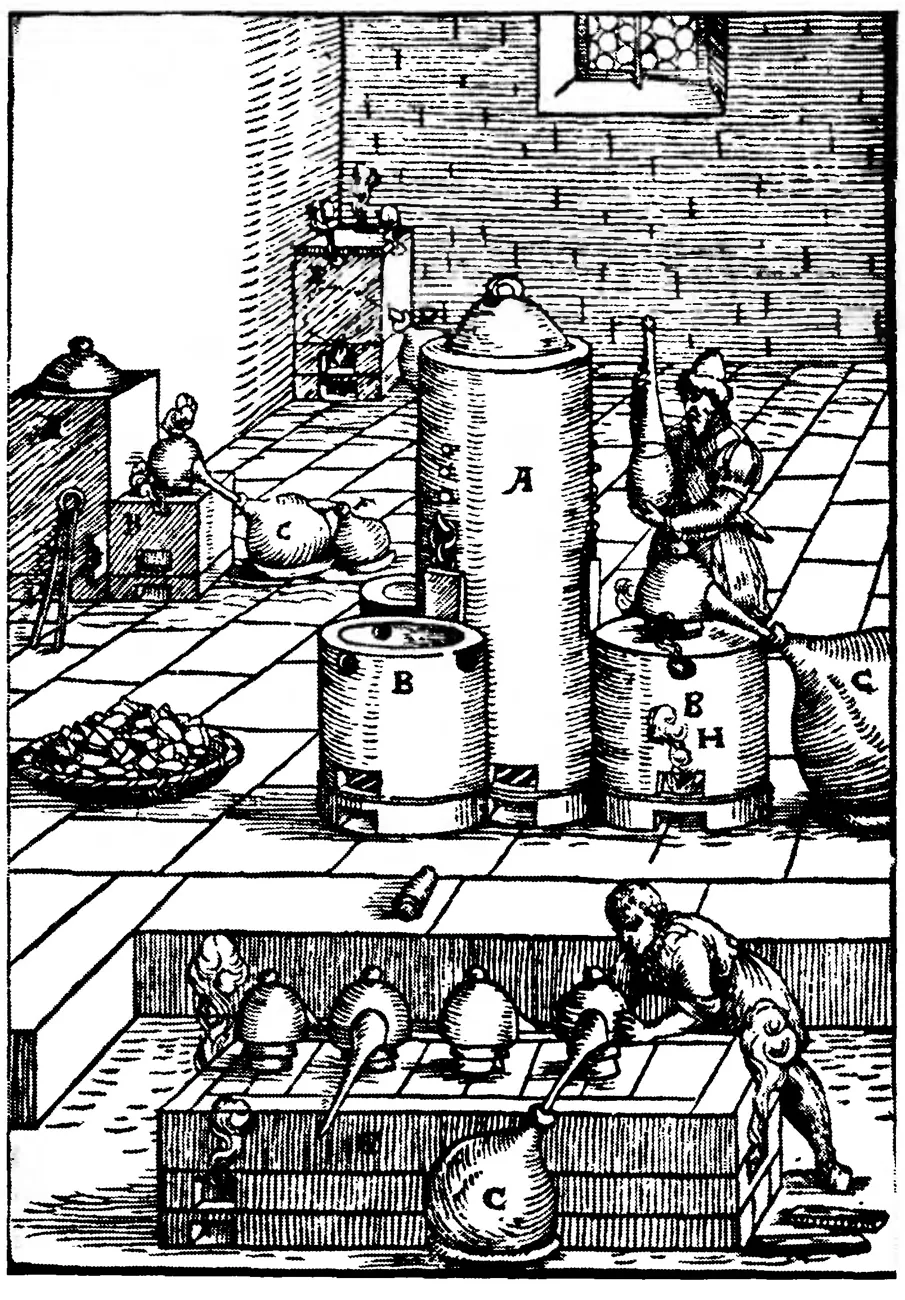
...In the laboratory, as usual, intense work was under way. The furnaces were burning, and all kinds of substances were heating in retorts. Boyle was about to make his morning round of the rooms when the gardener came into his study and set down in a corner a basket of magnificent dark violet violets. Delighted by their beauty and scent, the scientist took a small bunch with him and went to the laboratory: “vitriol” (a sulphate of a heavy metal) was to be distilled that day to obtain “oleum vitrioli”, concentrated sulphuric acid. Boyle opened the door — thick clouds of fumes were coming from the glass receiver.
“How is the work going, William?” he asked the young man who was watching the furnace.
“All in order, sir.”
“Anything new?”
“Nothing yet. Last night two bottles of hydrochloric acid were delivered to us.”
“From where?”
“From Amsterdam again. Bought from Rudolf Glauber.”
“I should like to have a look at this acid. Pour a little into a flask.”
Boyle put the violets on the table to help William pour out the acid. Acrid fumes poured from the neck of the bottle and slowly spread across the table. The pale yellow liquid in the flask was fuming too.
“Splendid! When you have finished the distillation, come up and see me, and we shall discuss the plan of work for tomorrow.” Boyle took the bunch from the table and carried it to his study. Only then did he notice that the violets were fuming slightly. What a pity! Drops of acid had splashed on them. They ought to be rinsed. He put the flowers in a glass of water and sat down by the window with a book. After a while, looking up from his reading, he glanced at the glass of violets. What a marvel! They had turned red. Boyle flung the book aside, seized the basket of fragrant flowers and hurried down to the laboratory.
“William, bring some glasses and a little of each of the acids. Don't forget water as well.”
The young assistant promptly did as the master told him. He knew that this was no time for questions. Boyle would explain everything later. They poured the acids into the glasses and diluted them with water, then dipped small bunches of violets into them. Boyle sat down on a chair and waited. Little by little the blue-violet colour of the flowers began to take on a reddish tinge. Soon they turned red.
“So it is not only ‘spiritus salis’ but the other acids too that can turn the blue colour of violets red,” Boyle concluded. “This is very important! Now we can easily tell whether a given solution is acid: we need only dip a violet petal into it.”
Boyle thought for a second.
“Better still, let us do this: we shall gather violet petals and make an infusion of them...”
“Shall we make it in water or in spirit?” asked William.
“In both. We shall see which works better. One drop of such an infusion added to the solution under test will colour it, and from the colour we shall be able to tell whether it is acid or not.”
“And perhaps alkalis will change the colour of the dye too?” William ventured timidly.
“Of course. We shall try that as well. And now to work! Get the extraction apparatus ready. I shall send the gardener for flowers.”
It was decided not only to extract violets but also to make an infusion of fragrant rose petals.
A tireless investigator, Boyle did not stop at infusions of flowers. For this purpose he gathered medicinal herbs, lichens, gall nuts, tree bark and plant roots... The scientist and his assistants made many infusions of different colours. Some changed colour only under the action of acids, others only under the action of alkalis. But the most interesting proved to be the violet infusion obtained from the litmus lichen. Acids turned it red, and alkalis blue. Boyle had paper soaked in this infusion and then dried. A scrap of such paper dipped into the solution under test changed colour and showed whether the solution was acid or alkaline. This was one of the first substances that Boyle, even then, called indicators. And, as so often happens in science, one discovery led to another. While studying an infusion of gall nuts in water, Boyle found that with salts of iron it formed a solution coloured black. This black solution could be used as ink. Boyle studied the conditions for making ink in detail and drew up the necessary recipes, which were used for almost a century to make high-quality black ink.
The observant scientist could not overlook yet another property of solutions: when a little hydrochloric acid was added to a solution of silver in nitric acid, a white precipitate formed, which Boyle called “luna cornea” (silver chloride). If this precipitate was left in an open vessel, it turned black. This was an analytical reaction that showed reliably that the substance under study contained “luna” (silver). Boyle mistakenly thought that the precipitate blackened through the action of the air. At that time he could not yet suspect that the decomposition was caused by light. The scientist also knew many other reactions that gave precipitates.
Boyle continued to doubt that fire had a universal power of analysis, and looked for other means of analysis. His many years of research showed that when substances are acted on by one reagent or another, they can break down into simpler compounds. By using specific reactions these compounds could be identified. Some substances formed coloured precipitates, others gave off a gas with a characteristic smell, still others gave coloured solutions, and so on. The breaking down of substances and the identification of the products by means of characteristic reactions Boyle called analysis. This was a new method of work, and it gave the impetus to the development of analytical chemistry.
At that time scientists believed that only fire could break down every substance. Boyle was by no means sure they were right. He knew from experience, for example, that when sand, soda and limestone were strongly heated, the mixture not only did not break down but turned into glass. Fire and air drew his attention more and more. And so his assistants were more and more often set the task of studying how fire and air affect chemical processes. At the centre of attention was combustion, one of nature's most hidden secrets, which Boyle tried to unravel. The scientist made several important discoveries, but he could not give a correct explanation of combustion, because, like many scientists of his age, he believed that fire contained a special element, “caloric”10. Boyle sincerely believed that in burning, substances combine with caloric. He saw the main proof of this in the calcination of metals: the ash (oxide) obtained was always heavier than the metal taken11.
“Caloric can pass even through glass, for a metal heated in a sealed glass vessel also burns and forms an ash that weighs more than the metal itself...” Boyle reasoned; but his other experiments proved beyond dispute that air plays no small part in combustion. Something from the air combined with the burning substances. Many of them, such as spirit, wax and resins, formed water when burnt. But the scientist could not bring these facts together and give them a theoretical basis, because he could not free himself from the strong influence of the alchemists' dogmas.
Had Boyle succeeded in discovering oxygen, there would have been no need to create the phlogiston theory12.
And yet Robert Boyle's services to science are immense. He tried to penetrate the secrets of nature. The results of his research, his philosophical conclusions and generalisations are set out in the pages of his many treatises13. Most of them he published, and some, those that remained in manuscript, he spoke about at the meetings of the “Invisible College”. Robert Boyle's name was spoken with respect. His remarkable mind, kind nature, unusual gentleness and goodwill towards people won the admiration of all around him.
But the scientific work at Stalbridge had to be suspended: bad news came from Ireland. Rebellious peasants had laid waste the castle at Cork, and the income from the estate fell sharply. At the beginning of 1652 Boyle was obliged to go to the family estate. Much time went on settling financial problems; a more experienced steward was appointed, and at times Boyle checked his work himself. But the affairs of the estate could not draw Boyle away from science. He did not confine himself to reading books. Since there were no proper conditions for chemical and physical experiments, he took up medicine. In this he was helped to a certain extent by William Petty14. Almost every day they met in Petty's study. Anatomy and physiology fascinated Robert Boyle. Besides, philosophy and economics were the constant subjects of their talks.
In those months the scientist kept up a large correspondence. Less than a year after Boyle had moved to Ireland, his thoughts turned to London again. The occasion was a letter from his friend the mathematician John Wilkins15. “Dear Boyle,” wrote Wilkins, “our ‘Invisible College’ has moved to Gresham College. Many English scholars have gathered in Oxford. The mathematicians John Wallis16 and Seth Ward, the physicians Goddard and Willis17 and many others work here. Worden is here too, but he works at Wadham College. Your absence is keenly felt. In my view there is no sense in sitting it out in Ireland. Everyone thinks you ought to be with us in Oxford.”
Return to England? Not a bad idea! The affairs of the estate had long since been put in order. And in Oxford there really were wide opportunities for scientific work.
Then came a letter from Worden — he too urged him to move to Oxford. Boyle gave his last instructions to the steward and quickly made ready for the journey.
The year was 1654. The snow was slowly melting, and the harsh winter was giving way to spring. Robert Boyle's heart, too, was full of spring joy. At last he would again have spacious laboratories. Besides the laboratories in the college, he would certainly build some of his own.
His friends welcomed him warmly; great and serious work lay ahead. Without losing a day, Boyle set about his research. He was helped by a young assistant recently arrived from France, Guillaume Homberg18. Air, the structure of substances, combustion — how many phenomena of nature were still unknown!
“Analysis alone is not enough,” Boyle said one day. “A theory is needed too, but not an invented one — one tested by practice.”
“But you already have views of your own,” Homberg replied.
“Yes, certainly. And they are borne out by our many years of research. Can all bodies be turned by analysis into one and the same salt, saltpetre and mercury? Of course not!”
“That is just one of the alchemists' inventions. It has not been proved by experiment,” Homberg agreed.
“Yes, experiment shows the opposite... The same must be said of Aristotle's teaching. There is no way of turning the enormous variety of bodies into only four elements: water, air, earth and fire. In nature there is a great number of elements, which form more complex substances. These, when they break down, give the elements, which are unchangeable, since they cannot be broken down into constituent parts. They consist of corpuscles19,” Boyle concluded.
“But, as far as I know, you also accept the existence of more complex corpuscles?”
“Yes: when the corpuscles of elements combine, they form compound corpuscles.”
“But are corpuscles eternal?”
“Yes. And here is an example. Take a little gold, put it in aqua regia and heat it, and you will see that before long it dissolves. If the solution is evaporated, we get a new substance, and if a little zinc is added to the solution, a gold powder settles to the bottom. This is the very gold you dissolved at first. So the corpuscles change their state but remain eternal. Aqua regia seems to destroy the nature of gold, but its essence — the corpuscles — stays unchanged.”
Boyle accepted the existence of a certain first principle of matter. This was nothing new. The ancient philosophers had also accepted the existence of a prime matter. For some it was water, for others earth... For Boyle it had a definite state, but he believed that the three basic properties of prime matter — shape, size and motion — were also the three basic properties of corpuscles. For him the property of “weight” did not exist. The absence of weight was the Achilles' heel of his views, for it was precisely through lacking weight that Boyle's corpuscles remained in the world of the immaterial: they were “ideas”, products of the mind, rather than particles that really existed.
On the one hand, Boyle's ideas brought something new, drawn from experiment and taking in all the latest achievements of scientific thought; on the other, born of the barren sophistries of the scholastic teachings, they could not break out into the open spaces of true knowledge. Yet the first brick had been laid. The concept of the “element”20 was used to explain chemical reactions. Alongside it there existed the concept of the “corpuscle”, but with a mainly philosophical colouring. These concepts developed step by step until Dalton's atomic theory appeared, and later the atomic and molecular theory.
The joint research of Boyle and Homberg had a single aim: to put substances in order and divide them into groups according to their properties.
“Elements, as the simplest, must be put first. Of course there are far more compounds, but in considering them too we must begin with the simpler ones,” Boyle reflected.
“Then we must begin with the metals,” Homberg suggested.
“Let us hope we are on the right track. Indeed, metals are simple compounds, because when they are dipped in acid they break down under its action and give off the ‘air’ they contain. Next comes the class of vitriols — blue, green, white. Metals form solids with ‘acidum oleum vitrioli’ — the ‘vitrioli’. Let us go on to study the compounds of metals with other acids.”
Boyle and Homberg prepared and studied many salts. With every experiment their classification grew wider and more complete. Not everything in the scientists' interpretation was sound, not everything agreed with the ideas of the time, and yet it was a bold step towards a consistent theory, a step that was turning chemistry from a craft into a science. It was an attempt to bring into chemistry the theoretical foundations without which a science is unthinkable and cannot move forward.
Guillaume Homberg, who in time settled in France, applied the new approach to the study of substances at the Paris Academy of Sciences.
Boyle meanwhile continued his research in Oxford. After Homberg his assistant was the young physicist Robert Hooke21. They devoted their research chiefly to gases and to developing the corpuscular theory.
“Descartes maintains that bodies consist of corpuscles and ether22,” Boyle said. “Then in gases, where the corpuscles move freely, there must be a great deal of ether.”
“Descartes's followers, the Cartesians, are convinced of it,” said Hooke.
“Yes, but what does Torricelli's experiment23 show? In the tube above the mercury there is an empty space.”
“Then perhaps the corpuscles of gases move in empty space?”
“That must be tested,” Boyle replied. “We shall make apparatus from which we shall remove the air with a pump, and examine what is left in the vessel: empty space or ether.”
“But our pumps are poor.”
“We shall try to make better ones ourselves, if need be.”
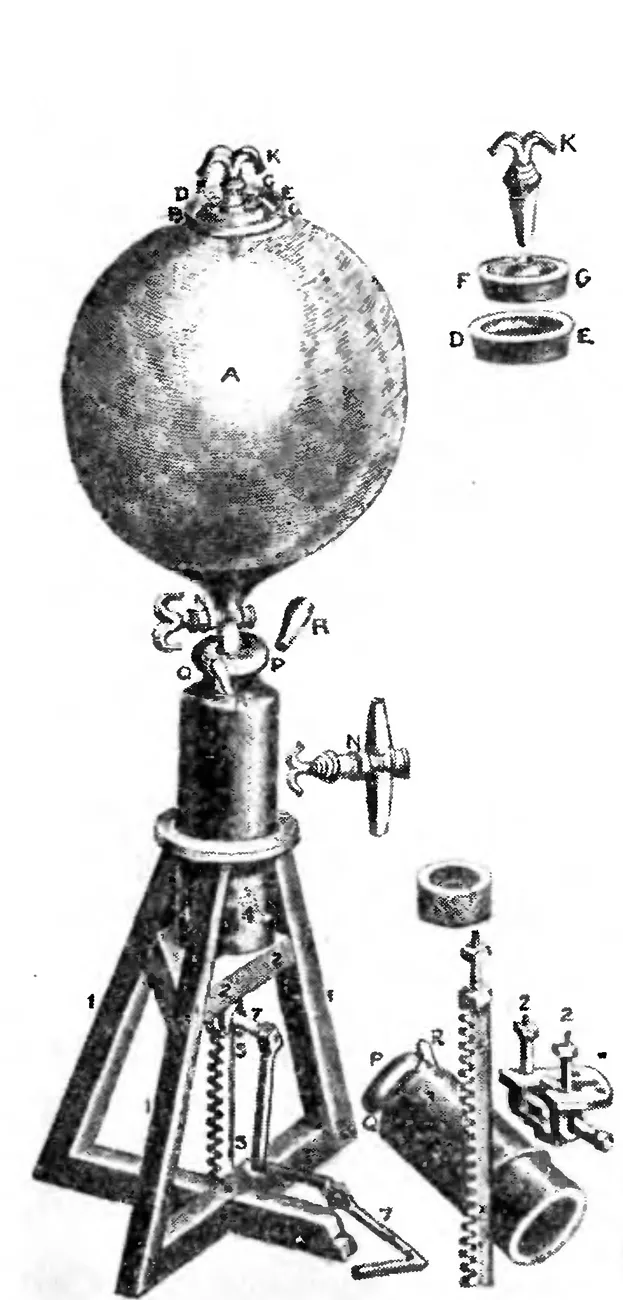
The work began. Sleepless nights, nervous strain, anxious waiting... The pumps really were useless. They could not remove all the air from the vessel. And so Hooke set about designing a new pump. With it the investigators managed to remove almost all the air. But all their attempts to prove the presence of ether in the empty vessel were in vain. Boyle made one more improvement to the pump. They repeated the experiment, but the result was the same.
“There is no ether at all,” Boyle summed up.
“It is an empty space, such as there is in the Torricellian void.”
“Yes, and we shall call this empty space a vacuum, which in Latin means ‘empty’. So in a vessel of gas there can be only corpuscles and vacuum.”
“But this is a blow to the Cartesians. They will not be slow to fall on us in their treatises.”
Hooke was right. Descartes's followers did indeed raise an outcry over it, but they argued their case in words, while Boyle had the results of experiments. He did not like getting into disputes. Fierce battles, such as the Cartesians challenged him to, were foreign to his gentle nature. He doggedly went on with his research: new data had to be gathered, new books written. That was how he would answer his opponents and present fresh proof that his conclusions could not be disputed24.
The crisis that gripped all England at the end of the fifties interrupted his scientific work. Outraged by Cromwell's cruel dictatorship, the supporters of the monarchy rose up again. Arrests and killings, bloody internecine strife became commonplace in the country.
Boyle withdrew to his estate: there he could work in peace. He decided to set out the results of his research over the last ten years. Two secretaries worked in Boyle's study almost round the clock. One took down the scientist's thoughts at his dictation; the other made fair copies of the drafts already written. In a few months they completed Boyle's first large scientific work, “New Experiments Physico-Mechanical, Touching the Spring of the Air, and its Effects”25. The book came out in 1660. In it Boyle described all the experiments carried out over the last two years and for the first time criticised Aristotle's teaching of the four elements, Descartes's “ether” and the three alchemical principles. Naturally, this work drew sharp attacks from the followers of Aristotle and the Cartesians. But Boyle based it on experiment, and so his proofs were beyond dispute. Most scientists — the followers of the corpuscular theory — received Boyle's ideas with enthusiasm. Many of his opponents in ideas were also obliged to acknowledge the scientist's discoveries, among them the physicist Christiaan Huygens26, a supporter of the existence of the ether.
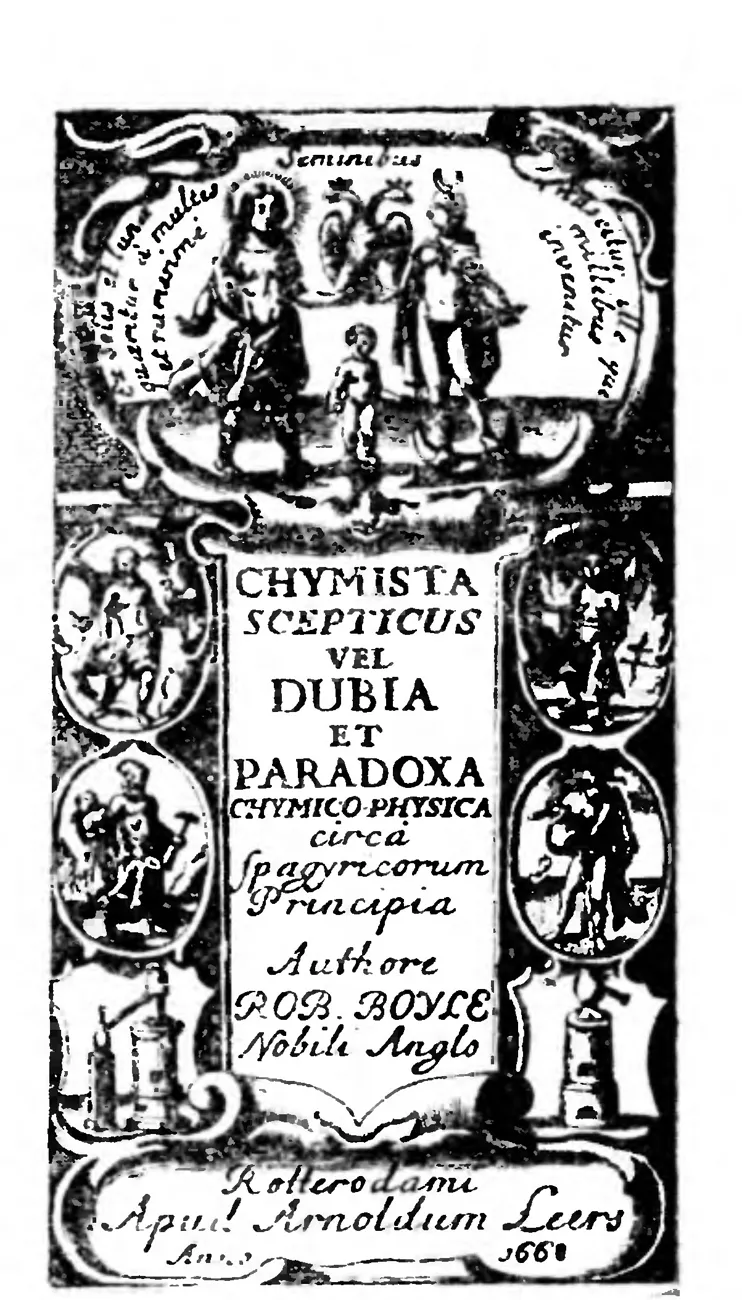
Without losing a day, Boyle set to work on his next book, “The Sceptical Chymist”27. In it the scientist developed his ideas on chemical elements. Having described his experiments one after another and drawn the appropriate conclusions, he completely refuted the alchemists' teaching of the three principles — sulphur, mercury and salt. Boyle also left not one stone standing of the teaching of the four elements, which had stood for almost two thousand years. But in this work he gave most of his attention to questions connected with fire. He showed that heating not only causes a substance to break down, but can also cause it to combine, or have no effect on it at all.
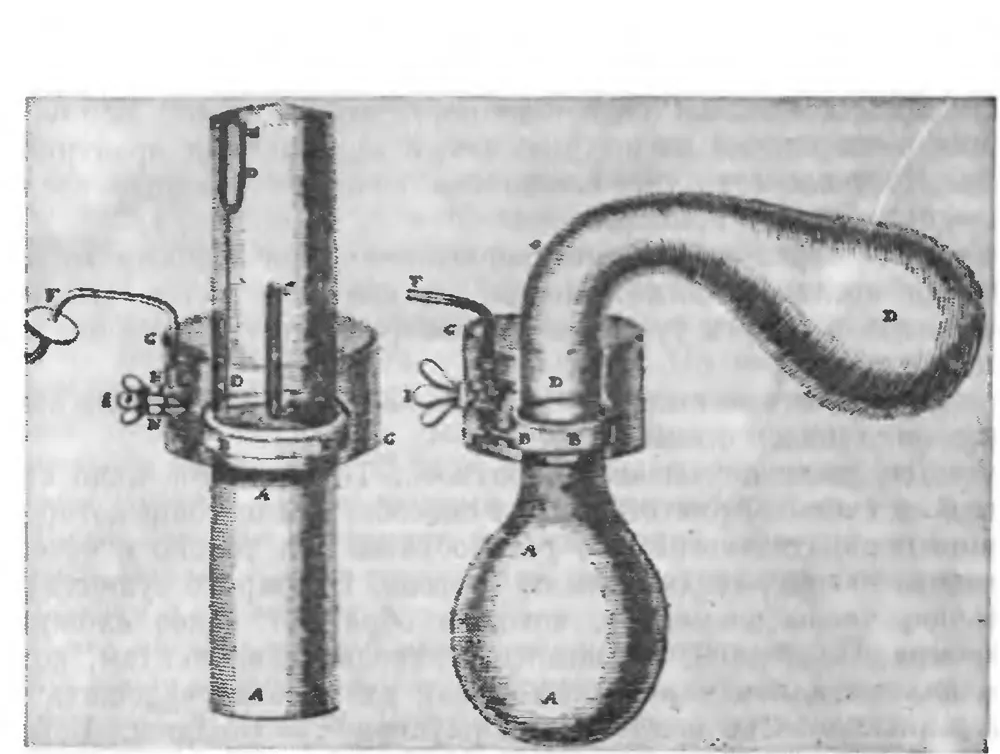
While working on “The Sceptical Chymist”, Boyle went on with his experiments in the laboratory. After Charles II came to the throne, the country's political life became somewhat more settled, and the scientist could now do his research in Oxford. Sometimes he visited his sister Katherine in London. His assistant in the Oxford laboratory was now the young physicist Richard Towneley28. Boyle had not given up his intention of answering the criticism of his “New Experiments” and of continuing to study air. Using special glass vessels with divisions marked on their walls29, by which the volume of the gas they held could be measured, the investigator tried to get to the bottom of difficult questions: what forces make the corpuscles bind together, and do such forces exist at all?
“Let us try applying different pressures,” Boyle said to his assistant. “Raise the levelling bulb so that the pressure is doubled. That's it. Higher still. Now measure the volume.”
“The volume is halved,” said Towneley.
“Interesting. Now halve the pressure.”
“Now it has doubled.”
“Let us increase it threefold...”
They repeated such experiments many times, but the result was always the same: the volume of a gas was inversely proportional to its pressure. It was the greatest discovery of the seventeenth century. Boyle first described it in 1662 (“A Defence of the Doctrine Touching the Spring and Weight of the Air”)30 and modestly called it a hypothesis. Fifteen years later in France Mariotte31 confirmed Boyle's discovery, finding the same law. It was in essence the first law of the nascent science of physical chemistry.
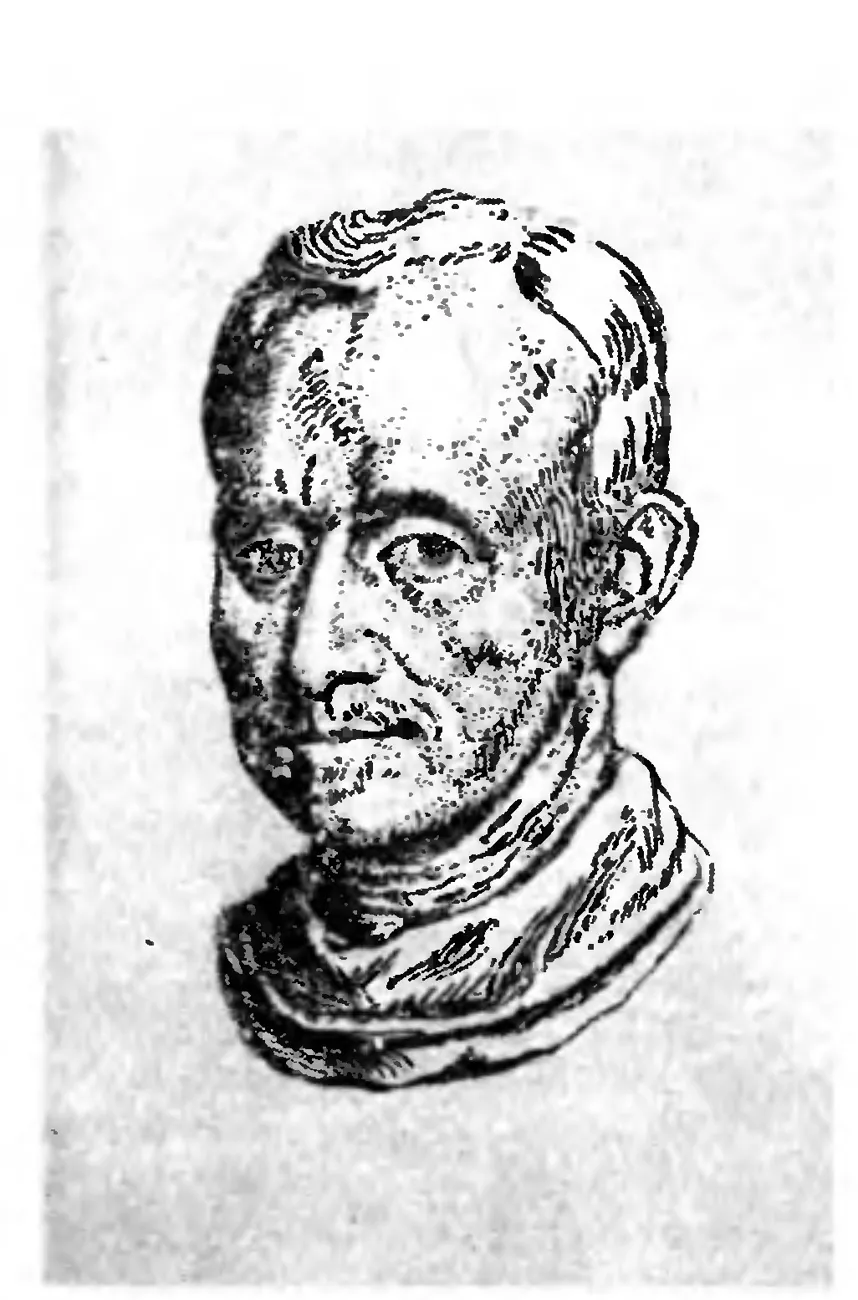
The work of the Oxford scientists was wonderfully fruitful; it was no accident that Oxford was then considered the centre of scientific thought in England. The “Invisible College” laid the foundations for the creation in 1663 of the English Academy of Sciences, or, as it was called, the Royal Society of London32. Robert Boyle was unanimously elected to the Society's Council. His first assistants were Robert Hooke and Henry Oldenburg33. Boyle was at the height of his creative powers: one after another, scientific works on philosophy, physics and chemistry came from his pen. In 1664 he published “Experiments and Considerations Touching Colours”. At that time a young German chemist, Johann Becher34, was working in his laboratory. Once again they studied fire together35. Boyle noticed that a substance put into a flame colours it in various colours. Compounds of copper, for example, give the flame a green colour. The discovery made it possible to recognise substances. Becher had to carry out a series of experiments to establish the colour characteristic of each element. A hard-working chemist with an unusual cast of mind, Becher, on his return to Germany, developed Boyle's teaching in his work “Physica subterranea”. Later Becher's fellow countryman Georg Stahl36 built the phlogiston theory on his observations and discoveries.
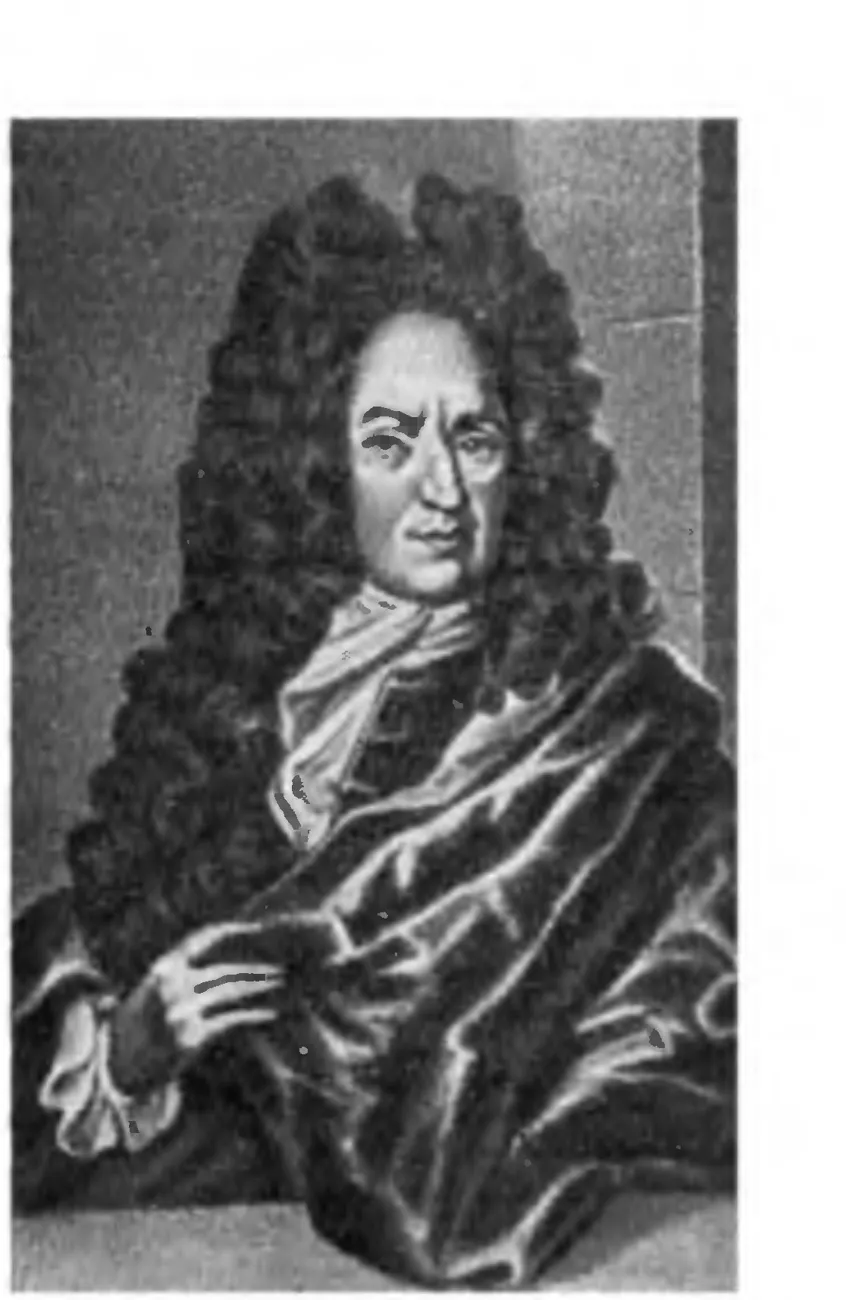
By then Boyle was at the height of his fame. He was now often invited to the palace, for the great and powerful, too, thought it an honour to talk even for a few minutes with “the luminary of English science”. Honours were paid him everywhere, and he was even offered membership of the “Royal Mines” company. The following year he was appointed a director of the East India Company. But none of this could distract the scientist from his main work. His books bear witness to that: “Hydrostatical Paradoxes”, “The Origin of Forms and Qualities According to the Corpuscular Philosophy”, “On Mineral Waters”. In the last of these he gave an excellent description of methods for analysing mineral waters.
In 1669, at a celebration on the occasion of Isaac Newton's appointment as professor of physics, Boyle met a friend of Johann Kunckel37, Krafft38. Krafft had worked for some time in Hamburg with the alchemist Brand39.
“I should like to meet you, Mr Krafft, and talk in more favourable surroundings. Could you call on me tomorrow?”
“With the greatest pleasure, Mr Boyle.”
The next day they sat facing each other.
“Mr Krafft, the discovery of the alchemist Brand interests me greatly,” Boyle began. “Tell me about it in more detail.”
“Brand heats the dry residue of urine, having first mixed it with sand. In this way he obtains an easily inflammable substance which, collected and cooled under water, glows at night. The substance gives off a cold light.”
“I should like to try to obtain such a substance. I should be grateful if you would visit my laboratory and be so kind as to give us some advice.”
“Perhaps we might begin the work today?”
“Excellent! I am at your service,” said Boyle, delighted.
The scientists went off to the laboratory.
For several years Boyle studied the substance called the glowing stone, or phosphorus. He discovered that burning phosphorus forms a white ash that reacts rapidly with water. The resulting solution gave an acid reaction, and so Boyle called it phosphoric acid. The scientist noticed that when phosphorus was heated with alkali a gas (phosphine) was produced. On coming into contact with air the gas caught fire and dense white smoke formed. Boyle tried to work out another, better method of making phosphorus, and in the end he succeeded. In 1680 he obtained white phosphorus, which for a long time afterwards was called Boyle's phosphorus40.
Time passed. Boyle's health grew much worse. He could no longer supervise the work in the laboratories or take an active part in research. Yet he needed to set down the knowledge he had gained in the course of almost thirty-five years of research. With this aim Boyle went off to the family estate, having declined the offer to become President of the Royal Society. Sometimes he travelled to Cambridge to talk with Newton, to Oxford to see old friends, or to London to meet the sophists. But he felt best of all at home, in his study among his books. Now he was taken up chiefly with philosophical problems. Boyle wrote a great many books; some came out only after the scientist's death: part of his manuscripts was found in the archives of the Royal Society.
He died in 169141, leaving a rich scientific legacy to future generations. His theory of the corpuscular structure of substances was a step forward on the road to the atomic and molecular theory. True, at the end of his life, having fallen under the influence of mystical philosophical teachings, Boyle came more and more to doubt the correctness of the corpuscular ideas. For him corpuscles were merely a form of thought, by which certain phenomena could be explained, and not things that really existed. And yet the great scientist's research marked the birth of a new chemical science. He set chemistry apart as an independent science and showed that it had its own problems and its own tasks, to be solved by its own methods, different from those of medicine. In Boyle's view, chemistry was to explain chemical processes and the structure of substances and also to create new methods of work. By systematising the many colour reactions and precipitation reactions, Boyle laid the foundation of analytical chemistry. His research on the burning of substances led to the first general theory in chemistry, Georg Stahl's phlogiston theory.
Notes
- 1. Robert Boyle was born on 25 January 1627; he was the thirteenth of the fourteen children of Richard Boyle, first Duke of Cork, a ferocious and successful acquirer of wealth who lived in the time of Queen Elizabeth and enlarged his holdings by seizing other people's land. (Haydn H. The Counter-Renaissance. New York, 1950, p. 67.)
- 1а. René Descartes, Cartesius (1596–1650), was a French philosopher, physicist, physiologist and mathematician. His works laid the foundation of analytic geometry. In the seventeenth century, thanks to the accumulation of experimental knowledge and observations, new teachings and systems of materialist natural philosophy arose that bore directly on chemistry. Among these theories was the corpuscular theory of R. Descartes, which he set out in a number of his writings (см.: Декарт Р. Избранные произведения. — М.: Госполитиздат, 1950). Descartes held that the bodies around us “consist of numerous small particles of various shapes and sizes”. But Descartes did not consider these particles indivisible; he held that they could be divided without end. Various physical phenomena, in Descartes's view, depended on the shape and size of the particles and above all on their vortex motions. Later, after a controversy with another French philosopher, P. Gassendi (1592–1655), who criticised Descartes's teaching of “innate ideas”, he partly changed his views on particles and held that there were three kinds of primary particles differing in size. These particles enter into every body in different proportions and, under the action of a number of factors, can change their shape. Sharp particles then form salt, soft ones sulphur, and heavy round ones mercury, that is, the three principles of the alchemists. On Descartes see: Выдающиеся физики мира: Рекомендательный указатель. — М.: ГБЛ и ЦНТБ, 1958, с. 42—49; Ляткер А. Я. Декарт. — М.: Мысль, 1975. — (Мыслители прошлого); Матвиевская Г. П. Рене Декарт. — М.: Наука, 1976.
- 2. Francis Bacon, Baron Verulam (1561–1626), was an English philosopher and statesman who put forward the study of phenomena by experience as the chief method of science. He was the founder of English materialism and of the experimental sciences, and opposed scholasticism. For Bacon, “science is experimental science and consists in applying a rational method to the data of the senses. Induction, analysis, comparison, observation and experiment are the chief conditions of a rational method.” His principal work is the “Novum Organum” (Л.: ОГИЗ, 1935). On Bacon see: Копелевич Ю. Х. Вопросы истории естествознания и техники, вып. I (38), 1972, с. 19—25; Луначарский А. В. Силуэты. — М.: Мол. гвардия, 1965. — (ЖЗЛ); Субботтин А. Л. Фрэнсис Бэкон. — М.: Мысль, 1974. — (Мыслители прошлого).
- 3. Democritus (Demokritos) of Abdera (c. 460 – c. 370 BC) was an ancient Greek philosopher and one of the founders of materialist atomism. He held that everything that exists consists of atoms and the void, in which indivisible particles, alike in quality but different in configuration, move, combining and separating. Knowledge, according to Democritus, rests on sensations, but the essence of the world (atoms and the void) is known by reason. (Демокрит. Тексты/Пер. и исследования С. Я. Лурье. — Л.: Наука, 1970). On Democritus see: Лурье С. Я. Демокрит. — М.: Мол. гвардия, 1937. — (ЖЗЛ); Асмус В. Ф. Демокрит. — М.: Изд-во МГУ, 1960; Виц Б. Б. Демокрит. — М.: Мысль, 1979. — (Мыслители прошлого).
- 4. Aristotle (Aristoteles) (384–322 BC) was an ancient Greek thinker. According to his teaching, the world consists of a primary matter (principle) and four basic qualities: heat, cold, dryness and moisture. Primary matter is always joined to two of these four qualities, heat and cold, and likewise dryness and moisture, excluding each other. From this arise the four elements: fire = primary principle + (heat and dryness); water = primary principle + (moisture and cold); air = primary principle + (heat and moisture); earth = primary principle + (cold and dryness). On Aristotle see: Зубов В. П. Аристотель. — М.: Изд-во АН СССР, 1963; Джохадзе Д. В. Диалектика Аристотеля. — М.: Наука, 1971; Кузнецов Б. Г. Путешествие через эпохи: Мемуары графа Калиостро и записи его бесед с Аристотелем, Данте, Пушкиным, Эйлером и многими другими современниками. — М.: Мол. гвардия, 1975. — (Биографии великих идей); Голин Г. М. Классики физической науки: Краткие творческие портреты. — Минск: Выш. школа, 1981, с. 5—8; Чанышев А. Н. Аристотель. — М.: Мысль, 1981. — (Мыслители прошлого). Some of Aristotle's works are available in Russian translation, for example the Prior and Posterior Analytics (Л.: Госполитиздат, 1952).
- 5. “Take nobody's word for it” is the motto on the arms of the Royal Society of London (the English Academy of Sciences), of which Boyle was one of the founders and a most active member. It is a paraphrase of line 14 of Horace's Epistles (Копелевич Ю. Х. Возникновение научных академий: Середина XVII—середина XVIII вв. — Л.: Наука, 1974, с. 52).
- 6. Stalbridge was one of the estates in England that Boyle inherited.
- 7. About 1645 a group of people interested in the new science, especially in the discoveries of Galileo and Torricelli, began to meet at Gresham College of the University of London. Soon the difficulties caused by the civil war (which ended in 1645) led some of the Gresham College professors to move to Oxford, where a circle of experimenters was formed, headed by J. Wilkins (see note 15). In 1653 Boyle, too, moved from London to Oxford. In his letters he called this circle "The invisible college" (Копелевич Ю. Х., ук. соч., с. 42, прим. 4).
- 8. Boyle was more the head of a laboratory than a lone experimenter. Under him worked numerous assistants and mechanics, who made observations and worked out in detail the problems the scientist set them. A staff of secretaries handled his large correspondence and kept track of reports of new scientific discoveries (Boas M. Robert Boyle and seventeenth-century Chemistry. — Cambridge: University Press, 1958, p. 6—7, 14—24; More L. T. The life and works of the Honourable Robert Boyle, 1944).
- 9. Boyle wrote of the new tasks of chemistry: “Chemists have so far been guided by far too narrow principles, which did not call for any particularly broad mental outlook; they saw their task as preparing medicines and extracting and transmuting metals. I look at chemistry from an entirely different point of view: I look at it not as a physician, not as an alchemist, but as a philosopher. I have sketched here a plan of a chemical philosophy, which I hope to carry out and perfect by my experiments and observations...” (Мейер Э. История химии от древнейших времен до нашего времени. — СПб, 1889, с. 85). The rule of Boyle's predecessors in chemistry was: “Without fire we perform no operations.” Fire was considered the chief means of decomposition, and all the products obtained by calcining metals or heating a substance (sublimation and the like) were considered elements (Шамин А. Н., Химия становится наукой. — В кн.: Крицман В. А., Ч. I, ук. соч., с. 53—72).
- 10. Caloric (the matter of heat), according to the mistaken views widespread in the physics of the eighteenth century and the first half of the nineteenth, was a special weightless matter that formed part of every body and accounted for its heat. Studying combustion, the calcination of metals and respiration after the alchemists, Boyle established that some constituent of the air takes an active part in these processes. Boyle's observations played an important part in the further development of scientific knowledge (Джуа М., ук. соч., с. 91; Копелевич Ю. Х., ук. соч., с. 47 и сл.).
- 11. Boyle brought the balance into laboratory practice, although one of no great accuracy (from 1 to 0.5 grain, that is, roughly from 60 to 30 mg), and worked out a method of weighing.
- 12. Phlogiston (from the Greek phlogistos, combustible), according to the ideas that prevailed in eighteenth-century chemistry, was a “fiery matter” with negative weight, supposedly contained in all combustible substances (metals among them) and released from them in burning. The phlogiston theory was created by G. E. Stahl in 1697. The term “phlogiston” occurs in Aristotle and also in the Swiss chemist N. Hapelius (1559–1622), who used it in 1606 (Джуа М., ук. соч., с. 129). On phlogiston see: Соловьев Ю. И. Эволюция основных теоретических проблем химии. — М.: Наука, 1971, с. 25—39; Становление химии как науки. — М.: Наука, 1983, с. 64—71. — (Всеобщая история химии); Штаубе И. Вопросы истории естествознания и техники, вып. 2 (31), 58 (1970); Сабадвари Ф., Робинсон А., ук. соч., с. 42—47.
- 13. All Boyle's books were written in English; in this he broke with the tradition of publishing scientific books only in Latin. A number of his writings were translated from English into Latin by H. Oldenburg, the secretary of the Royal Society of London. Thanks to this, Boyle's works became known to scholars all over the European continent, since Latin was then the international language of scholars (Копелевич Ю. Х., ук. соч., с. 45—46).
- 14. William Petty (1623–1687) was an English economist and statistician, a founder of the classical school of bourgeois political economy, a friend of Boyle and one of the twelve founders of the Royal Society of London. He is known as the author of “Political Arithmetick” (1690), one of the first works on economic statistics.
- 15. John Wilkins was the author of a number of works arguing the great usefulness of applying mathematics and natural science in technical practice. In his work “The Discovery of a World in the Moone” he put forward the idea that man might fly to the Moon and discussed the immense possibilities opened up by the new science. He was the first president of the English “College for the Promoting of Physico-Mathematical Experimental Learning”, which was founded on 28 November 1660. This date is considered the beginning of the Royal Society of London (Копелевич Ю. Х., ук. соч., с. 42, 44 и др.).
- 16. John Wallis (in some editions Уаллис or Валис) (1616–1703) was one of the most eminent English mathematicians of the seventeenth century and a convinced supporter of the experimental method in science (Копелевич Ю. Х., ук. соч., с. 43—46 и др.; Льоцци М. История физики. Пер. с итал. — М.: Мир, 1970, с. 94, 133—134).
- 17. Thomas Willis (Willisius) (1620–1675) was an English physician and anatomist. From 1660 he was a professor at the University of Oxford; in 1666 he moved to London. He did research on the anatomy of the brain. On Willis see: Епифанов Н. С. Архив анатомии, гистологии и эмбриологии, вып. 11, 125, 1975).
- 18. Wilhelm (Guillaume) Homberg (1652–1715) worked in botany, medicine, astronomy, alchemy and chemistry. For some time he worked in Boyle's laboratory. In 1691 he was elected a member of the Paris Academy of Sciences. He was the first to obtain pure boric acid, by the action of sulphuric acid on borax; he tried to establish the quantitative relations in neutralisation reactions, and studied metal alloys and natural products. On Homberg see: Partington J. R. ук. соч., т. 3, с. 42—47; Джуа М., ук. соч., с. 96; Фигуровский Н. А., ук. соч., с. 226. (The events the author describes probably belong to the 1670s.)
- 19. Corpuscle (from the Latin corpusculum, a little body) is a general name for particles of matter. In the eighteenth century the word replaced the concept of the “atom”.
- 20. The concept of the “element”, free of metaphysical philosophical errors, was first given in a relativistic and experimental sense by A. L. Lavoisier (Джуа М., ук. соч., с. 142—145). On the origin of this concept see: Фигуровский Н. А., ук. соч., с. 51—52.
- 21. Robert Hooke [1635 (or 1638) – 1703] became Boyle's assistant in Oxford and with him carried out almost all of the many experiments made at the Royal Society of London in the first period of its work. Hooke is sometimes called the father of modern instrument making: he invented the wheel barometer and the reflecting telescope, fixed the fixed points of the thermometer, and more. He was one of the first scientists of his time to note the increase in weight when metals are calcined and to point to the part played by air in this reaction. Hooke also discovered the law relating the stress in a body to its deformation. (Копелевич Ю. Х., ук. соч., с. 47—50 и др.; Бернал Дж., ук. соч., с. 254 и др.; Погребысская Е. И. Творцы физической оптики. — М.: Наука, 1973; Выдающиеся физики мира, ук. соч., с. 72—76.)
- 22. Ether (from the Greek aither, the upper layer of the air) was a once supposed universal continuous motionless medium filling all space, including the gaps between atoms and molecules in bodies. Scientists assumed the existence of the ether in order to explain the interaction at a distance of electrically charged and magnetised bodies, and also universal gravitation.
- 23. Evangelista Torricelli (1608–1647) was an Italian physicist and mathematician and a pupil of G. Galileo. With the mercury barometer he invented, he discovered air pressure and the possibility of a vacuum. In 1643 he formulated the law of the outflow of a liquid from a vessel, and established that above the free surface of a liquid filling a tube closed at the top, whose lower end stands in a dish of the same liquid, an airless space forms — the Torricellian void. On Torricelli see: Розенберг Ф. История физики. Ч. 2. — 2-е изд. — М.—Л., 1937; Цейтен Г. Г. История математики в XVI и XVIII вв. — 2-е изд. — М.—Л., 1938; Льоцци М., ук. соч., с. 87—89, 97—102 и др.; Дорфман Я. Г. Всемирная история физики с древнейших времен до конца XVIII в. — М.: Наука, 1974, с. 157—171 и др.; Кудрявцев П. С. Эванджелиста Торричелли. — М.: Знание, 1958; Выдающиеся физики мира, ук. соч., с. 50—53.
- 24. In his book “Of the Usefulness of Experimental Natural Philosophy” Boyle set out his philosophical views and showed what good comes of joining “philosophical science” with the “experimental crafts” (Копелевич Ю. Х., ук. соч., с. 55).
- 25. Full title: “New Experiments to Make Fire and Flame Stable and Ponderable” (London, 1673).ed.3
- 26. Christiaan Huygens (1629–1695) was a Dutch mechanician, physicist and mathematician, a member of the Paris Academy of Sciences (from 1666) and of the Royal Society of London (from 1663). He created the wave theory of light (1678, published 1690), laid the foundations of the theory of impact, built the first pendulum clock (1657), discovered Saturn's moon Titan in 1655 and found the ring around that planet. He designed the eyepiece that bears his name. On Huygens see: Льоцци М., ук. соч., с. 91—94 и др.; Дорфман Я. Г., ук. соч., с. 165—170 и др.; Веселовский И. Н. Христиан Гюйгенс. — М.: Учпедгиз, 1959; Гиндикин С. Г. Рассказы о физиках и математиках. — М.: Наука, 1981, с. 96—115; Голин Г. М., ук. соч., с. 20—23; Выдающиеся физики мира, ук. соч., с. 65—71. Some of Huygens's works are set out in the book: Гюйгенс Х. Три мемуара по механике. — М.: Изд-во АН СССР, 1951. — (Классики науки).
- 27. Full title: “The Sceptical Chymist: or Chymico-Physical Doubts and Paradoxes, Touching the Experiments whereby Vulgar Spagirists are wont to Endeavour to Evince their Salt, Sulphur and Mercury to be the True Principles of Things”. In this work Boyle proved the unreality of the elements of Aristotle (earth, air, fire, water) and of Paracelsus (salt, sulphur, mercury) and set out the foundations of the corpuscular theory as applied to chemistry (Соловьев Ю. И., ук. соч., с. 16—24; Либих Ю. Письма о химии. Т. I. — СПб, 1861). The book was published in Oxford, first anonymously (1661) and then under the author's name. It became widely known after it was translated into Latin.
- 28. Richard Towneley, an amateur physicist from Lancashire, repeated Boyle's experiment with the U-shaped barometric tube (the Boyle–Mariotte law) and suggested that the cause of the phenomenon was the elasticity of the air. On receiving word of this, Boyle published Towneley's observations, calling them “Towneley's law” (Льоцци М., ук. соч., с. 108).
- 29. Among the other improvements Boyle brought into laboratory practice were graduated instruments for measuring gases and liquids (Джуа М., ук. соч., с. 92).
- 30. In his experimental work on the elasticity of air Boyle built on the work of his predecessors: G. Galileo, who proposed a method of determining the weight of air; E. Torricelli, the inventor of the barometer; and O. von Guericke, who demonstrated the “Magdeburg hemispheres” in 1654 and built the first air pump. In his experiments Boyle used a U-shaped tube sealed at one end. Boyle's discovery was published in 1660 (Джуа М., ук. соч., с. 85) or in 1662, which is closer to the truth (Кудрявцев П. С. Курс истории физики. — 2-е изд., испр., доп. — М.: Просвещение, 1982, с. 84; Льоцци М., ук. соч., с. 107—108; Соловьев Ю. И., ук. соч., с. 16). In the same book Boyle described a method of obtaining hydrogen (which he called “air”) by the action of dilute sulphuric acid on iron. (См.: Выдающиеся химики мира, ук. соч., с. 27—31; Биографии великих химиков, ук. соч., с. 42—48; Сабадвари Ф., Робинсон А., ук. соч., с. 37—41; Выдающиеся физики мира, ук. соч., с. 59—61).
- 31. Edme Mariotte (1620–1684) was a French physicist, one of the founders and first members of the Paris Academy of Sciences. Mariotte did research in the most varied fields: he discovered the blind spot on the retina of the eye (1668), studied the coloured rings around Saturn (1681), designed the vessel named after him (1684), confirmed by experiment Torricelli's formula for the speed at which a liquid flows out (1668), and investigated how the height to which a liquid rises depends on the diameter of the tube, the freezing of water and the causes of winds; he was the first to begin regular measurements of rainfall. On Mariotte see: Розенберг Ф. История физики: в 2-х частях. — 2-е изд. — М.—Л., 1937. — Ч. 2, с. 171—177; Балчез В. Phys. Educ., 9, 275 (1974).
- 32. The founding of the Royal Society of London is dated 28 November 1660 (Royal Society for the Advancement of Learning — Королевское общество для развития знания); it received its present name, Royal Society of London, later (Копелевич Ю. Х., ук. соч., с. 44). This is why different dates of its founding are found in the literature.
- 33. Henry Oldenburg, the first secretary of the Royal Society of London (from 1660 to 1676), was born in Bremen. In his youth he moved from Dorpat to England. In 1656 he met Boyle in Oxford and became his loyal follower. He made Boyle's works widely known by translating them from English into Latin.
- 34. Johann Joachim Becher (1635–1682). His most important works are “Physica subterranea” (Frankfurt, 1669) and “Chemical Discourses” (1682). On Becher see: Яффе Б. Успехи химии, 8, 618 (1939); Partington J. R., ук. соч., т. 2, с. 637—652; Джуа М., ук. соч., с. 96.
- 35. No phenomenon has given rise to so many interpretations as combustion. The flame was probably the “culprit” behind the rise of the phlogiston theory. But already J. B. van Helmont (1577–1644) said: “Combustion is not the release of a special fiery matter but the incandescent state of volatile bodies” (1640). Newton pointed to the true nature of flame in his “Opticks” (1675) (Меншуткин Б. Н. Курс общей химии. — Л., 1933, с. 142; Сабадвари Ф., Робинсон А., ук. соч., с. 30 и сл.).
- 36. Georg Ernst Stahl (1659–1734) was professor of medicine at Jena, from 1693 professor of medicine and chemistry at Halle, and from 1716 physician to the royal court in Berlin. Stahl's thoughts and observations on combustion, the calcination of metals and the nature of bodies are set out in his works “Zymotechnia fundamentalis, or the general theory of fermentation”, “Specimen Becherianum” and “Fundamenta chymiae dogmaticae et experimentalis”. Stahl's phlogiston theory was a single theory covering all phenomena connected with the transformation of matter. On Stahl see: Джуа М., ук. соч., с. 107—109; Становление химии как науки, ук. соч., с. 65; Bugge G., ук. соч., с. 192—203; Штрубе И. Вопросы истории естествознания и техники, вып. 2 (31), 58 (1970); Биографии великих химиков, ук. соч., с. 48—53; Мусабеков Ю. С., Черняк А. Я., ук. соч., с. 32—35; Сабадвари Ф., Робинсон А., ук. соч., с. 44 и сл.
- 37. Johann Kunckel [1630 (or 1638) – 1703] was a court alchemist who enjoyed great fame in Germany. He was a leading expert in glassmaking. In 1678 Kunckel discovered the process of making phosphorus. His principal work is “Collegium physico-chymicum experimentale, oder Laboratorium chymicum” (Hamburg, 1716). On Kunckel see: Джуа М., ук. соч., с. 101; Фигуровский Н. А., ук. соч., с. 217; Становление химии как науки, ук. соч., с. 123; Сабадвари Ф., Робинсон А., ук. соч., с. 45, 47, 70.
- 38. Johann Daniel Krafft (1624–1697) was a German physician. During his travels in Europe and America he demonstrated experiments with phosphorus (Фигуровский Н. А., ук. соч., с. 217).
- 39. Hennig Brand (c. 1630 – after 1710). About 1669 he isolated phosphorus from human urine. Krafft bought the secret of making phosphorus from Brand. On Brand see: Фигуровский Н. А., ук. соч., с. 216.
- 40. The discovery of phosphorus is described in detail in: Фигуровский Н. А., ук. соч., с. 215—218. In Russia the term «фосфор» (phosphorus) was always used (M. V. Lomonosov, 1746), and the other names proposed by some Russian researchers (for example, «самоцвет», Ya. D. Zakharov, 1810; «светлец», Nilov, 1808) did not take root (Фигуровский Н. А. Очерк общей истории химии: От древнейших времен до начала XIX века. — М.: Наука, 1969, с. 215—218).
- 41. Robert Boyle died on 30 December 1691 and was buried in Westminster Abbey, the burial place of England's most eminent people.
From the site's editors
- ed.1 Richard Boyle (1566–1643) was Earl, not Duke, of Cork, and he was not killed in battle: he died in 1643 at Youghal, in Ireland.
- ed.2 Boyle described the experiments behind the law in his book of 1660; the law itself, that the volume of a gas is inversely proportional to its pressure, he drew from them and published in the second edition, in 1662. Mariotte arrived at it independently in 1676.
- ed.3 The work named in note 25 is a different book of Boyle's, of 1673. The book of 1660 is “New Experiments Physico-Mechanicall, Touching the Spring of the Air, and its Effects”.