1748–1822. A French chemist: he established the composition of ammonia and hydrogen sulphide, discovered Berthollet's salt and defended the variable composition of compounds in his dispute with Proust.
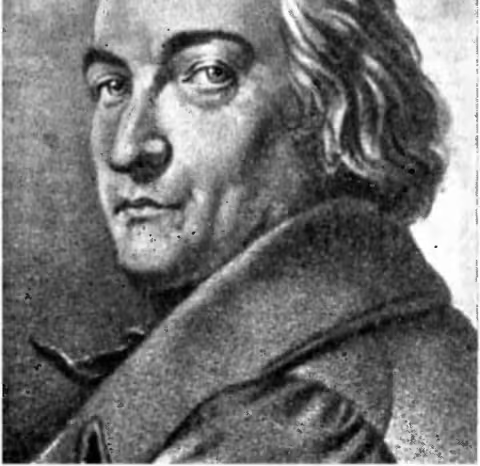
Claude Louis Berthollet (9 December 1748 – 6 November 1822) was a French chemist and a member of the Paris Academy of Sciences (from 1780). He was born at Talloires, in Savoy. He graduated from the University of Turin (1768). From 1770 to 1783 he practised as a physician and apothecary (in Paris from 1772) and was physician in ordinary to the household of the Duke of Orléans. At the same time he studied the natural sciences, did research in chemistry and organised chemical and metallurgical works. From 1794 he was a professor at the École Normale and the École Polytechnique in Paris (in 1798–1799 he was scientific adviser to Napoleon Bonaparte on the Egyptian campaign).
His main research was in inorganic chemistry and the chemistry of solutions and alloys. He established the composition of ammonia (1785), marsh gas (1786), hydrocyanic acid (1786) and hydrogen sulphide (1788). He discovered the salts of hypochlorous and chloric acids, in particular potassium chlorate (1786, Berthollet's salt). He discovered (1788) silver nitride (fulminating silver). He described (1787) a method of redox titration. From watching how precipitates fall out of solutions he came (1801) to the conclusion that the direction of reactions and the composition of the compounds formed depend on the mass of the reagents and on the conditions of the reaction. On the variable composition of compounds and the variation of the forces of chemical interaction between the atoms in a particle of a compound he carried on (1800–1808) a long dispute with J. L. Proust, which ended in Berthollet's defeat. But his ideas on the variation of the forces of the chemical bond were confirmed as early as the middle of the nineteenth century in the work of A. M. Butlerov, and compounds of variable composition were discovered in the twentieth century by N. S. Kurnakov. Today the chemistry of the condensed state rests to a great extent, in Kurnakov's words, on “laws foreseen by Berthollet”. Together with A. L. Lavoisier, L. B. Guyton de Morveau and A. F. Fourcroy he worked out (1786–1787) a new chemical nomenclature and classification of substances. With Lavoisier and other scientists he founded (1789) the journal “Annales de chimie”.
He founded the Society of Arcueil (1807).
From Kaloyan Manolov's “Great Chemists”
The mail coach from Geneva drew up at the inn in Annecy. The coachman did not usually stay long here: as a rule there were no passengers, and once he had quickly dealt with the post and rested a little, he would set off again. But this time a passenger was waiting for him at the door, a slim young man in a black frock coat. A fair-haired, large-eyed girl stood beside him, her head on his shoulder. Soon the luggage was loaded and the young people began to say goodbye.
“Have a good journey, Claude!”
“Goodbye, Jacqueline!”
The coach moved off, its wheels clattering over the cobbles. Then it turned onto a winding road, with the blue of Lake Annecy on the left. Over there, on the steep shore almost at the water's edge, lay his home village of Talloires1. Perhaps his mother was looking out of the window at this moment at the road that wound through the mountains, and thinking of her son.
“Farewell, Talloires! Farewell, dear France! Shall we ever meet again, Jacqueline?”
He gazed at the snowy peaks. Somewhere deep among them was Mont Blanc.
The coach braked sharply. Claude started and looked round: “Chambéry already?” The new passengers had barely taken their seats when the coach was on its way again. One more stop, a night at Saint-Jean-de-Maurienne, and then the frontier was within easy reach.
Turin, the capital of Piedmont, won the young Berthollet over with its beauty. The streets, the stately buildings, the Gothic cathedral: the young man liked it all. But he had not come to Turin to admire the sights. Claude dreamed of becoming a doctor, and that was why he had chosen this city, for it had one of the oldest universities in Italy.
The university buildings seemed rather gloomy, but to the enthusiastic young man they were lit by the eternal flame of learning. He was happy: now he could attend lectures in medicine, pharmacy and chemistry.
And what riches the library of the University of Turin held! With youthful zeal Berthollet threw himself into his studies and soon became a favourite of the professors. This allowed him to come to know his teachers better and to begin research.
In 1770 Berthollet was awarded the degree of doctor of medicine. The diploma, neatly rolled up and tied with a red ribbon, lay on the table in his room. Claude Berthollet, twenty-two years old, and now a doctor... He walked through the streets dreaming of the future. Suddenly someone clapped him on the shoulder from behind.
“Oh, it's you, Simone! You gave me a fright!”
“What are you thinking about, my friend? Weighty problems on your mind, by the look of it?”
“Weighty indeed, Simone. I've just said goodbye to the university. And what now, where am I to go?”
“The world is big. Come to me if you like. My pharmacy is a large one, and there'll be work for you too.”
“A splendid idea, especially as I don't want to leave Turin. I think I'll take you up on it.”
The young Simone had learnt the apothecary's trade a few years before and had begun working in his father's pharmacy. When his father died, Simone had had to take over the running of the pharmacy himself. Claude had met him in the university laboratories, and they soon became friends. In Simone's pharmacy Berthollet worked tirelessly. At the university he had already read the works of Lémery, Kunckel and Stahl... Now he decided to study them more closely and deeply. His interest in chemistry grew day by day, and so he spent more and more time doing chemical experiments in the pharmacy's laboratory.
Two years had passed since Claude had joined Simone. But the work could not satisfy the young scientist. He knew that he still had a great deal to learn, and for a long time to come.
“You've always been a good friend, Simone, but we shall have to part,” Claude told his friend one day.
“I've been expecting this for a long time,” Simone answered. “Watching you read Kunckel, and seeing how eagerly you work in the laboratory, I knew you wouldn't stay with me long. Come on, out with it: what are you planning now?”
“I'm going to study chemistry.”
“But you've studied everything already. What more do you need?”
“A great many secrets are hidden from our eyes, Simone. I must study. Only I haven't decided where to go, but...”
“If you've chosen chemistry, you must go to Leiden or to Paris. There's nothing more for you to do in Turin.”
“I think I'll choose Paris.”
The next day Berthollet packed his luggage, and the coach carried the young scientist home. After resting for a few months in Talloires, Berthollet moved to Paris.
At the university he met Tronchin, a young man who had not long before arrived from Leiden. They quickly became friends. Tronchin worked as an assistant in the university's research laboratory. One day he gave Berthollet Professor Boerhaave's1а textbook of chemistry, “Elementa chemiae”, the best manual of its day. Tronchin was soon convinced that Berthollet had a wide knowledge of chemistry and was, in fact, quite well prepared in this field. The laboratory where Tronchin worked needed a young assistant, and he recommended Berthollet. A few weeks later Berthollet was appointed. The road into chemistry on the grand scale lay open before him.
Berthollet's research ranged very widely. At this time news of great discoveries was coming from the research laboratories of France, England, Sweden and Germany. Priestley had discovered oxygen, Scheele had succeeded in obtaining “dephlogisticated muriatic acid” (chlorine), and Lavoisier had discovered the law of the conservation of the weight of substances. A new theory of combustion was being born. Berthollet took up the study of chlorine. What this gas was remained a mystery. Scheele had called it dephlogisticated muriatic acid, but now that the phlogiston theory had been thrown out, everything had to be studied afresh.
At that time acids without oxygen were not yet known, and scientists believed that gaseous hydrogen chloride was the oxide of an undiscovered element, murium. It was given this name because the “compounds” of murium were obtained from common salt, and in Latin “muria” means brine, a solution of salt in water. According to Lavoisier's theory, acids were formed when the oxide of an element dissolved in water. Nitric, sulphuric and many other acids were obtained in this way. Then the oxide of murium (hydrogen chloride) with water should form muriatic (hydrochloric) acid. But if the latter is heated in a mixture with pyrolusite (manganese dioxide), a yellow-green gas is obtained2. In this reaction the pyrolusite, which contains oxygen, turns into manganese chloride. Consequently the muriatic acid had been oxidised, and this yellow-green gas was a higher oxide of murium. Oxygenated muriatic acid (as Berthollet called chlorine) would contain oxygen, but that still had to be proved.
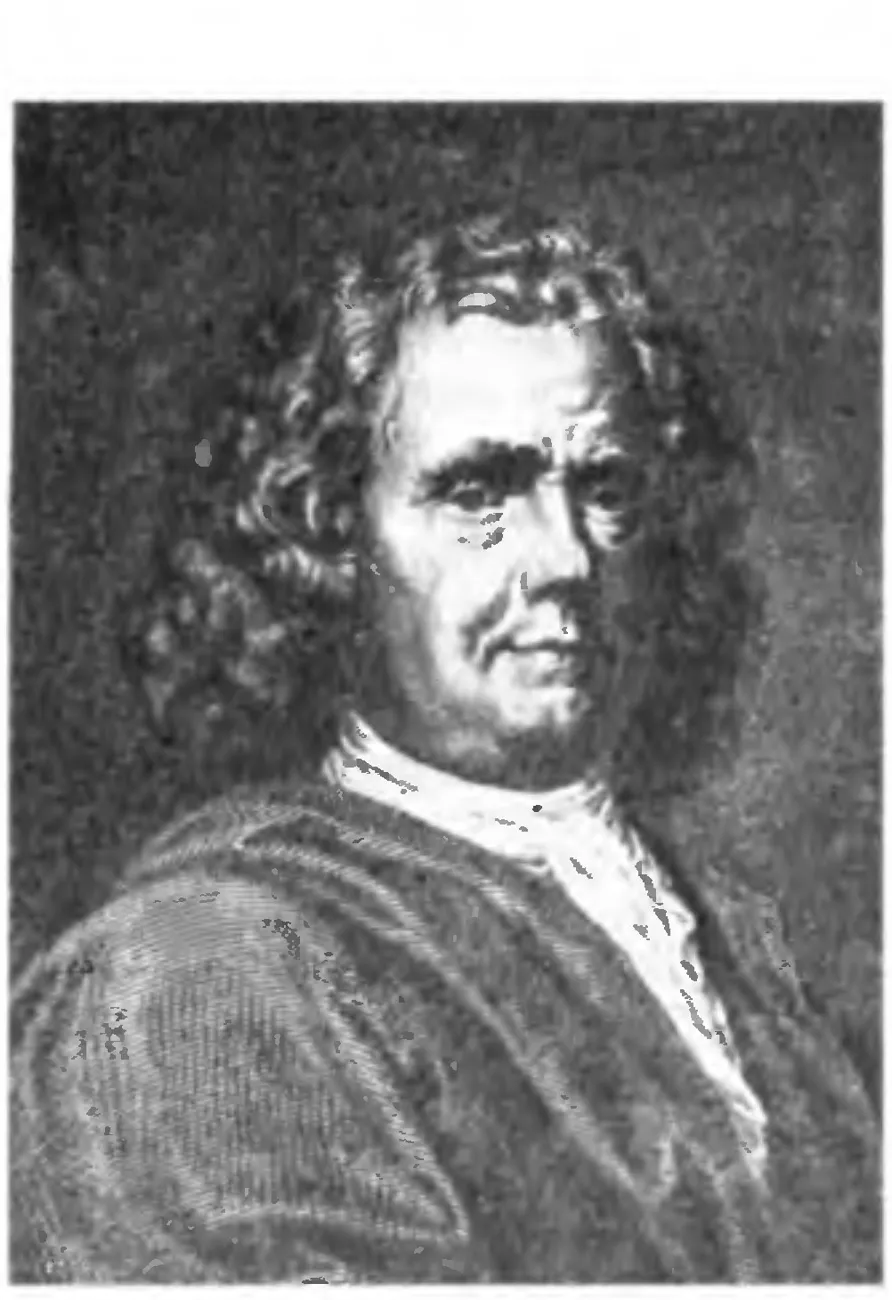
Experimenting, Berthollet obtained a gas with a sharp, choking smell. He poured water into the vessel in which the gas had been collected and shook it hard. Having absorbed the gas, the water turned pale yellow. When he had let the solution stand for a few days, Berthollet noticed that a gas had been given off above the liquid and that the solution had become colourless. He examined the gas and found that it was oxygen. The result of the experiment inspired the young scientist, and when he set about determining the proportions by weight in which muriatic acid combines with oxygen to form chlorine, he found that 87 parts by weight of muriatic acid take up 13 parts by weight of oxygen.
One of the main causes of the mistake about muriatic acid was water. The scientific world still believed that water was a simple substance, an element that takes part in almost all reactions. This mistake kept scientists from getting to the heart of the phenomena. An enormous amount of work and long, sleepless nights went before the discovery that chlorine is an element and not an oxide. Today it is easy to explain why chlorine water gives off oxygen: chlorine takes hydrogen from the water and sets the oxygen free. Yet Berthollet's conclusions were perfectly logical too, and at the time nobody doubted that he was right. What is more, in 1807 he was elected a member of the Paris Academy of Sciences for his work on muriatic acid.ed.3
Berthollet went on studying chlorine. He found that if this gas is passed through a solution of caustic potash, two salts are formed: one of them is ordinary potassium chloride, while the other was a new salt, which the chemist Higgins3 had mistakenly taken for saltpetre, since it contained a great deal of oxygen. When the new salt was melted, oxygen was given off from it in tiny bubbles. Studying the new substance, Berthollet very nearly lost his sight. It happened like this: he put a certain amount of the salt into a mortar that had held sulphur powder before, and began to grind it with the pestle. There was a violent explosion; the pestle was torn out of his hands and flew like a bullet barely a centimetre from his head. Stunned, Berthollet covered his burnt face with his hands.
“Can this salt really be so explosive?”
And Berthollet set about studying its explosive properties. He mixed it with sulphur and charcoal to make explosive mixtures. Today we call this salt Berthollet's salt (potassium chlorate) in his honour3а.
When Scheele's discovery became known, that chlorine bleaches natural dyes, Berthollet was asked to work out this problem, which was of great practical importance. He was to find a way of bleaching cloth. Before, to make cloth really white, it had been given a long and not always effective treatment. It was soaked in clean river water, spread out on a meadow and left in the sun. After many repetitions of this procedure the cloth did indeed become white, but it took many hands, sunshine and wide meadows.
In a single year Berthollet managed to work out several new ways of bleaching cloth4. He proposed a different treatment for each material. Some cloth was soaked in chlorine water, some was placed in barrels filled with chlorine, and some was dipped in alkaline solutions of chlorine. The cloth was then given a long washing, in different ways according to how it had first been treated. The result was cloth that was truly snow-white. From then on bleaching could be done in winter, too, and on dull, rainy days: meadows and sun were no longer needed. Only ten years after the discovery of chlorine was one of its most important uses found, but for another thirty years it went on being regarded as “oxygenated muriatic acid”, until at last Davy proved that it was an element and named it chlorine5.
The poisonous action of chlorine was not yet known in those days, and although Berthollet was very wary of its choking fumes, the researcher often suffered from the gas. Sometimes, gasping, with tears in his eyes, he would run out of the laboratory to snatch a breath of fresh air.
“Claude, be careful. This gas will be the death of you in the end,” Tronchin told him once, when he ran into Berthollet in the doorway as he was rushing out into the garden for air.
“My dear Tronchin, science demands sacrifices. Let's talk out here in the fresh air instead. That gas gives me no peace: it chokes me mercilessly, but I torment it no less. I'll uncover its secret, I won't let it go,” said Berthollet, and broke into a fit of coughing.
“Anything new in the laboratory?”
“I should say so!”
“Then tell me!”
“A few days ago I found that ammonia combines very violently with oxygenated muriatic acid. The reaction is as violent as when it acts on hydrogen.”
“And what does that produce?”
“Muriatic acid and nitrogen, can you imagine? So ammonia consists of hydrogen and nitrogen. I've now begun to study the composition of ammonia. A minute ago a flask of ammonia broke in the laboratory and I very nearly choked.”
“You're forever fiddling with poisonous substances. Mind you, one day it will end badly for you. And how, by the way, will you determine the composition of ammonia?”
“I've tried Priestley's method. I decompose the ammonia by passing an electric spark through it, and then burn the hydrogen formed with oxygen. What is left in the vessel is nitrogen, and that I measure. Now I shall repeat the experiments to make sure the earlier determinations were right. According to the results I've had, 80 parts by weight of nitrogen combine with 20 parts of hydrogen.”
These figures were very close to the true composition of ammonia: 82.3% nitrogen and 17.7% hydrogen. Such accuracy, even with the imperfect instruments of the day! With almost the same accuracy he established the composition of several other gaseous substances as well. The first was “prussic” (hydrocyanic) acid. To obtain it Berthollet used Scheele's method. In a flask he mixed charcoal, potash (potassium carbonate) and sal ammoniac (ammonium chloride), then heated the mixture. As the temperature rose, a colourless liquid began to distil over. It evaporated easily and turned into a gas that smelt of almonds. This was one of the most terrible poisons, which we now call hydrocyanic acid. It did indeed have the properties of an acid, but it contained no oxygen. However hard Berthollet tried, he could find no oxygen in it. His “prussic acid” contained only nitrogen, hydrogen and carbon. But according to Lavoisier's theory it ought, like every acid, to contain oxygen, which is what gives an acid its acidic properties. How, then, was the action of “prussic acid” to be explained?
The doubt that had seized Berthollet grew. The following year he established the composition of yet another gas. This was hydrogen sulphide, then called “hepatic air”. Berthollet found that it consists only of hydrogen and sulphur, even though it has the properties of acids. Its solution in water acted as an acid, forming many salts. A great variety of minerals occur in nature, galena*, pyrite** and others. All of them are salts of this same acid. These were the first facts that later led to a new theory of acids: it is hydrogen that determines acidic properties, and acids without oxygen exist in nature.
The new compounds Berthollet discovered created no small difficulties: it was getting ever harder to name these substances, ever harder to find symbols to denote them briefly. Lavoisier had already made some proposals in this direction, but they were not enough. The problem of chemical nomenclature, which Guyton de Morveau had put before the scientists, was still waiting to be solved.
Berthollet cleared the papers from his desk, put them in his bag and called for his carriage.
Settling himself comfortably, he grunted to the coachman:
“To Lavoisier's.”
The coachman knew well that when Berthollet had his bag with him and said little, it was time to hurry. Shouting, he urged the horses on with his whip. The carriage raced through the paved streets of the city to Lavoisier's laboratory.
Berthollet came in out of breath.
“Good day, Madame Lavoisier. May I see your husband?”
“Please come in. He's working in his study. Will you wait here, or go through to him?”
“It doesn't matter. Perhaps the laboratory would be more convenient?”
Hearing voices, Lavoisier came out.
“What brings you to me, my dear Berthollet?”
“I've come again, and with the same question as ever: nomenclature. It isn't enough to introduce a nomenclature for oxides alone. We ought to devise a new way of writing them and new, simpler names for all compounds.”
“A necessary thing for chemists, but it's not so simple. We still learn chemistry from Lémery's book, whose basic language is little crosses, little circles, Latin names...”
“All the same, a new language must be created. For instance, why should we have to say ‘acidum oleum vitrioli’? To my mind, sulphuric acid is better, because it contains sulphur, and instead of, say, ‘green vitriol’, iron sulphate.”
“That's far more convenient, Berthollet. I agree with you entirely. You ought to write an article and give plenty of examples in it. I hope other chemists will appreciate it too.”
“We should also think about the symbols in the new nomenclature.”
“Certainly. Why, for example, should we have to draw a crescent moon to denote silver? It would be better to draw a little circle and write inside it the first syllable of the Latin name of silver.”
“I welcome that idea,” Madame Lavoisier put in. “Now you won't need the services of your artist wife, Antoine. You can draw a little circle yourself.”
The conversation went on for a long time; it was the beginning of a great and difficult work, the creation of a new, convenient and simple nomenclature of chemical compounds. The great scientists met many more times on the subject. Professor Fourcroy gave them considerable help as well, but the general solution of the problem belonged to Guyton de Morveau, Lavoisier and Berthollet. The new nomenclature was received with enthusiasm by the scientific world.
At the same time Berthollet went on with his work in the laboratory. But now other problems drew his interest. The great year of 1789 had come. The Revolution, which stirred all Europe, made its own demands on a scientist's work. Berthollet greeted the French people's struggle against the monarchy with delight and was quick to offer his help. The Revolution needed steel for cannon and muskets; it needed explosives for shells. The Revolution needed scientists, and Berthollet became its soldier. He took part in setting up a works to produce saltpetre; he carried out a series of studies to develop a process for making high-quality steel; he prepared every kind of explosive mixture. The fulminating silver he had obtained found particularly wide use6; besides silver, it contained nitrogen. Its excellent detonating properties made it indispensable in making caps for shells and cartridges.
The swift political events in France inevitably brought with them a growth in industrial production. The country was in need of scientists and specialists. Berthollet was the first among those who dreamed of improving the system of education, and he did everything he could to that end. In 1794 two institutions of higher learning were opened in Paris, the École Normale and the École Polytechnique. Professor Berthollet taught at both. But he did not stay long in the professor's chair. Four years later the republican government entrusted Berthollet with a responsible mission: he was to go to Egypt. A great quantity of local raw materials was exported from the French colonies in Africa. People were needed who could supply French industry skilfully with everything it required. Berthollet was charged with supervising the preparation of the raw materials shipped out for the chemical industry.
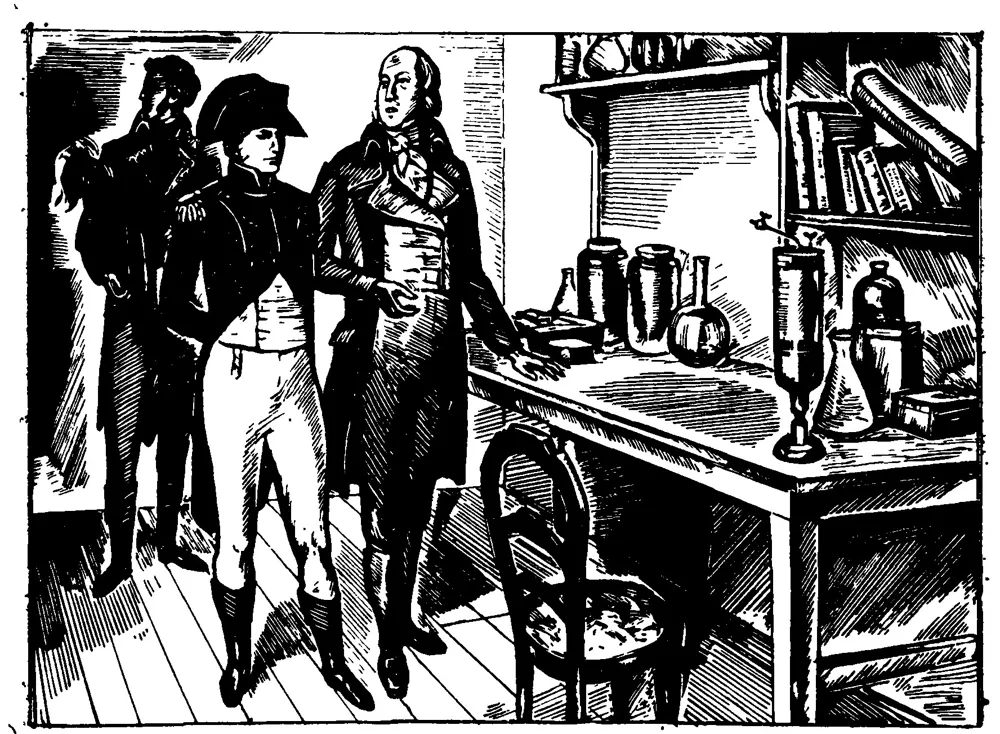
At the end of 1798 a ship brought him to Alexandria, and from there he went on to Cairo7, where the Institute of Egypt had been set up. Berthollet was given a laboratory of his own in it, and he took up one of the most important questions of the time, the production of indigo. Synthetic dyes were not yet known, and only natural ones were used. A cheap way of extracting indigo had to be found. Berthollet set to work on it readily.
One day Napoleon Bonaparte visited his laboratory.
“Greetings to you, the pride of French science!” he declared grandly as he came in.
Berthollet bowed politely.
“I should like to acquaint myself with your work.”
“With pleasure; I shall show you everything, General,” Berthollet replied, and led Bonaparte to the vessels filled with dark blue, almost black solutions of indigo. This was one of the most valuable dyes for cotton cloth. The scientist began to explain to Napoleon how it was extracted.
His work with indigo made Berthollet think about the problem of dyeing. Why is a dye held by the fibre so firmly that it is very hard to remove?
Today, when the structure of substances is known, we can easily explain the process of dyeing, but in those distant times nothing was yet known about the chemical composition of dyes and fibres. All the same, Berthollet noticed that fibres have a particular affinity for certain substances. Besides the known dyes, these substances included some metal bases. He understood that there are forces of attraction between a dye and a fibre, and that these forces are the reason why they combine with each other. Such an interpretation, naturally, did not throw light on the essence of the process, but it laid the foundations of the chemical theory of dyeing.
Berthollet had to supervise the extraction of saltpetre and soda from the salt lakes lying south-west of Cairo. The road there ran at first through fertile land and then went off into the desert. Perched somehow between the camel's humps, in a broad-brimmed hat, Berthollet was worn out by the heat. The caravan moved slowly; the oasis of El Faiyum and the cool lake of Birket el-Qarun were left behind... The guide led the caravan ever deeper into the desert. The heat grew unbearable, the air dry and stifling. They were nearing the boundless Libyan Desert. There, somewhere beyond the horizon, lay the oasis of Bahariya. The scientist wanted to see with his own eyes how soda was extracted from the salt lakes there.
The gruelling journey lasted a whole week. At last they reached their goal. The salt lakes glittered dazzlingly in the sun; their shores were edged with a narrow white strip, soda, which crystallised right there on the shore. Thin, exhausted black labourers raked up the white powder and filled sacks with it. The caravan was to carry this valuable cargo to the port of Alexandria, and from there it was shipped to France. The faces of the worn-out men spoke of boundless human suffering. The skin on their hands and feet was cracked: the soda ate into it constantly. Their labour was hard and bitter.
Berthollet could barely endure the scorching sun, but there were too many unsolved questions, and, paying no heed to the exhausting heat, he studied the crystallisation of the soda intently. Berthollet still could not make out why in some sacks the crystals looked more transparent and contained more water (the analysis showed this clearly), while in others they were opaque and looked more like ground chalk. Such crystals contained almost no water. He marked off a stretch of shore and gave orders that nobody was to collect soda there. Berthollet watched closely as the soda formed, growing in quantity from day to day. He was not a little surprised when he noticed that the appearance of the crystals depended on where they had formed. Those in contact with the water were transparent; others, left lying on the hot sand, gradually cracked and became opaque.
“The quantity of the starting substances evidently matters a good deal in the formation of soda,” Berthollet reasoned. “The nearer the water, the more water the soda contains. There is no water on the hot dry sand, and so almost anhydrous soda forms there8.”
Back in Cairo, at a meeting of the Institute of Egypt, Berthollet read his famous paper on the influence of the mass of a substance on the course of chemical reactions. Supporting his arguments with what he had observed of the crystallisation of soda, he asserted that substances do not have a constant composition. The starting products combine with one another in different proportions depending on their quantity. (It was not yet known then that soda can give two kinds of crystals, a crystal hydrate containing water of crystallisation and the anhydrous salt.) Berthollet had been led to this mistaken idea by the random mixtures formed under the scorching African sun. In his paper he also noted that substances of definite composition can nevertheless be obtained, and obtained repeatedly, if the same proportions of the starting substances are taken and the same conditions are kept. Joseph Louis Proust defended the exact opposite view, and this gave rise to the famous dispute between the two scientists9. For eight years running the chemists were split into two camps, some taking Proust's side, others Berthollet's. In the end Proust won the dispute.
The constantly changing composition Berthollet spoke of turned out to be due to impurities, to the possibility of several substances forming different mixtures. The influence of the mass of the starting substances also had to be taken into account. Almost sixty years later Guldberg and Waage proved that the mass of the reacting substances affects the rate of reactions10. At the beginning of the twentieth century (a hundred years later) the Russian chemist N. S. Kurnakov discovered the so-called intermetallic compounds, which have no constant composition. Such compounds were formed by aluminium and magnesium, lead and sodium, and other pairs of metals. Kurnakov named these compounds berthollides in Berthollet's honour10а.
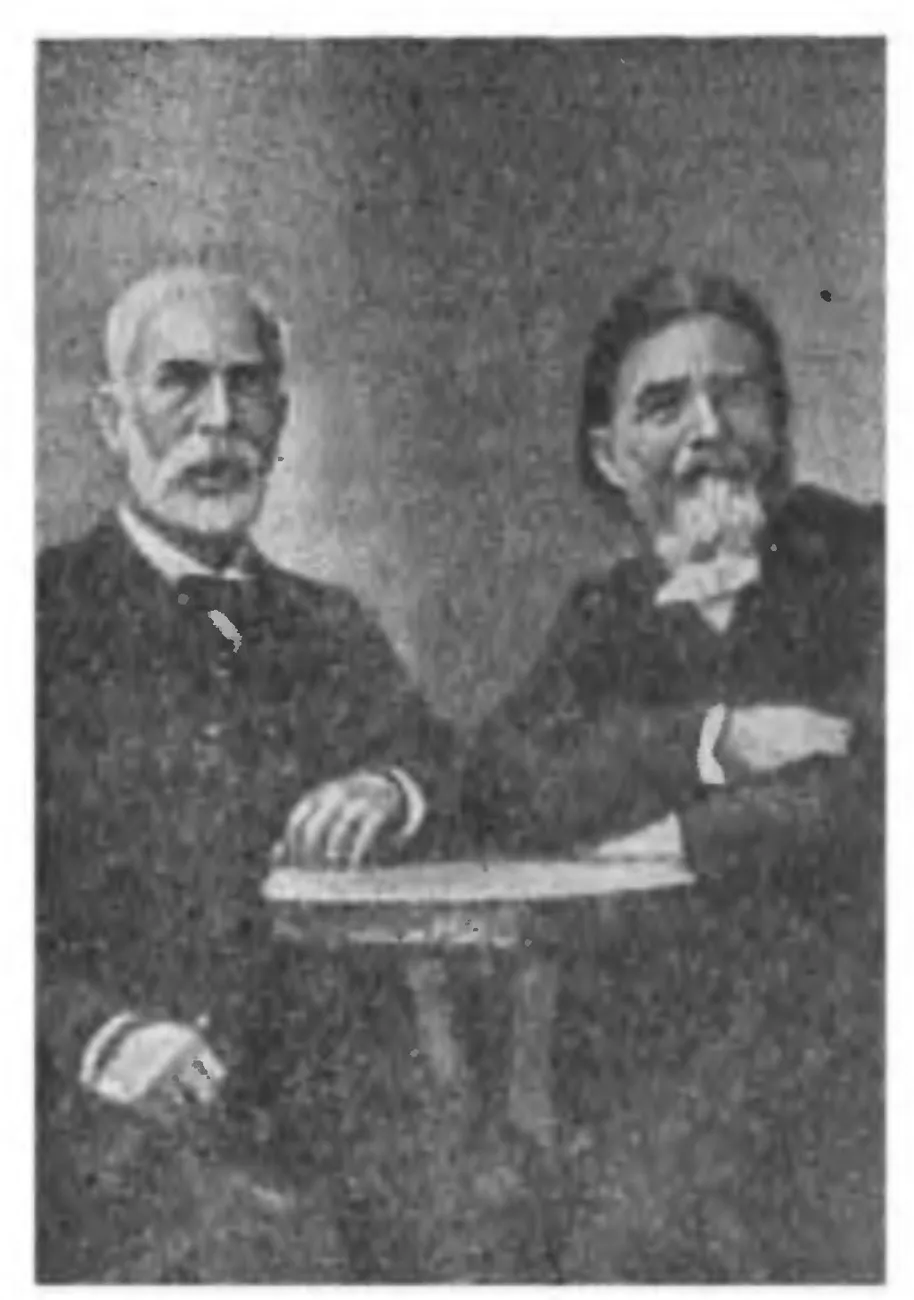
Berthollet spent two years in Egypt. When he returned to Paris in 1800, his attention was wholly taken up by the dispute with Proust. But he went on thinking about questions of the affinity of elements as well: why do substances combine with one another? What forces arise between them? Many theories had been put forward to explain chemical affinity, or “affinitivity”, as it was often called. But all of them were too naive: affinity was sometimes even spoken of as something like sympathy and hatred between people. Berthollet put forward his own view of affinity. He looked for the cause of the combination of elements in the physical forces of atoms. Though not very clear and not well enough argued, Berthollet's theory gave a considerable impetus to the development of chemical thought.
At that time Gay-Lussac was working in Berthollet's laboratory. They often discussed the results of their experiments and built new hypotheses. Berthollet thought very highly of Gay-Lussac, then still a very young scientist. One night Berthollet could not get to sleep for a long time and decided to go down to the laboratory: he was sure he would find Gay-Lussac there.
“Why aren't you resting, Monsieur Berthollet?”
“I can't sleep; there's a question that gives me no peace.”
“What question?”
“Listen to this. We know that to compress a gas, force must be applied to a cylinder with a piston. Forces of attraction arise between the particles of the gas, and the gas takes up a smaller volume. Very well, but what if this gas combines with another gas and forms a solid?”
“The volume will decrease again, of course.”
“Exactly. So forces of attraction are at work here too. But something else matters more: these forces are nothing out of the ordinary. They are the same forces of attraction or repulsion that physics speaks of.”
“I think the analogy is a good one. And your reasoning is right,” Gay-Lussac said thoughtfully. “Of course, nature is one, and it is unlikely that chemical forces are an exception in this respect. I have already suggested that these are forces of adhesion and cohesion.”
Berthollet beamed. This really was a new idea. Not perfect, but all the same more reliable than the theories of Buffon11, Boerhaave and Guyton de Morveau.
The Society of Arcueil12 gave Berthollet's paper an approving reception.
The astronomer Pierre Laplace, the physicists Jean Biot13 and Dominique Arago14, and Gay-Lussac spoke in support of his idea.
Berthollet was the organiser and the moving spirit of the scientific society at Arcueil. The years went by, life in Paris grew ever harder for him, and at last he decided to settle on his estate at Arcueil. But he could not imagine life without science. Berthollet fitted out a large library and spacious laboratories and invited the most famous scientists to Arcueil. In 1807 the society was joined, among others, by the celebrated German traveller and physicist Alexander Humboldt15. Intense work went on in the laboratories at Arcueil. In the evenings, when the experiments were over, the scientists usually gathered at Berthollet's to talk, to discuss their results or to ask for friendly advice. Despite his age, Berthollet worked on an equal footing with the others. Questions of chemical affinity and of why chemical reactions take place still occupied his thoughts.
“It is perfectly clear that there are some complex regularities that show themselves when substances interact,” said Berthollet.
“And every effort is being made now to discover them,” Thénard16 agreed, gazing thoughtfully out of the window.
“Yes, but the bond that causes atoms to combine shows itself in a very particular way: some reactions go to completion, while in others a large part of the starting substances does not react.”
“That accounts for the enormous variety of chemical processes,” said Gay-Lussac, who had been listening to their conversation.
“But what matters in practice is mainly those reactions that can go to completion,” Berthollet went on. “My research shows that a reaction can go to completion if at least one of the products is a gas, a sparingly soluble substance or water.”
This was, in essence, the famous Berthollet rule.
Before he had even finished this research, Berthollet was already making plans for new experiments. He worked with enviable energy, but suddenly a grave illness confined him to his bed. For the last eleven years of his life he suffered unbearable pain; for eleven years he fought death. Berthollet died on 7 November 1822ed.2 at Arcueil, a little short of his seventy-fourth birthday.
Notes
- 1. C. L. Berthollet was born on 9 December 1748 at Talloires (south-eastern France).
- 1а. Herman Boerhaave (1686–1738), a prominent Dutch physician, chemist and botanist, professor of chemistry at the University of Leiden and the author of the celebrated manual “Elementa chemiae” (1732), in its day one of the best textbooks of chemistry. Boerhaave's work was translated into many languages; several generations of chemists learnt from it, M. V. Lomonosov among them (Коровин Г. М. Библиотека Ломоносова. — М.: Изд-во АН СССР., 1961). On Boerhaave see: Фигуровский Н. А., ук. соч., с. 243—246; Partington J. R., ук. соч., т. 2, с. 740—759; Погодин С. А., Раскин Н. М. Химия и жизнь, № 11, 71 (1969); Bugge G., ук. соч., с. 204—220; Становление химии как науки, ук. соч., с. 61 и сл.
- 2. The method of obtaining chlorine discovered by Scheele: MnO₂ + 4HCl = MnCl₂ + 2H₂O + Cl₂.
- 3. Bryan Higgins (1737–1818), an English chemist and physicist, a “phlogistonist” and one of the forerunners of J. Dalton. He was the author of major works and of course programmes in philosophical, pharmaceutical and technical chemistry (in 1774 he opened a school of practical chemistry in London); he studied the nature of light, acids and air, and proposed a theory of the atomic and molecular structure of gases. On B. and W. Higgins see: Джуа М., ук. соч., с. 145, 159 и др.; Partington J. R., ук. соч., т. 3, с. 727—754; Соловьев Ю. И. История химии, ук. соч., с. 114—117.
- 3а. Studying the action of chlorine on various substances, Berthollet discovered the salts of chloric and hypochlorous acids, among them potassium chlorate, KClO₃ (Berthollet's salt). The explosiveness of the salts of chloric acid that he found led to the proposal to replace saltpetre (which was in short supply in France at the time of the bourgeois revolution) with potassium chlorate in making gunpowder. In the first trials at Essonnes in 1788 five people were killed; A. Lavoisier and his wife escaped by pure chance. Further trials were carried out under Berthollet's own supervision (Старосельская-Никитина О. А., ук. соч., с. 219—220).
- 4. The bleaching action of chlorine on vegetable dyes was discovered by Scheele. Berthollet worked out practical methods of applying this discovery, showing ways of decolourising cloth, paper and wax. Very soon Berthollet's method was in use all over Europe (Старосельская-Никитина О. А., ук. соч., с. 208—209).
- 5. The history of the discovery of chlorine, of its study and of the origin of its name is described in: Фигуровский Н. А. Открытие элементов и происхождение их названий. — М.: Наука, 1970, с. 139—141.
- 6. The fulminating silver that bears Berthollet's name was discovered by him in 1788 and is silver nitride, Ag₃N. “Berthollet's fulminating silver” should not be confused with the other fulminating silver, silver fulminate, the salt of fulminic acid, H—O—N⁺≡C⁻ ⇄ H—C≡N⁺—O⁻.
- 7. In the spring of 1798, on Napoleon's initiative, the government of the Directory undertook a campaign in Egypt with the aim of turning that country into a French colony and so striking a blow at England on her routes to India. On 2 July 1798 Napoleon landed in Egypt and, having taken Alexandria, marched victoriously across the whole country. Berthollet and other French scientists accompanied Bonaparte on this campaign. Later Napoleon heaped honours on Berthollet, making him a senator and giving him the title of count, which did not prevent the scientist, as a member of the Senate, from voting in 1814 for Napoleon's deposition. After the Restoration Berthollet, who had managed to keep all his privileges, was made a peer of France (Bugge G., ук. соч., с. 342—349.)
- 8. From his observations of the processes and conditions under which soda forms in the salt lakes of Egypt, Berthollet arrived at new views on chemical affinity. His paper “Researches into the Laws of Chemical Affinity”, read at the Institute of Egypt in Cairo in 1799, contained for the first time the assertion that the direction of chemical reactions is determined by mass and by other physical forces: cohesion, volatility, solubility, elasticity. Regarding chemistry as a part of applied mechanics, Berthollet held that chemical combinations are governed by the laws of Newtonian mechanics and that the force of chemical affinity is of one kind with gravitation. From this he concluded that chemical affinity is proportional to the masses of the reacting substances. In Berthollet's view, the greater the quantity of a substance taking part in a reaction, the stronger its action. He even introduced the notion of chemical mass, defining it as the product of the magnitude of affinity and the quantity of a body by weight (Джуа М., ук. соч., с. 164—165; Соловьев Ю. И. Эволюция основных теоретических проблем химии. — М.: Наука, 1971, с. 99—102; Шептунова З. И. Химическое соединение и химический индивид: Очерк развития представлений. — М.: Наука, 1972, с. 29—46; Становление химии как науки, ук. соч., с. 90 и сл.). Berthollet set out his doctrine of chemical affinity in his work “Essai de statique chimique” (Paris, 1803), where he wrote: “Only since affinity was introduced as the cause of all combinations has it become possible to regard chemistry as a science with general principles.”
- 9. Berthollet considered solutions to be chemical compounds of variable composition, differing according to the conditions under which they are obtained. Besides liquid solutions, examples of such compounds in Berthollet's view were metal alloys and glasses. He argued that the difference between a chemical compound and a solution lies only in the different actions of affinity. Berthollet extended his view of variable composition to all other substances and admitted the composition of some substances to be constant only as an exception. Even at the time this view began to meet with objections. But Berthollet's authority as a scientist made many scientists hesitate and kept them from speaking out against him. Berzelius and Gay-Lussac did, it is true, try to find a compromise between Berthollet's dynamism and Dalton's atomism. The French chemist J. L. Proust came out against Berthollet and showed that Berthollet's theoretical conclusions were untenable. Proust showed that if one element forms several compounds with a second, their composition changes by leaps, whereas Berthollet thought of a gradual change of composition. Proust pointed out Berthollet's analytical errors. The dispute between Berthollet and Proust aroused enormous interest in the scientific world and lasted from 1801 to 1808. It ended in Proust's victory and the establishment of the law of constant composition, which strengthened atomistic views in chemistry. On the dispute between Proust and Berthollet see: Джуа М., ук. соч., с. 164—166; Кедров Б. М., ук. соч., с. 202—208; Ладенбург А., ук. соч., с. 153.
- 10. Berthollet's ideas drew the attention of scientists of later generations. In 1867 the Norwegian chemists Cato Maximilian Guldberg (1836–1902) and Peter Waage (1833–1900), like Berthollet, held that the chemical action of a substance is proportional to its chemically active quantity (in unit space). Some historians of chemistry saw in this a revival of Berthollet's theory (Майер Э., ук. соч., с. 427—429). Present-day historians of chemistry, however, do not agree with this view (Фигуровский Н. А., ук. соч., с. 438). On Guldberg and Waage see: Соловьев Ю. И. Очерки по истории физической химии. — М.: Наука, 1964; Partington J. R., ук. соч., т. 4, с. 588—595.
- 10а. The development of chemistry showed that Proust's victory was temporary. His dispute with Berthollet over whether chemical changes can take place gradually (continuously) or by leaps (discontinuously) had not been settled. Thus D. I. Mendeleev, in his chemical theory of solutions based on atomic and molecular theory, showed how these points of view could be reconciled. The dispute between Proust and Berthollet was resolved in the research of the Russian academician Nikolai Semyonovich Kurnakov (1860–1941) and his pupils at the end of the nineteenth century. This work proved convincingly that the composition of a chemical individual can be either constant or variable. In solutions there is almost always a continuous transformation. Kurnakov and members of his school discovered numerous compounds, which were named daltonides (compounds of definite composition, obeying the laws of constant and multiple proportions) and berthollides (compounds of variable composition). The former correspond to singular points, which are marked by a gentle maximum on the composition–property curve.ed.4 Kurnakov wrote of the dispute between Berthollet and Proust: “In the history of chemistry it is usual to consider that the dispute ended in Proust's victory... But this victory was undoubtedly only temporary... At present the whole body of data of physico-chemical analysis allows us to state with complete confidence that both sides are right in their assertions, but that Berthollet's point of view is the more general... Strange as it may seem at first sight, it is precisely the principle of continuity that is henceforth destined to defend the inviolability of the law of constant composition...”. On Kurnakov see: Аносов В. Я., Погодин С. А. Основные начала физико-химического анализа. — М.—Л., 1947; Соловьев Ю. И., Звягинцев О. Е. Николай Семенович Курнаков: Жизнь и деятельность. — М.: Изд-во АН СССР, 1960; Николай Семенович Курнаков. — М.: Изд-во АН СССР, 1961. — (Материалы к биобиблиографии ученых СССР. Сер. хим. наук. Вып. 30); Мусабеков Ю. С., Черняк А. Я., ук. соч., с. 72—73.
- 11. Georges Louis Leclerc de Buffon (1707–1788), a well-known French naturalist and populariser of natural history. He wrote the 36-volume “Histoire naturelle” (1749–1788), in which he set out his views on the unity of the plant and animal worlds. On Buffon see: История биологии с древнейших времен до начала XX века. — М.: Наука, 1972; Бернал Дж., ук. соч., с. 357—358.
- 12. Arcueil, Berthollet's estate near Paris, where he settled in 1807 and set up a laboratory of his own. There, too, he founded the Society of Arcueil. The proceedings of this society (in three volumes) appeared in Paris in 1807, 1809 and 1817.
- 13. Jean Baptiste Biot (1774–1862), a French physicist and astronomer; together with F. Savart (1791–1841) he discovered the Biot–Savart law, which gives the strength of the magnetic field produced by an electric current. On J. B. Biot see: Льоцци М., ук. соч., с. 201—210; Храмов Ю. А. Физики: Биографический справочник. — 2-е изд., испр., доп. — М.: Наука, 1983, с. 32.
- 14. Dominique François Jean Arago (1786–1853), a French astronomer and physicist, a brilliant populariser of science and a politician. He is known for his work in optics, meteorology, electromagnetism, astronomy and physical geography. On Arago see: Льоцци М., ук. соч., с. 201—210; Гранин Д. До поезда оставалось три часа. — Л.: Детиздат, 1973, с. 73—105; Колчинский И. Г., Корсунь А. А., Родригес М. Г. Астрономы: Биографический справочник. — Киев: Наукова думка, 1977, с. 16—17; Храмов Ю. А., ук. соч., с. 18.
- 15. Alexander Freiherr Wilhelm von Humboldt (Humbold) (1769–1859), a German naturalist, geographer and traveller, an encyclopaedic scholar and one of the founders of scientific regional geography. Together with Gay-Lussac he discovered the law of multiple volumes of gas mixtures. On Humboldt see: Биографический словарь деятелей естествознания и техники, ук. соч., Т. I, с. 275—276; Сафонов В. А. Александр Гумбольдт (На горах свободы). — 3-е изд. — М.: Мол. гвардия, 1959.
- 16. Louis Jacques Thénard (1777–1857), a French chemist and an honorary foreign member of the St Petersburg Academy of Sciences. He obtained “Thénard's blue”, studied the composition and properties of ethyl chloride and of esters, discovered the amines of potassium and sodiumed.1, found the action of light on the reaction of chlorine with hydrogen, proved that sodium, potassium and chlorine are elements, and discovered hydrogen peroxide. His four-volume “Traité élémentaire de chimie théorique et pratique” (1813–1816) was widely known. On Thénard see: Джуа М., ук. соч., с. 204 и сл.; Волков В. А. и др., ук. соч., с. 486—487; Становление химии как науки, ук. соч., с. 152 и сл.
- * Lead sulphide, PbS, the chief ore of lead. — Editor's note.
- ** Iron sulphide, FeS₂, a raw material for smelting pig iron and a sulphur-bearing mineral. — Editor's note.
From the site's editors
- ed.1 What is meant is the amides of potassium and sodium, KNH₂ and NaNH₂, which Thénard obtained together with Gay-Lussac, not amines.
- ed.2 Berthollet died on 6 November 1822, the date the handbook “Выдающиеся химики мира” also gives.
- ed.3 Berthollet became a member of the Paris Academy of Sciences in 1780 (so the handbook “Выдающиеся химики мира”); in 1807 he founded the Society of Arcueil.
- ed.4 The other way round: the singular points of daltonides are sharp maxima (breaks) on the composition–property curve, while a gentle maximum with no singular point marks berthollides. Kurnakov introduced the terms “daltonide” and “berthollide” in 1912–1914.