Organic Syntheses, Volume 65 (1987)
(1,3-Dioxolane-4,5-dicarboxylic acid, 2,2-dimethyl-, bis(1-methylethyl)ester, (4R-trans)-)
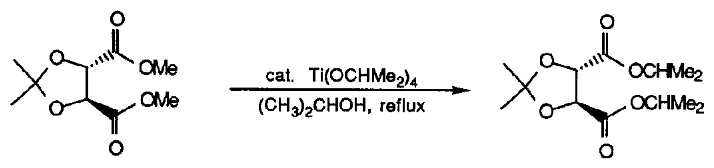
Submitted by René Imwinkelried, Martin Schiess, and Dieter Seebach.1
Checked by Isao Kurimoto and Ryoji Noyori.
1. Procedure
A dry, 500-mL, two-necked flask equipped with a magnetic stirrer and a reflux condenser is flushed with nitrogen and charged with 8.4 mL (45.8 mmol) of dimethyl (2S,3S)-2,3-O-isopropylidenetartrate (Note 1) and 250 mL of absolute 2-propanol (Note 2). To the resulting solution is added with a plastic syringe and hypodermic needle 1.35 mL (4.6 mmol) of tetraisopropyl titanate (Note 1). The mixture is refluxed with stirring for 2 hr. To remove the methanol formed, the flask is transferred to a rotary evaporator, and the contents are concentrated to 10 to 12 mL. The oily residue is once more dissolved in 250 mL of absolute 2-propanol (Note 2) and refluxed for 2 hr. The solvent is removed again in a rotary evaporator, and the resulting yellow oil is dissolved in 100 mL of diethyl ether. After addition of 5 mL of water (Note 3) the pale mixture is vigorously stirred for 10 min and then dried over anhydrous magnesium sulfate. The flaky suspension is filtered and the filter-cake washed with three 25-mL portions of ether. The ether solution is concentrated in a rotary evaporator. The residue, 12.5-13.1 g of a slightly yellow oil, solidifies on standing. This solid is freed from small amounts of solvent by an oil-pump vacuum (ca. 0.01 mm) at room temperature for 2 hr. Further purification by short-path distillation at 91-93°C/0.05 mm furnishes 11.5-12.0 g (91-95%) of a slightly yellow solid, which turns colorless upon crushing, mp 41.5-42.5°C, [α]Drt +42 ± 0.3° (CHCl3, c 4).
2. Notes
1. Commercial (Fluka purum) (−)- or (+)-dimethyl 2,3-O-isopropylidenetartrate and tetraisopropyl titanate can be used without further purification.
2. 2-Propanol was heated at reflux over CaSO4, distilled, and redistilled with addition of tetraisopropyl titanate (ca. 10 g/L).
3. This is done to hydrolyze titanium alkoxides. Part of the titanium alkoxides is removed during evaporation of the solvents in the rotatory evaporator [Ti(OCHMe2)4, bp 78°C/12 mm].
3. Discussion
Normally, transesterifications are acid- or base-catalyzed, e.g., sulfuric acid, p-toluenesulfonic acid, and potassium or sodium alkoxides in the appropriate alcohols.2 These methods fail with molecules containing acid- or base-labile functional groups. The titanate-mediated esterifications, deacylations, and transesterifications of rather simple, monofunctional substrates are described in the patent literature; see the references in a recent article.3 Recently, Seebach, et al.3,4,5 have demonstrated that this method is applicable also to substrates with additional functional groups which would not survive acid- or base-catalyzed transesterification conditions, such as C≡C and C≡N bonds, acetals, β-hydroxy and β-acyloxy esters, β-lactams, tert-butyldimethylsilyloxy groups, BOC6 and other carbamate protecting groups, etc. In the accompanying Scheme, the possible applications of this transesterification are illustrated, and some characteristic examples are given in the Table. Of course, the method can only establish equilibrium conditions. Therefore, depending on the particular case, components of the equilibria have to be removed (see procedure above) or used in large excess to drive the conversion to the desired products.
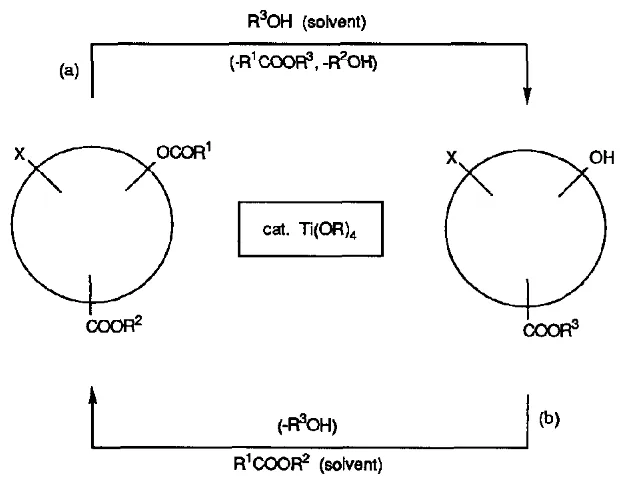
Scheme. Titanate-mediated Transesterifications
X = Functional group (see accompanying text)
(a) Transesterification in alcoholic solvents, with removal of acyl protecting groups and exchange of the alcohol component of ester groups in the substrate.
(b) Transesterification in ester solvents, with acylation of hydroxy groups and exchange of the alcohol or of the acid component of ester groups in the substrate.
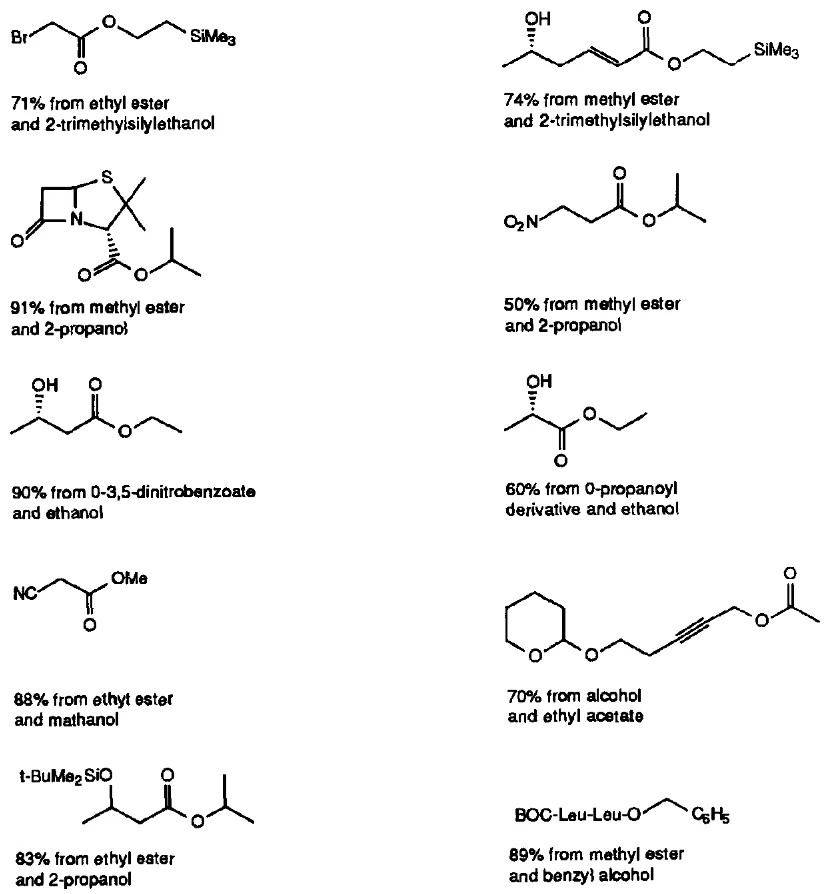
Table I. Products of Transesterification with Titanate Catalysis3-6
References and Notes
1. Laboratorium für Organische Chemie der Eidgenössischen Technischen Hochschule, ETH-Zentrum, Universitätstrasse 16, CH-8092 Zürich, Switzerland.
2. Patai, S., Ed. "The Chemistry of Acid Derivatives", Supplement B, Part 1; Interscience Publishers: New York, 1979.
3. Seebach, D.; Hungerbühler, E., Naef, R.; Schnurrenberger, P.; Weidmann, B.; Züger, M. F. Synthesis 1982, 138.
4. Schnurrenberger, P.; Züger, M. F.; Seebach, D. Helv. Chim. Acta 1982, 65, 1197. See also: Seebach, D.; Züger, M. Helv. Chim. Acta 1982, 65, 495.
5. Seebach, D.; Weidmann, B.; Widler, L. In "Modern Synthetic Methods 1983", Scheffold, R., Ed.; Otto Salle: Frankfurt, Sauerländer: Aarau, Wiley: New York, 1983; Vol. 3, p. 217.
6. Rehwinkel, H.; Steglich, W. Synthesis 1982, 826.
Appendix
Chemical Abstracts Nomenclature (Collective Index Number); (Registry Number)
Diisopropyl (2S,3S)-2,3-O-isopropylidenetartrate: 1,3-Dioxolane-4,5-dicarboxylic acid, 2,2-dimethyl-, bis(1-methylethyl) ester, (4R-trans)- (11); (81327-47-1)
Dimethyl (2S,3S)-2,3-O-isopropylidenetartrate: 1,3-Dioxolane-4,5-dicarboxylic acid, 2,2-dimethyl-, dimethyl ester, (4R-trans)- or (4S-trans)- (9); (37031-29-1) or (37031-30-4)
2-Propanol (8,9); (67-63-0)
Tetraisopropyl titanate: Isopropyl alcohol, titanium (4+) salt (8); 2-Propanol, titanium (4+) salt (9); (546-68-9)