Organic Syntheses, Volume 65 (1987)
(D-glycero-D-ido-Nonononitrile, 4,8-anhydro-2,3-dideoxy-, 5,6,7,9-tetraacetate)

Submitted by Bernd Giese, J. Dupuis, and Marianne Nix.1
Checked by John P. Daub and Bruce E. Smart.
1. Procedure
Caution! Acrylonitrile is an OSHA-regulated carcinogen and appropriate precautions should be taken in handling this substance.
A 250 mL, three-necked, round-bottomed flask equipped with a magnetic stirring bar, dry nitrogen inlet, reflux condenser, and septum is flushed with nitrogen and charged with 20.6 g (50 mmol) of 2,3,4,6-tetra-O-acetyl-α-D-glucopyranosyl bromide (Note 1) and 100 mL anhydrous ether. The mixture is brought to reflux with a heat gun. A nitrogen atmosphere is maintained over the reaction mixture during this and the ensuing steps. When the 2,3,4,6-tetra-O-acetyl-α-D-glucopyranosyl bromide dissolves, 13.5 g (250 mmol) of acrylonitrile and 16.0 g (55 mmol) of tributyltin hydride (Note 2) are added by means of a syringe. The refluxing solution is irradiated with a sunlamp positioned 2.5-3.8 cm from the reaction flask (Note 3). The heat from the sunlamp maintains a vigorous reflux. After 4 hr, the irradiation is stopped and the reaction mixture is cooled and filtered to collect the precipitated crystals (Note 4). The filtrate is reintroduced under nitrogen into the reaction vessel. An additional 6.6 g (120 mmol) of acrylonitrile and 5.8 g (20 mmol) of tributyltin hydride are added and irradiation is resumed for another 4 hr until the starting bromide is completely reacted (Note 5). After the reaction mixture is cooled, it is filtered, the filtrate is saved, and the filter cake (Note 6) is combined with the crystals collected above. The solids are stirred with 250 mL of hot isopropyl alcohol and filtered. The hot filtrate is concentrated to a total volume of 75 mL, allowed to cool and filtered to give 7.8-8.6 g (40-45%) of 1-deoxy-2,3,4,6-tetra-O-acetyl-1-(2-cyanoethyl)-α-D-glucopyranose as long, colorless crystals, mp 121-122°C, [α]D25 +66.2 (CHCl3, c 0.7) (Note 7). The isopropyl alcohol mother liquor is set aside. The above filtrate from the crude reaction mixture is concentrated, taken up in 50 mL of acetonitrile, and extracted three times with 50-mL portions of pentane. The acetonitrile phase is combined with the isopropyl alcohol mother liquor and concentrated. The resulting syrup is flash-chromatographed on silica gel using ethyl acetate/hexane (1:1) eluent to afford an additional 2.2-2.5 g of pure 1-deoxy-2,3,4,6-tetra-O-acetyl-1-(2-cyanoethyl)-α-D-glucopyranose after separation of byproducts (Notes 8 and 9). The combined yield of pure product is 53-56%.
2. Notes
1. This material was obtained from the Sigma Chemical Company and was recrystallized from ethyl ether/pentane before use. It also can be prepared by the procedure of Redemann, C. E.; Niemann, C. Org. Synth., Collect. Vol. III 1955, 11.
2. Acrylonitrile and tributyltin hydride were obtained from the Aldrich Chemical Company, Inc., and used without further purification. The use of a large excess of acrylonitrile reduced the amount of reduction by-product (2,3,4,6-tetraacetyl-1,5-anhydroglucitol). Because tributyltin hydride also reacts with acrylonitrile, a small excess must be used.
3. The checkers used a 275-watt General Electric sunlamp. The submitters indicate that the type of sunlamp is not critical and that a 125-watt Philips E99/2 sunlamp or a 125-watt Philips 57203 high-pressure mercury lamp are suitable. If the heat from the sunlamp does not maintain reflux, the reaction flask should be about one-fourth submerged into a hot oil bath.
4. During the reaction the amount of precipitate gradually increases until the light from the sunlamp is totally blocked and the reaction stops.
5. The reaction can be followed by TLC using 0.25-mm silica gel 60 F-254 plates (E. Merck & Company) and ethyl acetate/hexane (1:1) eluent: 2,3,4,6-tetra-O-acetyl-α-D-glucopyranosyl bromide (Rf = 0.39); 2,3,4,6-tetra-O-acetyl-1,5-anhydroglucitol (Rf = 0.28); 1-deoxy-2,3,4,6-tetra-O-acetyl-1-(2-cyanoethyl)-β-D-glucopyranose (Rf = 0.20); 1-deoxy-2,3,4,6-tetra-O-acetyl-1-(2-cyanoethyl)-α-D-glucopyranose (Rf = 0.16).
6. This solid contains a large amount of insoluble polymer in addition to product.
7. The product is analytically pure: Anal. Calcd for C17H23NO9: C, 52.98; H, 6.02; N, 3.63. Found: C, 52.80; H, 6.01; N, 3.63; 1H NMR (CDCl3, 360 MHz) : 1.84-1.95 (m, 1 H, CCH2), 2.05 (s, 6 H, 2 OAc), 2.09 (s, 3 H, OAc), 2.11 (s, 3 H, OAc), 2.05-2.22 (m, 1 H, CCH2), 2.46 (m, 2 H, CH2CN), 3.88 (ddd, 1 H, H5, J5,6 = 5.80, J5,6' = 2.88, J4,5 = 8.30), 4.12 (dd, 1 H, H6', J6,6' = 12.24), 4.23 (m, 1 H, H1), 4.32 (dd, 1 H, H6), 4.98 (t, 1 H, H4, J3,4 = 8.30), 5.09 (dd, 1 H, H2, J1,2 = 5.23, J2,3 = 8.30), 5.23 (t, 1 H, H3); IR (KBr) cm−1: 2240 (C N), 1745 (C=O).
8. E. Merck 230-400 mesh Kieselgel 60 silica gel was used in the flash-chromatography. The first fraction contained 3.5 g (21%) of the tetra-O-acetyl-1,5-anhydroglucitol by-product; the second fraction contained 0.95-1.00 g (5%) of pure 1-deoxy-2,3,4,6-tetra-O-acetyl-1-(2-cyanoethy) or cyanoethyl) (in the editors’ view)-β-D-glucopyranose: mp 91-93°C, 117-119°C (two forms); [α]D25 −19.6 (CHCl3, c 1.01). The final fraction contained the desired product. The ratio of α:β isomers based on isolated yields is 11:1. The submitters report a ratio of 14:1 based on chromatographic analysis of the crude reaction mixture.
9. 1-Deoxy-2,3,4,6-tetra-O-acetyl-1-(2-cyanoethyl)-β-D-glucopyranose shows IR (KBr) cm−1: 2240 (C≡N), 1745 (C=O); 1H NMR (CDCl3, 360 MHz) δ: 1.79 (br m, 1 H, CCH2), 1.92 (br m, 1 H, CCH2), 2.00 (s, 3 H, OAc), 2.03 (s, 3 H, OAc), 2.07 (s, 3 H, OAc), 2.09 (s, 3 H, OAc), 2.52 (m, 2 H, CH2CN), 3.56 (dt, 1 H, H1, J1,2 = 9.6, J = 9.6, 2.6), 3.68 (ddd, 1 H, H5, J4,5 = 9.9, J5,6 = 5.0, J5,6' = 2.1), 4.11 (dd, 1 H, H6', J6,6' = 12.2), 4.24 (dd, 1 H, H6), 4.88 (t, 1 H, H2, J2,3 = 9.6), 5.05 (t, 1 H, H4, J3,4 = 9.4), 5.20 (t, 1 H, H3). Anal. Calcd for C17H23NO9: C, 52.98; H, 6.02; N, 3.63. Found: C, 52.85; H, 6.09; N, 3.70.
3. Discussion
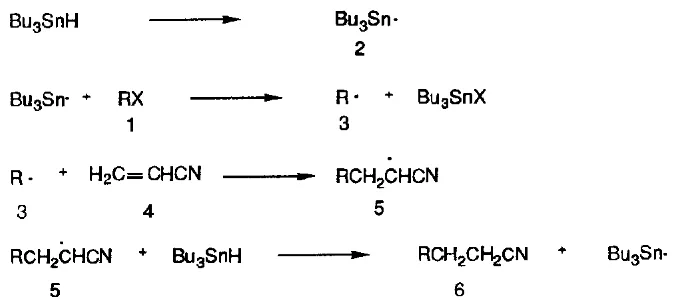
The formation of the C-C bond occurs in a radical chain reaction2 (Scheme 1). Bromine abstraction from halide 1 by tin radicals 23 leads to carbon radicals 3 that react with alkenes 4 to give product radicals 5. Trapping of 5 by tributyltin hydride yields products 6 and the tin radical 2.
Scheme 1
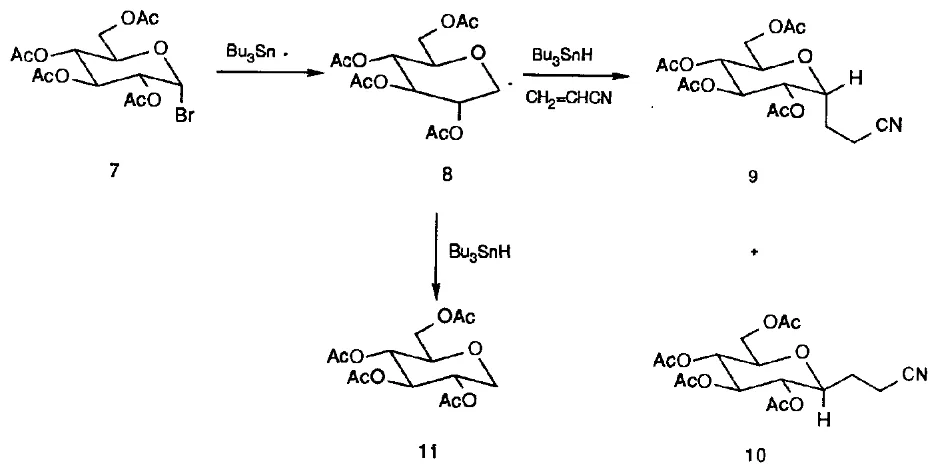
In contrast to anionic 1,4-addition methods, the radical procedure tolerates an acetoxy group adjacent to the reactive center (radical - bearing carbon). In applying this general method to tetraacetylglucosyl bromide 7,4 products 9, with an axial C-C bond, and 10 are obtained in a ratio of ca. 10:1. ESR experiments show that the radical intermediate has the boat conformation 8.5 The attack that leads to the axial product 9 is, therefore, the favored pesudoequatorial or pseudoequatorial (in the editors’ view) attack,6 assuming that the transition state also resembles boatlike 8. Some of the radical 8 is trapped directly by tributyltin hydride to give the simple reduction product 11. This is a common side-reaction in tin hydride-initiated radical coupling reactions.
Scheme 2
This method has been applied also to mannosyl bromide and galactosyl bromide.4 Because alkoxyalkyl radicals are nucleophilic radicals, only alkenes with electron-withdrawing substituents can be used.7 The 1,5-anhydroglycitol side product 11 is formed in amounts that increase with the decreasing reactivity of alkene 4.
References and Notes
1. Institut für Organische Chemie und Biochemie, TH Darmstadt, Petersenstrasse 22, D-6100 Darmstadt, Germany.
2. Giese, B.; González-Gómes, J. A.; Witzel, T. Angew. Chem. 1984, 96, 51; Angew. Chem. Intern. Ed. Engl. 1984, 23, 69; Giese, B. Angew. Chem. 1985, 97, 555; Angew. Chem., Intern. Ed. Engl. 1985, 24, 553.
3. Kuivila, H. G. Synthesis 1970, 499.
4. Giese, B.; Dupuis, J. Angew. Chem. 1983, 95, 633; Angew. Chem., Intern. Ed. Engl. 1983, 22, 622.
5. Dupuis, J.; Giese, B.; Rüegge, D.; Fischer, H.; Korth, H.-G.; Sustmann, R. Angew. Chem. 1984, 96, 887; Angew. Chem., Intern. Ed. Engl. 1984, 23, 896.
6. Giese, B.; Gröninger, K. Tetrahedron Lett. 1984, 25, 2743.
7. Giese, B. Angew. Chem. 1983, 95, 771; Angew. Chem., Intern. Ed. Engl. 1983, 22, 753.
Appendix
Chemical Abstracts Nomenclature (Collective Index Number); (Registry Number)
1-Deoxy-2,3,4,6-tetra-O-acetyl-1-(2-cyanoethyl)-α-D-glucopyranose: D-glycero-D-ido-Nonononitrile, 4,8-anhydro-2,3-dideoxy-, 5,6,7,9-tetraacetate (11); (86563-27-1)
Acrylonitrile (8); 2-Propenenitrile (9); (107-13-1)
2,3,4,6-Tetra-O-acetyl-α-D-glucopyranosyl bromide: Glucopyranosyl bromide tetraacetate, α-D- (8); α-D-glucopyranosyl bromide, 2,3,4,6-tetraacetate (9); (572-09-8)
Tributyltin hydride: Stannane, tributyl- (8,9); (688-73-3)