Organic Syntheses, Volume 65 (1987)
(Silane, 1,3-butadiyne-1,4-diylbis[trimethyl-)

Submitted by Graham E. Jones, David A. Kendrick, and Andrew B. Holmes.1
Checked by James Armstrong and Clayton H. Heathcock.
1. Procedure
A. Copper(I) chloride - tetramethylethylenediamine complex. A 200-mL, three-necked, round-bottomed flask equipped with a magnetic stirring bar, rubber septum, nitrogen inlet tube, and bubbler is charged with acetone (90 mL) and copper(I) chloride (5 g, 51 mmol) (Note 1). After the flask is purged with nitrogen, the mixture is stirred and N,N,N',N'-tetramethylethylenediamine (TMEDA) (2.5 mL, 16.6 mmol) (Note 2) is added. Stirring is maintained for 30 min, and the solid material is then allowed to settle, leaving a clear deep blue-green solution of the CuCl-TMEDA catalyst which is used in the oxidative coupling reaction.
B. 1,4-Bis(trimethylsilyl)buta-1,3-diyne (BTMSBD). A 1-L, four-necked flask, equipped with a mechanical stirrer (Note 3), dry ice cold-finger condenser (Note 4), sintered gas inlet, and a swan-neck adapter which supports a thermometer and rubber septum is charged with acetone (300 mL) and trimethylsilylacetylene (50 g, 0.51 mmol or mol (in the editors’ view)) (Note 5). The reaction mixture is agitated and a rapid stream of oxygen is passed through the solution (Note 6). The supernatant solution containing the CuCl-TMEDA catalyst is transferred by syringe in 5-mL portions into the reaction vessel. The temperature rises as the catalyst is added and should have reached 35°C after about 75% of the catalyst has been added. When this temperature is reached, external ice cooling is applied to moderate the exothermic reaction (Note 7). The remaining catalyst is added and the temperature is maintained in the range of 25-30°C for 2.5 hr (Note 8). When the reaction is complete there should be no evidence of trimethylsilylacetylene condensing on the cold trap. Agitation and oxygenation are then stopped.
The acetone is removed by evaporation with a rotary evaporator, and the residue is dissolved in petroleum ether (bp 30-40°C, 150 mL) (Note 9) and shaken in a separatory funnel with 3 M aqueous hydrochloric acid (150 mL). The phases are separated and the aqueous phase is washed with petroleum ether (bp 30-40°C, 3 × 150 mL). The combined organic layers are washed with saturated aqueous sodium chloride (50 mL), dried (Na2SO4), and evaporated to dryness with a rotary evaporator. The solid residue is dissolved in hot methanol (400 mL) to which has been added 3 M aqueous hydrochloric acid (4 mL). The solution may be filtered at this stage if it is necessary to remove colored insoluble impurities. Water is then added dropwise until recrystallized material is permanently present. The solution is allowed to cool, finally in ice, and crystalline bis(trimethylsilyl)butadiyne (BTMSBD) is collected. The material is washed with a small portion of ice-cold methanol-water (50:50 v/v; 50 mL), and dried in the air to give bis(trimethylsilyl)butadiyne (31-35 g, 68-76%), mp 111-112°C (lit.2,3 107-108°C) (Note 10). A further 3-5 g (6-10%) of the product is obtained from the mother liquors (Notes 11 and 12).
2. Notes
1. Copper(I) chloride, S.L.R. grade, was used as supplied by Fisons Scientific Apparatus Ltd. Best results are obtained with fresh samples of copper(I) chloride which usually contains ≤ 2% copper(II) chloride. Further purification4 did not improve the yield of BTMSBD. The checkers used Mallinckrodt Chemical Company, Analytical Reagent Grade copper(I) chloride, without further purification.
2. N,N,N',N'-Tetramethylethylenediamine (TMEDA) (98%) was used as supplied by B.D.H. The checkers used 99% TMEDA, as supplied by Aldrich Chemical Company, Inc.
3. Mechanical stirring is adequate for a 50-g scale, as described herein, and magnetic stirring is sufficient for a 5-g scale. The submitters ran the procedure on a 200-g scale, and found that use of a Vibro-mixer is essential to obtain satisfactory oxygenation of the reaction mixture. The Vibro-mixer model E-1 was supplied by Chemap AG, Alte Landstr. 415, CH-8708, Mannedorf, Switzerland.
4. The reactant is sufficiently volatile in the fast oxygen stream that substantial loss of material occurs unless a cold finger condenser with a large contact area, charged with dry ice-2-propanol, is used. The use of a short Vigreux column between the dry ice condenser and the reaction vessel is strongly recommended to provide additional protection against loss of material as an aerosol.
5. Trimethylsilylacetylene is prepared by silylation of ethynylmagnesium chloride as described in the accompanying procedure in Organic Syntheses. It is also commercially available from the Aldrich Chemical Company, Inc.
6. CAUTION. Although no hazard has been encountered in this reaction, due care should be taken with acetylenic compounds in an atmosphere of oxygen. The experiment should be conducted in a well-ventilated hood behind a safety shield and away from any source of ignition. Dilution of exit gases (T-joint) with nitrogen is strongly advised.
7. On two occasions the temperature was observed to reach 35°C well before 75% of the catalyst had been added by the checkers. The temperature should be monitored closely during this addition. If ice cooling is necessary, it is important to lower the temperature only to 25°C; otherwise the reaction will become too sluggish. After the internal temperature is brought to 25°C, further cooling is not needed during addition of the remaining catalyst.
8. A deep blue-green coloration should be evident throughout the addition of the catalyst. The color is determined by the rate of oxygen flow. Too high a flow rate can lead to over-oxidation, producing a black precipitate, whereas too low a flow rate can lead to over-reduction of the catalyst, with the green color fading to be replaced by an orange-red precipitate. Both factors reduce the yield of BTMSBD.
9. The checkers used pentane instead of petroleum ether.
10. The checkers observed mp 109-110°C for all crops.
11. Yields of 95% on a 5-g scale, and 70-75% on a 200-g scale were reproducibly obtained by the submitters.
12. Pure bis(trimethylsilyl)butadiyne exhibits the following spectroscopic data: IR (CCl4) cm−1: 2080 (s), 1250 (s), and 650 (s); UV (C6H12) nm max(ε): 224 (80), 235 (150), 248 (260), 262 (345), and 278 (250); 1H NMR (CDCl3, 250 MHz) δ: 0.22 (18 H).
3. Discussion
Oxidative coupling of terminal acetylenes in the presence of copper(I) catalysts is the best method of preparing symmetrically substituted butadiyne derivatives,5 and has been applied to the coupling of trimethylsilylacetylene.6 Better yields are obtained using the Hay procedure in which the catalyst is the TMEDA complex of copper(I) chloride.7 The procedure submitted here is an improved version of Walton and Waugh's synthesis of BTMSBD by the Hay coupling of trimethylsilylacetylene.2 BTMSBD has also been prepared by silylation of butadiynedimagnesium bromide3 and chloride8 in moderate yield, and more recently from the dilithium derivative in good yield.25
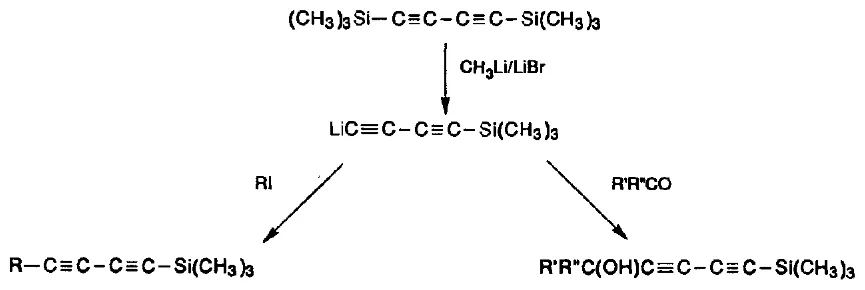
BTMSBD is a very convenient source of butadiyne, an extremely useful, but dangerously explosive chemical.9 It is also a synthon for the vinylacetylene anion. A single trimethylsilyl group can selectively be replaced by reaction with electrophiles (Friedel-Crafts reaction) to give trimethylsilylbutadiynyl ketones.2

Alternatively, a more nucleophilic anionic reagent can be generated by selective cleavage of a single trimethylsilyl group with methyllithium-lithium bromide complex.10 This lithiobutadiyne derivative will react with electrophiles such as carbonyl compounds10,11 or primary alkyl iodides.12
Regio- and stereoselective reduction of the non-silylated triple bond, either by partial catalytic hydrogenation,13,14,15 or by lithium aluminum hydride reduction of the propargylic alcohols,11,16,17 afford (after desilylation), respectively, terminal (Z)- and (E)-enynes. Furthermore, the remaining trimethylsilyl group in both silylated diynes and enynes may be replaced by another electrophile in a second Friedel-Crafts reaction.18
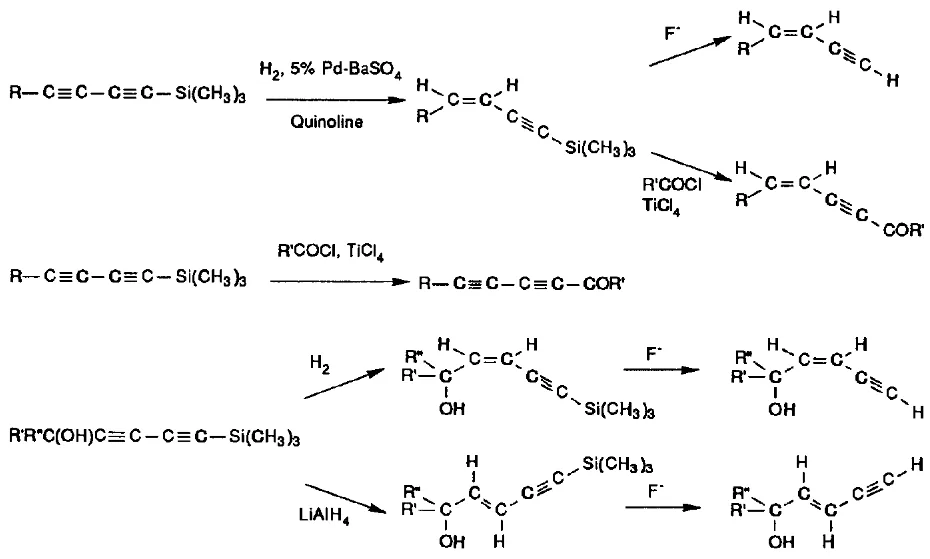
Such reactions have found a variety of applications in natural products synthesis.11,13,14,16,17,19
BTMSBD reacts with a variety of nucleophiles to give novel heterocycles such as selenophen,20 tellurophen,21 and pyrazoles.22 It has also been used in [2+4] cycloaddition/cycloreversion sequences to prepare ethynyl-substituted pyridazines23 and furans.24
References and Notes
1. University Chemical Laboratory, Lensfield Road, Cambridge, CB2 1EW, U.K.
2. Walton, D. R. M.; Waugh, F. J. Organomet. Chem. 1972, 37, 45.
3. Shikhiev, I. A.; Shostakovskiĭ, M. F.; Kayutenko, L. A. Dokl. Akad. Nauk Azerbaĭdzhan, S.S.R. 1959, 15, 21; Chem. Abstr. 1959, 53, 15957e.
4. Keller, R. N.; Wycoff, H. D. Inorg. Synth. 1946, 2, 1.
5. Eglinton, G.; McCrae, W. In "Advances in Organic Chemistry: Methods and Results", Raphael, R. A.; Taylor, E. C.; Wynberg, H., Eds.; Wiley: New York, 1963; Vol. 4, p. 225; Cadiot, P.; Chodkiewicz, W. In "Chemistry of Acetylenes", Viehe, H. G., Ed.; Marcel Dekker: New York, 1969, Chapter 9.
6. Minh, L. Q.; Billiotte, J.-C.; Cadiot, P. C.R. Hebd. Seances Acad. Sci. 1960, 251, 730.
7. Hay, A. S. J. Org. Chem. 1962, 27, 3320.
8. Ballard, D. H.; Gilman, H. J. Organomet. Chem. 1968, 15, 321.
9. Armitage, J. B.; Jones, E. R. H.; Whiting, M. C. J. Chem. Soc. 1951, 44.
10. Holmes, A. B.; Jennings-White, C. L. D.; Schulthess, A. H.; Akinde, B.; Walton, D. R. M. J. Chem. Soc., Chem. Commun. 1979, 840.
11. Salaün, J.; Ollivier, J. Nouv. J. Chim. 1981, 5, 587.
12. Holmes, A. B.; Jones, G. E. Tetrahedron Lett. 1980, 21, 3111.
13. Holmes, A. B.; Raphael, R. A.; Wellard, N. K. Tetrahedron Lett. 1976, 1539.
14. Kobayashi, A.; Shibata, Y.; Yamashita, K. Agric. Biol. Chem. 1975, 39, 911.
15. Shakhovskoi, B. G.; Stadnichuk, M. D.; Petrov, A. A. Zh. Obshch. Khim. 1964, 34, 2625; J. Gen. Chem. U.S.S.R. (Engl. Transl.) 1964, 34, 2646.
16. Patrick, T. B.; Melm, G. F. J. Org. Chem. 1979, 44, 645.
17. Holmes, A. B.; Jennings-White, C. L. D.; Kendrick, D. A. J. Chem. Soc., Chem. Commun. 1984, 1594.
18. Jones, G. E.; Holmes, A. B. Tetrahedron Lett. 1982, 23, 3203.
19. Holmes, A. B.; Jennings-White, C. L. D.; Kendrick D. A. J. Chem. Soc., Chem. Commun. 1983, 415.
20. Jacobs, P. M.; Davis, M. A.; Norton, H. J. Heterocycl. Chem. 1977, 14, 1115.
21. Lohner, W.; Praefcke, K. Chem. Ber. 1978, 111, 3745.
22. Birkofer, L.; Richtzenhain, K. Chem. Ber. 1979, 112, 2829.
23. Birkofer, L.; Hänsel, E. Chem. Ber. 1981, 114, 3154.
24. Liotta, D.; Saindane, M.; Ott, W. Tetrahedron Lett. 1983, 24, 2473.
25. Zweifel, G.; Rajagopalan, S. J. Am. Chem. Soc. 1985, 107, 700.
Appendix
Chemical Abstracts Nomenclature (Collective Index Number); (Registry Number)
1,4-Bis(trimethylsilyl)buta-1,3-diyne: 2,7-Disilaocta-3,5-diyne, 2,2,7,7-tetramethyl- (8); Silane, 1,3-butadiyne-1,4-diylbis[trimethyl- (9); (4526-07-2)
Copper(I) chloride: Copper chloride (8,9); (7758-89-6)
N,N,N',N'-Tetramethylenediamine or Tetramethylethylenediamine (in the editors’ view): Ethylenediamine, N,N,N',N'-tetramethyl- (8); 1,2-Ethanediamine, N,N,N',N'-tetramethyl- (9); (110-18-9)
Trimethylsilylacetylene: Silane, ethynyltrimethyl- (8,9); (1066-54-2)