Organic Syntheses, Volume 65 (1987)
([1,1'-Biphenyl]-2,2'-dicarboxaldehyde, 4,4',5,5'-tetramethoxy-)
Submitted by F. E. Ziegler, K. W. Fowler, W. B. Rodgers, and R. T. Wester.1
Checked by Tetsuji Oshima and Ryoji Noyori.
1. Procedure
CAUTION! Aqueous sodium cyanide is used in this procedure. All operations should be conducted in a well-ventilated hood and rubber gloves should be worn.
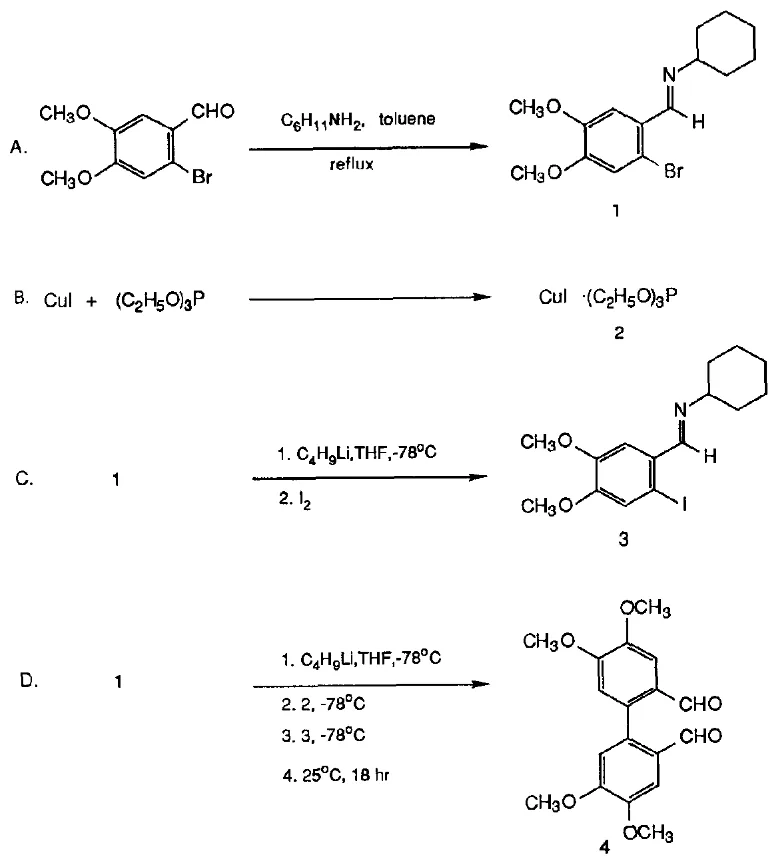
A. 6-Bromo-3,4-dimethoxybenzaldehyde cyclohexylimine (1). A 2-L, three-necked flask is equipped with a Dean-Stark trap, reflux condenser, magnetic stirrer, and nitrogen inlet. The vessel is purged with nitrogen and charged with 40.0 g (0.16 mol) of 6-bromo-3,4-dimethoxybenzaldehyde (6-bromoveratraldehyde) (Note 1), 22.4 mL (0.20 mol) of cyclohexylamine (Note 2), and 800 mL of toluene. The mixture is refluxed for 16 hr (Note 3). The solution is cooled to room temperature and the solvent is removed on a rotary evaporator. The residual crystalline mass is recrystallized from a 3:1 hexane-methylene chloride mixture (1.5 L) to provide 48.4-51.4 g of the imine 1 as white crystals in two crops (mp 172-172.5°C)2 (Note 4).
B. Cuprous iodide-triethyl phosphite complex (2). (Note 5). A 1-L, round-bottomed flask equipped with a magnetic stirrer and reflux condenser is flame-dried under nitrogen. The vessel is charged with 38.2 g (0.20 mol) of cuprous iodide, 33.4 mL (0.20 mol) of triethyl phosphite (Note 6) and 400 mL of dry toluene (distilled from CaH2). The mixture is stirred at 80°C for 8 hr, cooled to room temperature, and filtered under reduced pressure on a pad of Celite. The solvent is removed from the filtrate successively with a rotary evaporator and briefly (15 min) under high vacuum. The residual solid is recrystallized from ether (25 mL) to yield 41.1-49.9 g (57.4-69.8%) of cuprous iodide-triethyl phosphite complex in two crops, mp 114-115°C.
C. 6-Iodo-3,4-dimethoxybenzaldehyde cyclohexylimine (3). A 1-L, three-necked flask is equipped with a Claisen adapter (Note 7), Trubore stirrer, nitrogen inlet, and glass stoppers. The flask is thoroughly flame-dried under nitrogen. To the cooled flask is added 14.0 g (0.043 mol) of cyclohexylimine 1 and the glass stoppers are replaced by an alcohol thermometer and a rubber septum. Tetrahydrofuran (400 mL) (Note 8) is added via syringe through the septum and the resultant mixture is stirred at room temperature (27°C) for 30 min to effect solution. The solution is cooled to −78°C in a dry ice-acetone bath (Note 9). A solution of butyllithium in hexane (30.9 mL, 1.53 M, 0.047 mol) (Note 10) is added by syringe over 10 min at such a rate as to maintain the temperature below −75°C (Note 11). As the butyllithium is added the precipitate slowly dissolves leaving a clear, golden-yellow solution which is stirred for 15 min after the addition is complete. A solution of 27.0 g (0.11 mol) of iodine dissolved in 50 mL of dry THF is added via syringe to the reaction mixture at such a rate as to maintain the temperature below −70°C. The iodine solution (20-25 mL) is added until the red iodine color persists; precipitation also occurs. The mixture is warmed to room temperature, poured into 400 mL of water, and extracted with methylene chloride (5 × 400 mL). The combined organic extracts are dried (anhydrous MgSO4), filtered, and concentrated on a rotary evaporator to 200 mL, and then washed with 200 mL of aqueous saturated sodium sulfite solution. The organic phase is redried, filtered, and concentrated. The solid residue is recrystallized from a 1:4 chloroform-hexane mixture (300 mL) to afford 12.6-13.5 g (78.6-85.0%) yield of 6-iodoveratraldehyde cyclohexylimine as white crystals, mp 180-181°C2 (Note 4).
D. 4,5,4',5'-Tetramethoxy-1,1'-biphenyl-2,2'-carboxaldehyde or dicarboxaldehyde (in the editors’ view) (4). The metalation procedure described in Section C is repeated using a 3-L flask, 18.4 g (0.056 mol) of 6-bromoveratraldehyde cyclohexylimine (1), 575 mL of tetrahydrofuran, and 40.6 mL (1.53 M, 0.062 mol) of butyllithium. After the metalation is complete at −78°C, the septum is replaced by a glass stopper. Solid cuprous iodide-triethyl phosphite complex (30.3 g, 0.085 mol) is added to the vessel at −78°C in one portion, immediately giving a green solution. The mixture is stirred for an additional 30 min. After the first 15 min, the solution turns a brownish-orange to red color. Solid 6-iodoveratraldehyde cyclohexylimine (3) (21.0 g, 0.056 mol) is added in one portion to produce an orange suspension. The reaction mixture is allowed to warm to room temperature (27°C) during which time the mixture becomes dark brown. The reaction mixture is stirred for 18 hr at room temperature. The reaction mixture is diluted with 600 mL of methylene chloride and 850 mL of 15% aqueous acetic acid and stirred vigorously for 17 hr. The yellow solution is transferred to a 4-L separatory funnel and the layers are separated. The organic layer is dried (anhydrous magnesium sulfate), filtered, and concentrated on a rotary evaporator to 800 mL and then transferred to a 2-L separatory funnel. The organic solution is washed with 5% aqueous hydrochloric acid (5 × 100 mL) and saturated aqueous sodium bicarbonate solution (10 × 50 mL). [CAUTION: The final washings must be alkaline to avoid the liberation of hydrogen cyanide in the subsequent step.] The organic layer is washed twice with 500 mL of 10% aqueous sodium cyanide solution, once with 500 mL of saturated aqueous sodium bicarbonate, and twice with 500 mL of water. [CAUTION: The sodium cyanide washes should be bottled separately and labeled appropriately for approved disposal.] The organic layer is dried (anhydrous magnesium sulfate), filtered, and concentrated to provide 16.3-20.3 g of residue. Crystallization from a 1:3 methylene chloride-hexane mixture at 5°C affords 13.1-16.9 g (70.4-90.7%) of beige crystals of the biphenyl, mp 215-216°C (lit3 214-215°C) after drying under high vacuum (0.1 mm) (Note 4).
2. Notes
1. 6-Bromo-3,4-dimethoxybenzaldehyde was purchased from the Aldrich Chemical Company, Inc. (Milwaukee) or readily prepared by bromination of veratraldehyde (Aldrich Chemical Company, Inc. or Tokyo Kasei).4
2. Cyclohexylamine (Aldrich Chemical Company, Inc. or Nakarai Chemicals) and all solvents and reagents (reagent grade) were used as received, unless otherwise specified.
3. The water level in the trap remains constant after this period of time.
4. Spectral characterization; 1H NMR (CDCl3). 6-Bromoveratraldehyde cyclohexylimine, δ: 1.07-1.82 (m, 10 H), 3.30 (m, 1 H, NCH), 3.89 (s, 3 H, OCH3) 3.92 (s, 3 H, OCH3), 6.97 (s, 1 H), 7.55 (s, 1 H), and 8.54 (s, 1 H, N=CH); 6-Iodoveratraldehyde cyclohexylimine, δ: 1.07-1.82 (m, 10 H), 3.31 (m, 1 H, NCH), 3.88 (s, 3 H, OCH3), 3.92 (s, 3 H, OCH3), 7.22 (s, 1 H), 7.53 (s, 1 H), and 8.32 (s, 1 H, N=CH); 4,5,4',5'-Tetramethoxy-1,1'-biphenyl-2,2'-dicarboxaldehyde, δ: 3.96 (s, 6 H, OCH3), 4.01 (s, 6 H, OCH3), 6.80 (s, 2 H), 7.56 (s, 2 H), and 9.67 (s, 2 H, CHO).
5. This method was adapted from the procedure of Nishizawa.5 The complex is reported to have mp 109-110°C.6
6. Cuprous iodide was purchased from Alfa Products, Morton/Thiokol Inc. or Kishida Chemicals and triethyl phosphite from the Aldrich Chemical Company, Inc. or Nakarai Chemicals.
7. The offset neck of the adapter was fitted with the nitrogen inlet and the other neck with a glass stopper which was eventually replaced with a thermometer.
8. Tetrahydrofuran (THF) was distilled from sodium benzophenone ketyl under nitrogen in all applications.
9. The bromide, 1, precipitated during the cooling.
10. Butyllithium was purchased from Alfa Products, Morton/Thiokol Inc. or Mitsuwa Pure Chemicals and was standardized by the method of Kofron.7
11. Alcohol thermometers were found not to read temperatures accurately. A temperature of −78°C designates the lowest temperature to which a large dry ice-acetone bath cools the reaction mixture. The temperature −75°C signifies a 3° rise in temperature.
3. Discussion
The Ullmann reaction has been traditionally conducted at elevated temperatures (100-250°C), with or without solvent, in the presence of copper powder. Often the quality of copper can be extremely important to the success of the reaction.8 Aromatic bromides and halides which bear ortho-substituted electron-withdrawing groups undergo coupling at the low end of the temperature range. Cross coupling is best accomplished when only one of the aryl halides bears an electron-withdrawing group.9 In such instances, an excess of the aryl halide without the electron-withdrawing group may have to be employed.10
Nickel(0) reagents have been employed in the symmetrical coupling of aryl halides in sterically unencumbered cases.11,12 An efficient cross coupling reaction between an arylzinc halide and an ortho-iodoarylimine under mild conditions mediated by Ni(0) has been reported.13 Thallium(III) trifluoroacetate has been employed in the symmetrical coupling of aromatic ethers.14 The use of diazonium salts in the formation of unsymmetrical biphenyls has been reviewed.15
The present method permits both symmetrical and unsymmetrical coupling to occur at room temperature. It is necessary for a substitutent or substituent (in the editors’ view) (nitrogen or sulfur) to be situated ortho to the halogen so that the heteroatom can chelate well with copper. This requirement must be fulfilled in both reacting partners. The organolithium species may be generated by metal-hydrogen or metal-halogen exchange. The coupling works well in sterically congested compounds, and only for aryl iodides. o-Iodoaldehydes may also be prepared by direct iodination of aromatic aldehydes.12,16 Representative applications of this reaction are provided in the Table.
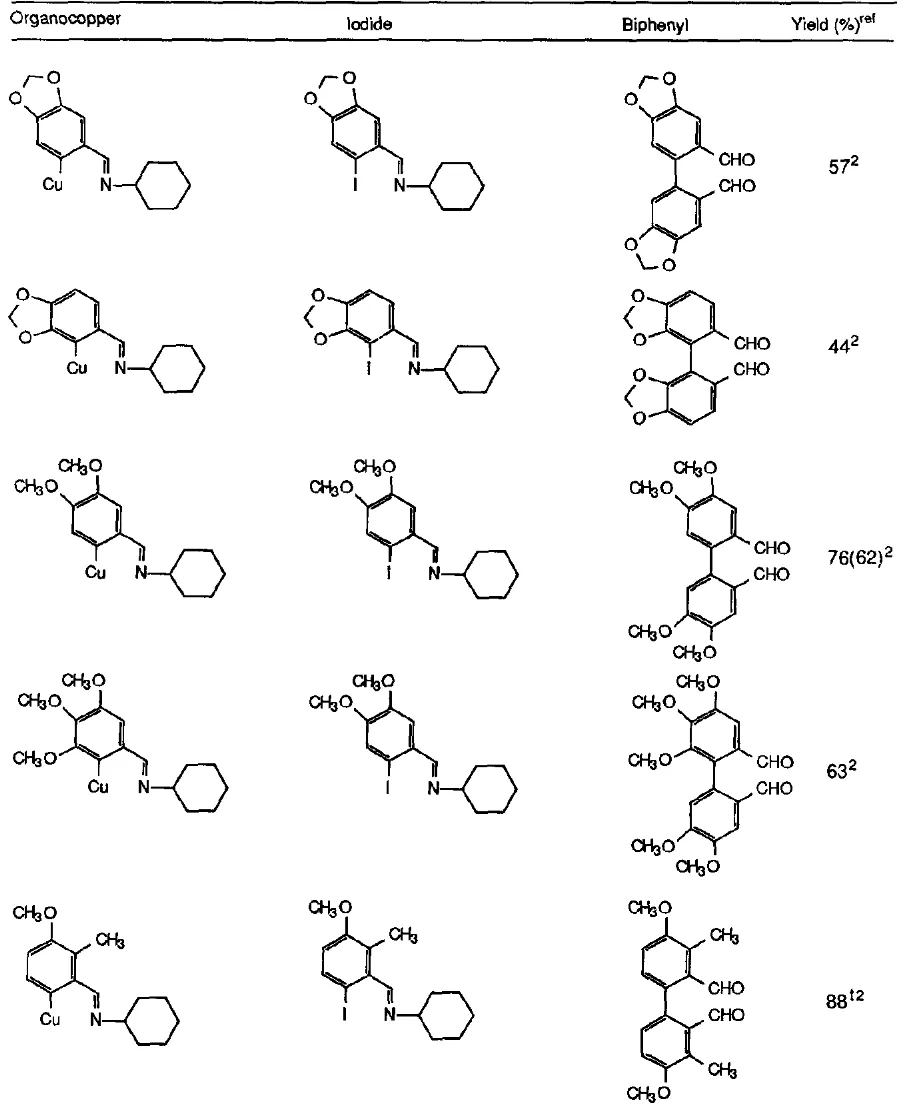
Table I. Ambient Temperature Ullman or Ullmann (in the editors’ view) Reaction
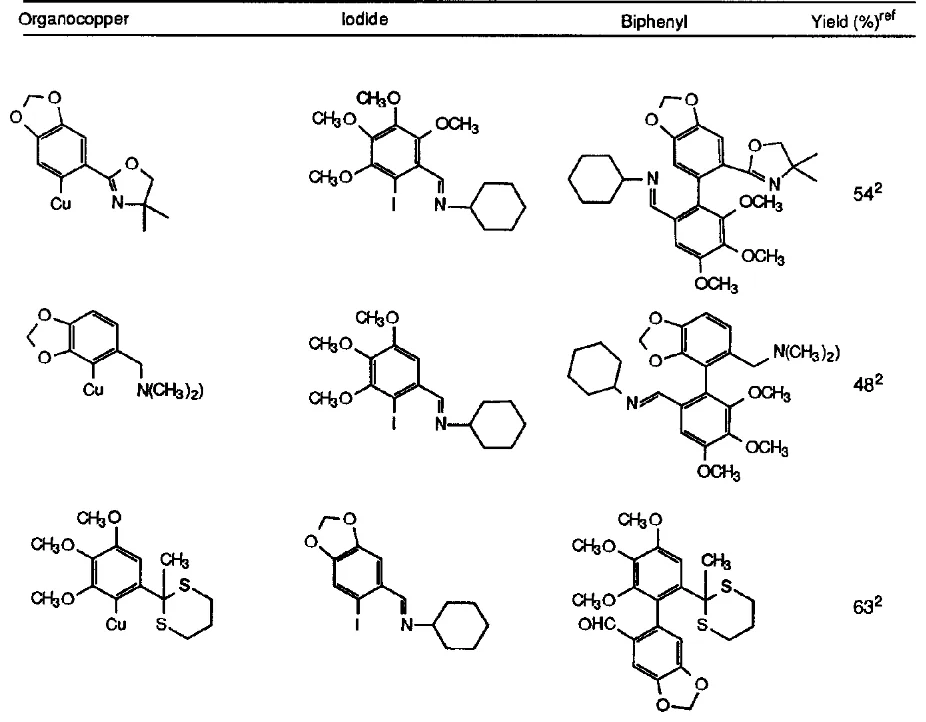
Table I. (continued) Ambient Temperature Ullman or Ullmann (in the editors’ view) Reaction
References and Notes
1. Department of Chemistry, Yale University, New Haven, CT 06511.
2. Ziegler, F. E.; Chliwner, I.; Fowler, K. W.; Kanfer, S. J.; Kuo, S. J.; Sinha, N. D. J. Am. Chem. Soc. 1980, 102, 790.
3. Bick, I. R. C.; Harley-Mason, J.; Sheppard, N.; Vernengo, M. J. J. Chem. Soc. 1961, 1896.
4. Pschorr, R., Justus Liebigs Ann. Chem. 1912, 391, 23.
5. Nishizawa, Y. Bull. Chem. Soc. Jpn. 1961, 34, 1170
6. Arbusott, A, Ber. 1905, 38, 1171
7. Kofron, W. G.; Baclawski, L. M. J. Org. Chem. 1976, 41, 1879.
8. Newman, M. S.; Dali, H. M. J. Org. Chem. 1977, 42, 734.
9. Ikeda, T.; Taylor, W. I.; Tsuda, Y.; Uyeo, S.; Yajima, H. J. Chem. Soc. 1956, 4749; Jeffs, P. W.; Hansen, J. F.; Brine, G. A. J. Org. Chem. 1975, 40, 2883; Koizumi, J.; Kobayashi, S.; Uyeo, S. Chem. Pharm. Bull. 1964, 12, 696.
10. Brown, E.; Robin, J.-P. Tetrahedron Lett. 1977, 2015.
11. Semmelhack, M. F.; Helquist, P. M.; Jones, L. D. J. Am. Chem. Soc. 1971, 93, 5908; Kende, A. S.; Liebeskind, L. S.; Braitsch, D. M. Tetrahedron Lett. 1975, 3375.
12. Kende, A. S.; Curran, D. P. J. Am. Chem. Soc. 1979, 101, 1857.
13. Larson, E. R.; Raphael, R. A. Tetrahedron Lett. 1979, 5041.
14. McKillop, A.; Turrell, A. G.; Young, D. W.; Taylor, E. C. J. Am. Chem. Soc. 1980, 102, 6504.
15. Bachmann, W. E.; Hoffman, R. A. "Organic Reactions", Wiley: New York, 1944; Vol. II, p. 224.
16. Janssen, D. E.; Wilson, C. V. Org. Synth., Collect. Vol. IV 1963, 547.
Appendix
Chemical Abstracts Nomenclature (Collective Index Number); (Registry Number)
4,5,4',5'-Tetramethoxy-1,1'-biphenyl-2,2'-dicarboxaldehyde: [1,1'-Biphenyl]-2,2'-dicarboxaldehyde, 4,4',5,5'-tetramethoxy- (9); (29237-14-7)
6-Bromo-3,4-dimethoxybenzaldehyde cyclohexylimine: Cyclohexanamine, N-[(2-bromo-4,5-dimethoxyphenyl)methylene]- (10); (73252-55-8)
6-Bromo-3,4-dimethoxybenzaldehyde: Benzaldehyde, 2-bromo-4,5-dimethoxy- (9); (5392-10-9)
Cyclohexylamine (8); Cyclohexanamine (9); (108-91-8)
Cuprous iodide: Copper iodide (8,9); (7681-65-4)
Triethyl phosphite: Phosphorous acid, triethyl ester (8,9); (122-52-1)
6-Iodo-3,4-dimethoxybenzaldehyde cyclohexylimine: Cyclohexanamine, N-[(2-iodo-4,5-dimethoxyphenyl)methylene]- (10); (61599-78-8)
Butyllithium: Lithium, butyl- (8,9); (109-72-8)
Iodine (8,9); (7553-56-2)