Jean-Pierre Senet - The Recent Advance in Phosgene Chemistry
2-1 Physical properties
At ambient temperature and pressure, phosgene is a colorless gas which exhibits an irritating and suffocating odor. At low concentrations, it has a characteristic odor like moldy hay. However, the odor threshold of phosgene is higher than its toxic limit and one must remember that the sense of smell fails to detect small concentrations in air.
Some physical properties of phosgene are presented in table 2-1.
Table 2-1. Principal physical properties of phosgene.
| CAS number | 75 - 44 - 5 |
| Molecular weight | 98.92 |
| Structure | Planar molecule Inter atomic distances : C-O = 0.128 nm, C-Cl = 0.168 nm |
| Melting point | − 130°C |
| Boiling point | + 8.2°C |
| Vapor pressure | 1.6 atm. (20°C) ; 3.99 atm. (50°C) |
| Vapor density | 3.42 |
| Liquid density | 1.43 (0°C) ; 1.275 (50°C) |
| Conversion factor | 1 ppm = 4.043 mg/m3 |
| Odor | Reminiscent of moldy hay |
2-2 Chemical reactivity of phosgene
A large part of phosgene reactivity may be accounted for on the basis of two main mechanisms :
a) Nucleophilic attack on carbonyl function :
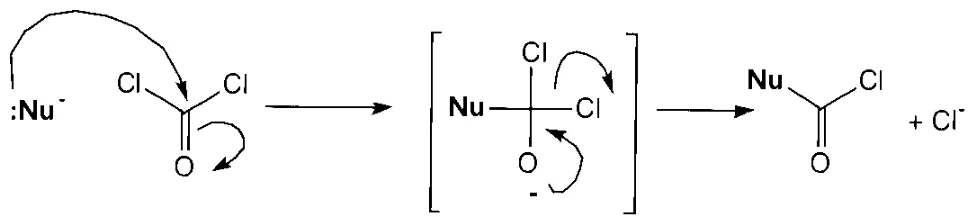
Scheme 3.
b) Electrophilic reactions, especially Friedel & Crafts related reactions :
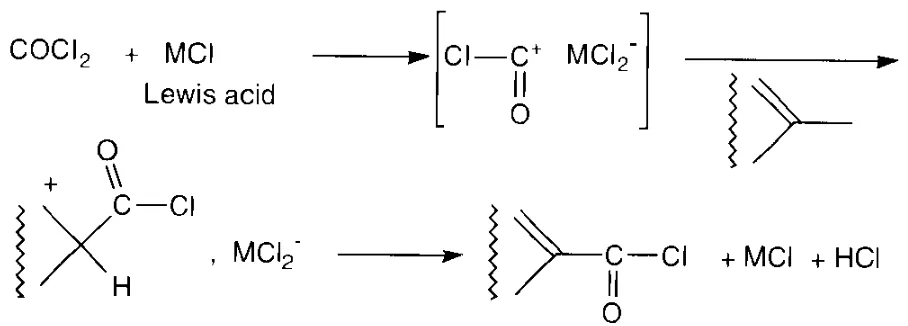
Scheme 4.
Because some important aspects of the mechanism of the nucleophilic reactions with phosgene seemed somewhat neglected or unknown in the previous art, SNPE teams have focused their efforts in terms of basic and applied research on the catalysis of such reactions. The main goal of this active and long investigation was to improve industrial phosgenation processes and to extend the range of substrates able to react with phosgene.
As a consequence, this investigation succeeded in development of many improved processes and the discovery of several previously unknown reactions which are discussed in this book.
The principal obstacle to progress in this field has been the difficulty of establishing the catalytic mechanism of phosgene reactions. Two catalytic paths are obviously possible :
– substrate activation by means of an increasing of its nucleophilicity ;
– phosgene activation by improvement of the « leaving character » of chloride anion.
Concerning phosgene reactions with active hydrogen substrates [Scheme 5] :

Scheme 5.
mechanistic studies performed with the help of Nantes University in France (Ref. 4) resulted in the revelation of substrate activation based on nucleophilicity of chloride anion in the case of Q+ Cl− type catalyst (quaternary ammonium chloride for example). The mechanism of nucleophilic assistance of these catalysts can be understood as an increase of the nucleophilicity of the substrate by proton abstraction followed by the condensation of the promoted anion on the electrophile (phosgene) [Scheme 6] :
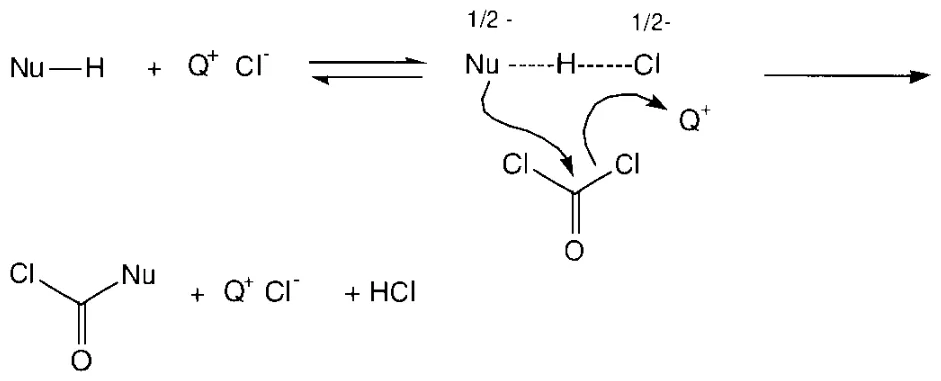
Scheme 6.
This mechanism has been confirmed by reacting a series of onium chloride salts with phenol using 35Cl NMR determination as physical probe as shown in table 2-2.
Table 2-2. General correlation between catalyst efficiency and nucleophilicity of chloride anion. Study by 35Cl NMR.
| Range of phosgenation efficiency (a) | Q+ Cl− | Line width ½ (Hz) (c) |
|---|---|---|
| HIGH | TMCA (b) | 240 |
| Tetra hexyl ammonium chloride | 220.5 | |
| MEDIUM | Benzyl tributyl ammonium chloride | 145.5 |
| Tetrabutyl ammonium chloride | 141 | |
| LOW | Benzyl trimethyl ammonium chloride | 58 |
(a) Phosgenation of phenol into phenyl chloroformate or carboxylic acids into acid chlorides
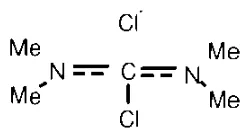
(b) Tetramethyl chloroformamidinium chloride :
(c) Line width of the chloride anion resonance in the system onium chloride salt/phenol (solvent : CH3CN)
We pointed out that the C-nucleophilicity of chloride anion is also acting. In the course of our research related to the reaction of phosgene with carbonyl compounds, we reported that aldehydes are readily converted to 1-chloroalkyl chloroformates when treated with phosgene in the presence of a Q+ Cl− catalyst (Ref. 5). The assumed mechanism involves the nucleophilic attack of the chloride anion on the aldehyde followed by the acylation of the intermediate chloroalkoxide anion by phosgene [Scheme 7] :
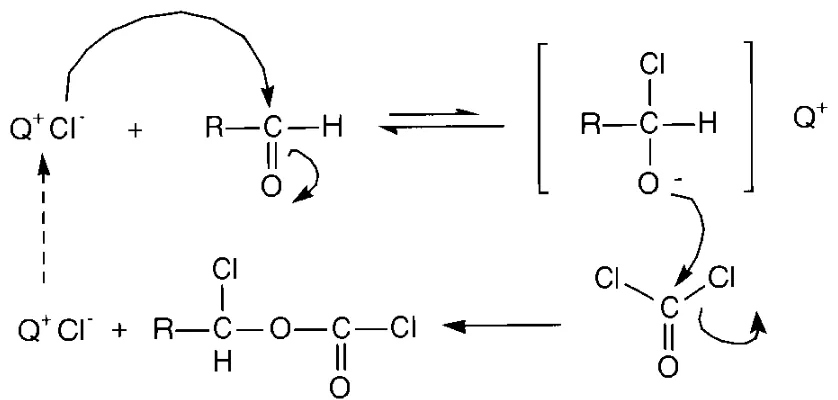
Scheme 7.
The success of this new synthetic route to α-chorinated or chlorinated (in the editors’ view) chloroformates which are very useful intermediates (see chapter 3, section 3-2) is strongly dependent on the nucleophilic power of the chloride anion as shown in table 2-3 :
Table 2-3. Correlation between nucleophilicity determined by 35Cl NMR and results obtained in phosgenation of acetaldehyde.
| Catalyst (5 mol. %) | Nucleophilicity (Hz) | 1-Chloro ethyl chloroformate Yield % |
|---|---|---|
| Benzyl tributyl ammonium chloride | 145.5 | 95 |
| Benzyl trimethyl ammonium chloride | 58 | 0 (No reaction) |
The role of the nucleophilicity of the chloride anion is supported by the high activity of complexed salts such as KCl/18 crown 6 as catalysts for the phosgenation of aldehydes.
Traces of HCl (moisture) inhibit the reaction because HCl2− anion exhibits much less nucleophilicity than Cl−. Including hydrochloric acid scavenger such as little toluene diisocyanate in the mixture generally solves the problem.
The nucleophilicity of the chloride anion is of course a function of the nature of the counterion Q+. To increase the nucleophilicity, one can either or both increase the bulkiness and the dispersal of the positive charge of the counterion. We discovered that hexaalkyl guanidinium chlorides are very efficient and powerful phosgenation catalysts [Scheme 8] :
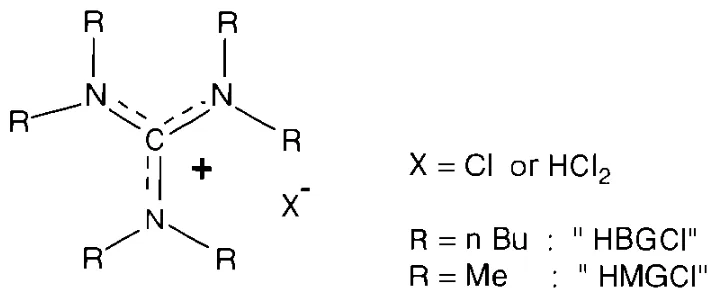
Scheme 8. Hexaalkyl guanidinium chlorides.
We introduced these guanidinium salts in a 1985 patent (Ref. 6) on the conversion of carboxylic acids to acid chlorides with phosgene. In this process, only 0.02 mol. % of HBGCl was required, two orders of magnitude less than the quantities of other catalysts typically used. Many new other applications including phosgene reactions with phenols, thiols, aldehydes, epoxides or O-demethylation methods have been developed later and are discussed in this book.
Moreover, these new catalysts may be considered themselves as phosgene derivatives because they are made from phosgene and secondary amines by the scheme depicted below [Scheme 9] :
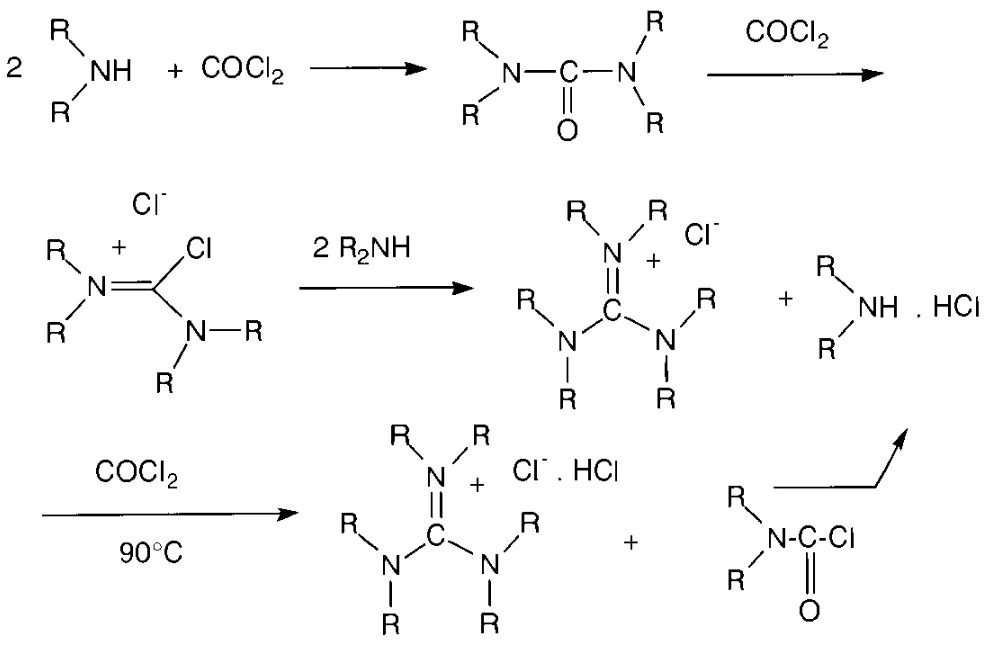
Scheme 9. Preparation of hexa alkyl guanidinium chlorides.
This industrial process leads to hexabutylguanidinium chloride hydrochloride (HBGCl.HCl) which, as above mentioned, failed as a catalyst in the reaction requiring high C-nucleophilicity of chloride anion. Pure HBGCl may be obtained by shaking a solution of HBGCl.HCl with excess 10% NaOH. The dried (MgSO4) organic layer is concentrated and then treated at 100°C under vacuum (0.2 torr) for 24 h. The off-white powder obtained is stored under nitrogen.
The decomposition of methyl chloroformate is a very convenient method to establish a nucleophilicity power scale of the chloride anion in onium chlorides, allowing thus to easily compare a priori the catalytic efficiency of different candidates. It is known that the decarboxylation of methyl chloroformate is catalyzed by Q+ Cl− type compounds thus producing only methyl chloride and carbon dioxide according to a pure SN2 reaction (Ref. 7) [Scheme 10] :

Scheme 10. Decomposition of methyl chloroformate.
We used this specific reaction on IR analysis as kinetic chemical probe (Ref. 8). Among the various onium chlorides commonly encountered, hexabutyl guanidinium chloride (HBGCl) exhibits the highest activity as shown in table 2-4 :
Table 2-4. Relative rate constant values of SN2 decomposition of methyl chloroformate at 70°C in the presence of onium chloride catalysts (1%). For HBGCl, the k value is 12.52 min.−1 (Ref. 8).
| Catalyst | Relative rate constant |
|---|---|
| HBGCl | 100 |
| HMGCl | 47 |
| Tetrahexyl ammonium chloride | 42 |
| Benzyl tributyl ammonium chloride | 27 |
| Trioctyl methyl ammonium chloride | 14 |
As expected considering table 2-4, hexabutyl guanidinium chloride displays higher catalytic activity than its hexamethyl analogue. However, HMGCl offers some advantages because of its solubility in water which makes easier elimination by aqueous washings and because it precipitates in several phosgenation media after removal of phosgene excess.
To sum up, hexabutyl guanidinium chloride exhibits some particularities due to its extraordinary bulkiness and the hydrophobicity of the the n-butyl substituents. However, the dispersal of the positive charge is somewhat counterbalanced by the out of plane distortion of the bulky substituents as suggested by molecular modeling calculations on HBGCl using the CSC Chem 3D program (Ref. 9). Due to this kind of geometry and for reasons of symmetry, it is assumed that the chloride anion will be located along the central axis and will interact weakly with the positive center [Scheme 11] :
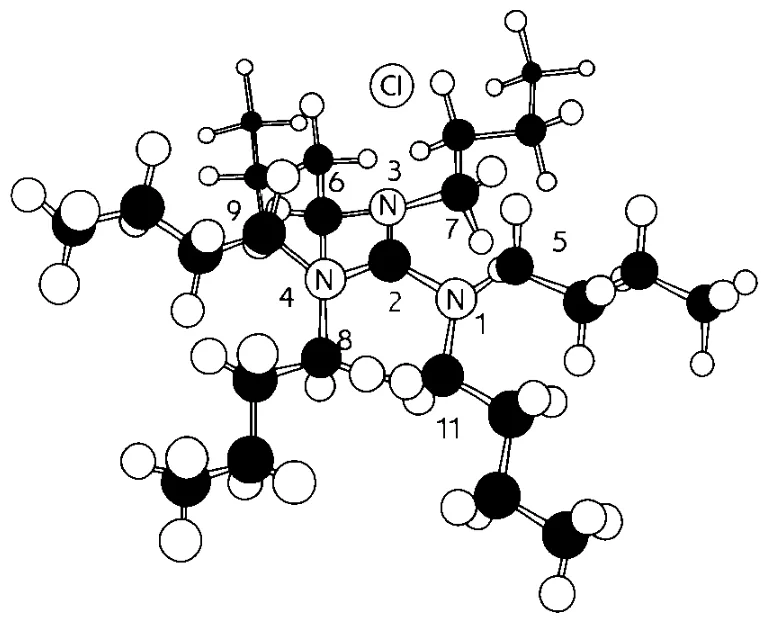
Scheme 11. Molecular model of hexabutyl guanidinium chloride.
Although hexamethyl guanidinium chloride (HMGCl) is less active than its hexabutyl congener, it is very useful in several industrial applications, because of its good water solubility, and also because its hydrochloride is often insoluble in organic mediums. These two properties allow easy removal of the catalyst after reaction.
For example, phosgenation of octane thiol proceeds rapidly in presence of HMGCl, even at 30°C to give octyl thiochloroformate [Scheme 12] :

Scheme 12. Synthesis of n octyl thiochloroformate in presence of HMGCl.
After completion of the reaction and removal of phosgene excess, HMGCl.HCl which precipitates completely is filtrated thus giving very pure product (Ref. 10).
Another approach is to have a catalytic system strictly insoluble in all media and therefore easily removable by filtration and indefinitely reusable. Such heterogeneous catalyst offers many advantages, particularly in the case of products difficult to purify by distillation because of thermal instability or too high boiling point.
We have recently reported the preparation of silica-supported guanidinium salts, especially pentabutyl propylguanidinium chloride grafted on silica beads, and their uses as phosgenation heterogeneous catalysts (Ref. 11). For example, starting from macroporous silica glass beads having the following characteristics :
– diameter : 1 mm
– specific surface : 78 m2/g
– porous volume : 0.9 cm3/g
– OH content : 4.8 µ mol./m2
we obtained at pilot scale a catalytic system bearing 0.085 meq./g of active sites.
The synthesis route we developed is depicted on scheme 13 :
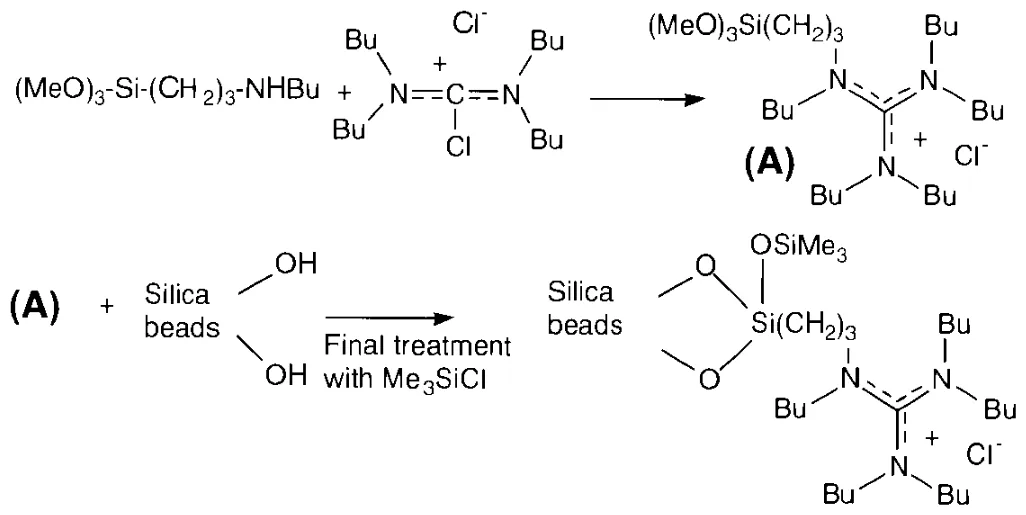
Scheme 13. Synthesis route to silica-supported guanidinium chloride catalyst.
Since this supported catalyst is stable, insoluble and composed of mechanically strong particles of 1 mm diameter, it can be easily recovered by filtration and be reused. The high stability and activity of silica supported guanidinium salts, along with the ability to reuse the solid catalyst were demonstrated on repetitive batch phosgenations of carboxylic acids.
The utility of silica supported guanidinium salts was also well established in reactions sensitive to reversal while heating. Thus, we discovered that treatment of aldehydes with oxalyl chloride in the presence of a « naked » catalyst (e.g., HBGCl) produces 1-chloroalkyl oxalyl chlorides in 60-97% yields (Ref. 12) [Scheme 14] :
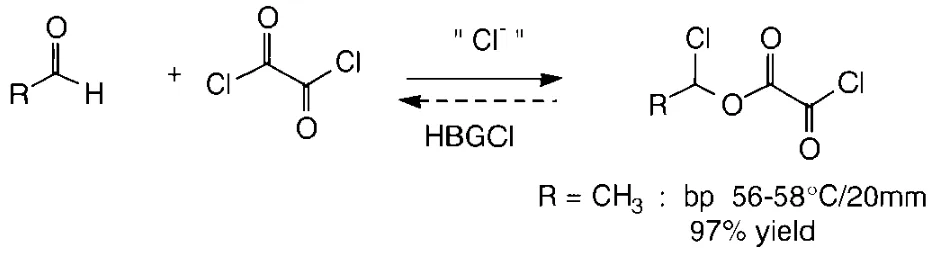
Scheme 14. Reaction of excess oxalyl chloride with aldehydes.
However, with aromatic aldehydes or with chloral, heating in the presence of the catalyst during distillation resulted in reversion to the aldehyde and attempts to entirely remove the fatty HBGCl catalyst, for example by pentane trituration failed due to the partial solubility of this salt in the non-polar medium.
This problem was overcome by utilizing the supported catalyst above described. In a typical example, distilled 1,2,2,2-tetrachloroethyl oxalyl chloride was thus obtained from chloral in 95% yield after 4 h reaction.